
Generative AI
5 Ways Custom Generative AI Boosts ROI 2026
Custom generative AI helps businesses increase ROI by improving efficiency, reducing operational costs, and delivering more tailored, scalable outcomes in 2026.
Teams spend 33 hours on the average RFP, according to 2026 RFP statistics. This guide covers eleven ways to automate RFP responses with generative AI, plus the retrieval workflow, guardrails, and metrics behind them.
Anyone who has spent a weekend copy-pasting answers from last year's proposal into a new questionnaire knows the pain. Most of that work is answering the same questions with slightly different wording, and it takes hours away from the parts of a bid that decide it.
According to Loopio's 2026 RFP statistics, proposal teams spend an average of 33 hours on a single response, and 79% of teams have now used generative AI in their RFP process, up from 68% a year earlier.
If you are exploring generative AI development for internal workflows, RFP response is a strong candidate for AI automation. Much of the workload is repetitive, source-driven, and reviewable. The goal is not to let AI submit proposals on its own. It is to remove the searching, copying, routing, and first-draft work that consumes the proposal team's time.
This guide walks through 11 ways to do it, plus the workflow, guardrails, and metrics behind them.
Automated RFP responses are proposal answers produced by software that reads a buyer's request for proposal, extracts each question, retrieves matching passages from an approved content library, and drafts a cited answer for human review. The same workflow covers RFIs, due diligence questionnaires, and security questionnaires. Automation replaces the search-and-copy work between question and first draft, while people keep approval of anything contractual, strategic, or regulatory.
Automating RFP responses with generative AI means using retrieval-augmented models to pull approved answers from a governed content library, generate cited drafts for each question, score confidence, and route uncertain items to subject matter experts for review. The AI does the retrieval and drafting. Humans still own approval, strategy, and the executive summary.
Let's talk about how generative AI can draft, review, and organize your RFP responses so your team can focus on winning the deal, not filling in the paperwork.
Talk to a Generative AI ExpertBefore you automate anything, you should know where the hours disappear. Most teams assume "writing" is the bottleneck. It usually isn't. With the average RFP taking 33 hours, most of that time goes to coordination, hunting, and rework.
A single RFP can contain hundreds of questions buried inside Word tables, PDFs, and portal forms. This step alone can take hours.
Even at companies with a content library, answers live in five places: the library, last quarter's proposal, an SME's inbox, a Confluence page, and someone's head.
The security lead is on vacation. The product manager owns three questions and has not opened Slack.
Every proposal has a section describing your company, your certifications, and your implementation approach.
The final stretch of the timeline goes to formatting, page limits, and filling in the RFP's compliance matrix correctly.
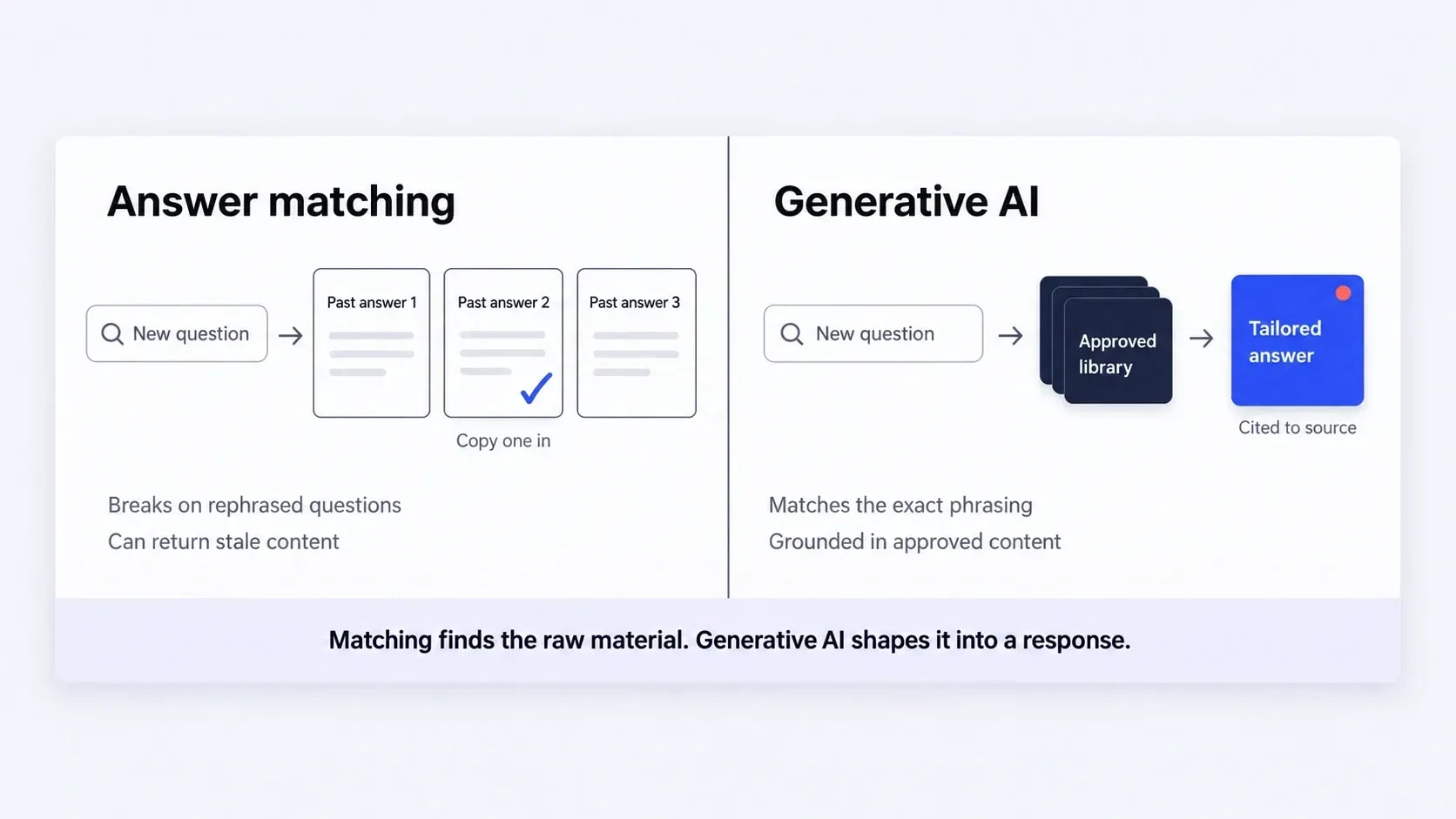
Older RFP tools relied on keyword or semantic matching. You typed a question, the system returned the top three past answers, and you copied one in. That worked, but it broke on rephrased questions and produced stale content. Generative AI changes this in one specific way: it can rewrite a retrieved answer to match the exact phrasing and context of the new question, while still grounding the content in your approved library. Matching finds the raw material. Generative AI shapes it into a response.
No single change automates an RFP. What works is a set of workflow changes, each removing one specific bottleneck. These 11 have the biggest impact.
Feed every incoming RFP through a model that scores fit against your ideal customer profile, checks for disqualifying clauses (data residency, incumbent-favored terms, unrealistic timelines), and returns a recommendation. Teams that do this spend less time on bids they had little chance of winning. For a wider view of tools that handle qualification and outreach, see top AI companies for sales and GTM automation agents.
How it helps: dealbreakers surface before any drafting starts, and the score comes with logged reasons that sales can review and overrule.
Best for: teams that receive more RFPs than they can answer well.
If your content library is messy, no amount of AI will save you. Assign owners to every category (security, pricing, product, legal), set review dates, and archive anything that has not been re-approved within a set window, such as 18 months. This is unglamorous work, but every later step depends on it.
How it helps: retrieval gets one current source of truth, so drafts stop contradicting each other, and review dates make freshness measurable.
Best for: teams with years of accumulated answers spread across shared drives.
Use a model to parse Word, PDF, and Excel RFPs, extract the actual questions, and drop them into a structured table. Compound questions ("Describe your uptime SLA and your incident response process") get split into two. Numbering is preserved. This removes a step that can otherwise take hours.
How it helps: every question gets an owner, category, and status on day one, so nothing is missed and assignment starts immediately.
Best for: teams that receive RFPs in mixed formats or with hundreds of questions.
Never let a general-purpose chatbot write an RFP answer from its training data. Use retrieval-augmented generation so every draft is built from passages in your approved content library, with citations back to the source document. If the model cannot find a source, it should say so, not invent something.
How it helps: reviewers verify against the cited source in one click, and gaps show up as gaps instead of confident guesses.
Best for: any team using generative AI for RFPs, especially where a wrong product claim carries contractual risk.
Every generated draft gets a confidence score based on retrieval quality, source freshness, and how closely the draft follows its sources. High-confidence answers go straight to the proposal manager for a light review. Low-confidence answers get routed to the right SME with the retrieved passages attached, so the SME can approve, correct, or write from scratch.
How it helps: reviewer attention goes to the risky answers, and SMEs receive fewer, better-prepared questions.
Best for: small proposal teams that depend on busy SMEs.
Some answers must not be rewritten: certifications, insurance limits, data center locations, SOC 2 scope. Tag these as verbatim in the library. The AI retrieves them and inserts them exactly, with no paraphrasing. This is one of the safest automations you can deploy.
How it helps: paraphrase risk disappears on statements buyers treat as commitments, and expiry dates stop a lapsed certification from being submitted.
Best for: teams in regulated sectors or with heavy security and compliance sections.
When a question needs a human, the system should know who that human is, ping them in Slack or Teams, and follow up automatically if they do not respond in 24 hours. Removing manual chasing from the proposal manager's plate frees them for strategy work.
How it helps: questions are assigned by category on day one, reminders fire before deadlines, and unanswered ones escalate to a backup owner.
Best for: teams that rely on SMEs outside the proposal group or across time zones.
SIG, CAIQ, HECVAT, and custom vendor questionnaires cover much of the same ground. Build a mapping layer so an answer approved for SIG Lite auto-populates the equivalent CAIQ field. Mapping works at the control level, and differences in scope or wording still need a quick review. This is often where the most repeated work sits.
How it helps: one approved answer fills its equivalents across frameworks, which cuts repeat work.
Best for: vendors whose buyers regularly send frameworks such as SIG, CAIQ, or HECVAT.
The executive summary should still be written by a human, but AI can produce a strong first pass by combining the buyer's stated priorities (pulled from the RFP itself), your relevant case studies, and your standard value props. The human then edits for voice and strategy.
How it helps: the writer starts from a structured draft tied to the buyer's priorities, so time goes to strategy and voice.
Best for: teams that write many summaries per quarter, often under deadline.
Ariba, Coupa, Jaggaer, and their peers all have web forms with the same fields. A browser automation layer plus your content library can pre-fill these and cut most of the manual re-keying. Check each portal's terms first, since some restrict automated input, and keep a person in charge of the final submission.
How it helps: company details, contacts, and standard answers are entered once instead of on every form.
Best for: teams that respond to buyers who run repeat procurement portals.
When a proposal wins or loses, tag which answers were used. Over time, you learn which phrasing of your security answer correlates with wins in financial services and which lands better in healthcare. Tracking this at answer level takes discipline, and it is where the learning compounds. Treat the results as correlation, not proof, until the sample is large enough.
How it helps: library owners see which answers and phrasings line up with wins by segment, and know what to improve first.
Best for: teams with a CRM tied to RFP outcomes and enough volume per segment to see patterns.
"The teams getting real value from RFP automation are the ones that treat it as a content governance problem first and an AI problem second. If your library is stale or unowned, a generative model will just produce stale answers faster. Get the source of truth right, tier your answers by risk, and then let retrieval do the heavy lifting. That sequence matters."
Head of AI Development, Folio3 AI
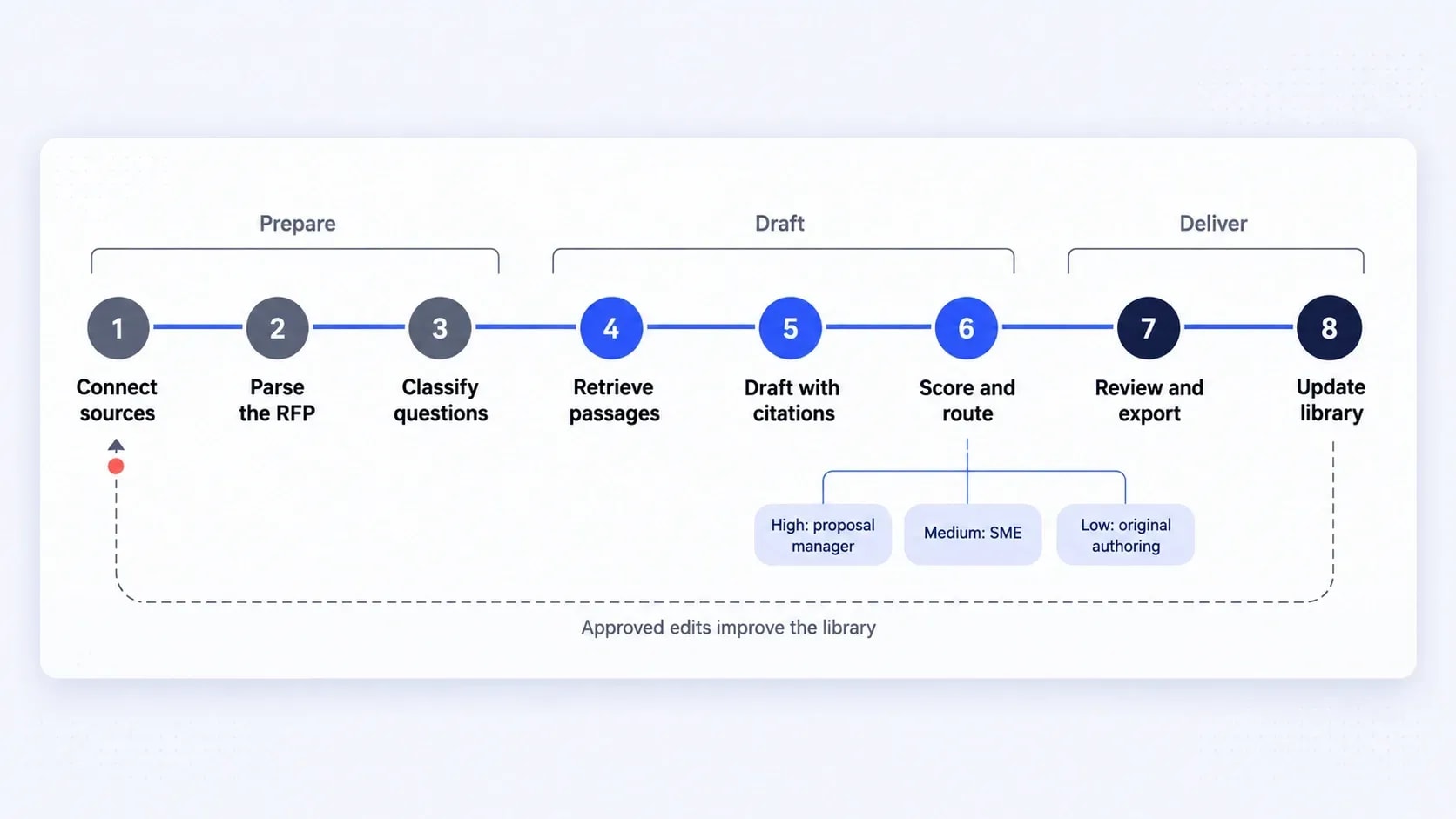
The workflow below is what most mature implementations look like in production. You can build it in-house or buy a platform that gives you most of it out of the box. Either way, the eight steps are the same. Teams planning the rollout can map these steps onto an AI implementation roadmap.
Point the system at your content library, past proposals folder, product documentation, and compliance evidence repository.
Note: Start with fewer, cleaner sources. A drafting system that reads every old proposal will repeat every old mistake.
Upload the RFP. The parser handles Word, PDF, and Excel formats, preserves numbering, and extracts embedded tables.
Note: Scanned PDFs need OCR first, and poor scans are the most common cause of missed questions.
Each question is tagged by category (security, technical, commercial, legal) and by required answer type (narrative, yes/no, attach document).
Note: Classification decides routing later, so spot-check the tags on the first few RFPs before trusting them.
For each question, the system searches your library using vector search and returns the top passages with source metadata.
Note: Retrieval quality sets the ceiling for everything after it. A strong model cannot fix a weak passage.
The model writes a draft using only the retrieved passages. Citations link back to the original source, so a reviewer can verify in one click.
Note: Locked answers, such as legal and certification statements, should be inserted verbatim and never rewritten.
Each draft gets a confidence score. High confidence goes to the proposal manager queue. Medium confidence goes to the topic SME. Low confidence or gaps get flagged for original authoring.
Note: Confidence scores are a triage tool, not proof of accuracy. Tune the thresholds against reviewer corrections.
Reviewers approve, edit, or reject in a single interface. The final response is exported to whatever format the buyer requires, including their portal if applicable.
Note: Keep a named approver for every submission, since the human sign-off is what makes the answers accountable.
Every edit is a signal about what the library gets wrong. If a reviewer rewrites an answer, the system asks whether to update the library version. Approved edits become the new canonical answer.
Note: Without this step, the same corrections get repeated on every RFP.
For teams that want this wired into existing CRM, proposal, and compliance systems, generative AI integration solutions usually cover the connector work.
Not every answer should be automated to the same degree. Sorting your content into five tiers keeps you fast on the safe material and careful on the risky material. Tier assignment usually comes from the question categories tagged in Step 3, and the tier decides how much the model is allowed to do. The tiers work best inside a wider governance program, covered in AI governance and compliance readiness: a practical guide.
Certifications, insurance amounts, corporate addresses, and data residency statements. These are pulled exactly as stored, with no model rewriting.
Technical architecture, security controls, and integration approaches. AI drafts from retrieved sources, and an SME approves before submission.
Product feature descriptions, standard implementation timelines, and the support model. AI drafts, the proposal manager reviews, and an SME is pulled in only for exceptions.
Executive summary, win themes, and references to the buyer's specific situation. A human writes the text.
Pricing, contract terms, liability and indemnity language, and questions with no approved source. Generation is switched off for these.
RFP automation projects tend to stall for a handful of predictable reasons.
If half your answers are three years old and the other half contradict each other, the AI will confidently produce contradictions faster. Retrieval also has no way to tell which conflicting version is the right one. Poor data quality is a common reason AI projects stall, as AI project failure rate data shows.
Copy-pasting RFP questions into a general chatbot with no retrieval layer produces plausible answers that are wrong about your product. This is how teams end up committing to features that do not exist, and those commitments can carry into the contract.
Even at high confidence scores, every answer should pass through a named human before submission. A confidence score measures how closely a draft follows its sources, not whether the sources are still true. Removing the gate is how an outdated claim reaches a buyer.
If your response time drops 60% and your win rate drops 20%, for example, you have not improved. Speed gains can hide weaker answers, and a fast response to a bid you should have skipped is still wasted work.
The library needs a librarian. Without one, answers go stale as products, certifications, and policies change, and the automation quietly repeats the old versions.
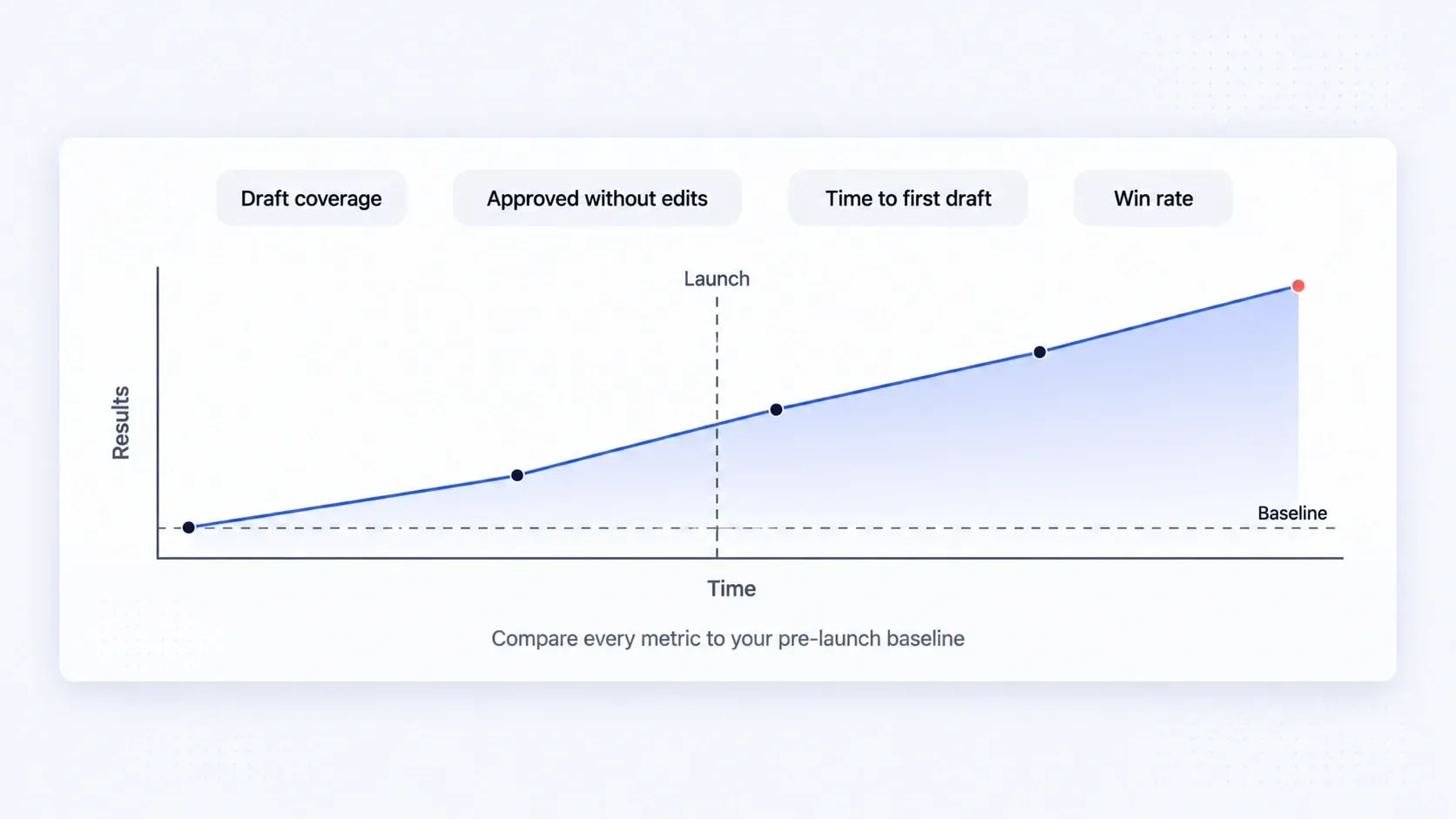
You need metrics for two audiences: the proposal team, who cares about speed and toil, and the executive who signed the check, who cares about revenue. Set a baseline on your last few RFPs before launch, so every number below has something to be compared against.
What percentage of questions in a typical RFP get a usable AI-generated draft?
Formula: questions with a draft that reached review, divided by total questions in the RFP.
Read it by category: coverage on security and technical questions matters more than a high overall figure padded by boilerplate.
Watch for: a rising rate with a rising rewrite rate means the drafts are present but not usable.
Of the AI drafts that reach a reviewer, how many ship unchanged?
Formula: drafts approved as-is, divided by drafts reviewed.
Track over time: the rate should climb as reviewer edits feed back into the library.
Watch for: a very high rate with no rejections can mean reviewers are rubber-stamping, so pair it with sampling audits.
Hours from RFP ingestion to a complete draft ready for review.
Split it into stages: parsing, retrieval and drafting, and SME turnaround, since the last stage is usually where the delay sits.
Report the median: one unusually large RFP will skew the average.
Track these before and after. If they hold steady or improve while your response time drops, the automation is working.
Segment the data: compare by deal size and RFP type, so a few large bids don't hide the trend.
Allow time: a sales cycle can run for months, so early results will be incomplete.
Watch for: a bid or no-bid change can lift win rate on its own, so note when your qualification rules change.
Percentage of library answers reviewed and re-approved in the last 12 months.
Watch it like a burn-down chart: a falling score is the earliest sign that answer quality will decline.
Add a related metric: the count of answers past their review date that were still used in a submission.
Platforms like Responsive, Loopio, and Ombud give you the workflow, the library structure, and the AI drafting layer in one package. The right choice depends on volume, engineering capacity, and how sensitive your content is.
Factor | Buy a platform | Build in-house | Hybrid |
Best fit | High RFP volume, few engineers to spare | Unusual security needs or deep internal integrations | Standard workflow, sensitive content |
Time to launch | Shorter, since the workflow already exists | Longer, since parsing, retrieval, and review UI are built | Medium |
Control over retrieval and prompts | Limited to vendor settings | Full | Full on custom pipelines |
Data handling | Depends on vendor terms and hosting | Kept in your own environment | Sensitive content stays in your environment |
Ongoing effort | Vendor maintains the product | Your team maintains and monitors it | Split between both |
Main risk | Lock-in and limited customization | Underestimating maintenance | Two systems to keep in sync |
As a rough guide, if you answer 50 or more RFPs a year and do not have engineers to spare, buy. If you have unusual security requirements, deep integration needs with internal systems, or you want to own the retrieval and prompting layer, build. Some teams do both: they buy a platform for the workflow and build custom retrieval pipelines on top of it for their most sensitive content. Budgeting for either path is covered in AI implementation cost explained.
If you are shortlisting build partners, how to choose a company that builds multi-agent systems lists the criteria to compare.
We design custom generative AI solutions that pull from your past proposals and content library to help you respond to RFPs faster and more consistently.
Automate Your RFP ResponsesFolio3 AI builds custom RFP automation systems for teams that have outgrown generic platforms or need deep integration with internal knowledge sources, security tooling, and CRM data. The work sits in generative AI development and generative AI integration services, and it follows the same eight-step workflow described above.
Teams still deciding between a platform, a custom build, or a hybrid can start with an assessment of their content library, volume, and security requirements. If you want to talk through your setup, get in touch with the team.
Most of the gain in RFP automation comes from three plain jobs: cleaning up the content library, tiering answers by risk, and putting retrieval-grounded drafting in the middle of a workflow that still respects human review. Teams that get those right spend fewer hours on first drafts and more on the parts of a proposal that win deals.
No, and you should not want it to. AI handles the repetitive drafting and retrieval work well. The executive summary, win themes, and any answer that carries contractual or regulatory weight need a human owner. The best setups aim for a strong first draft, not a finished submission.
Accuracy depends almost entirely on your content library and whether the system is grounded in retrieval. With a well-maintained library and retrieval-augmented generation (RAG), drafts on standard questions often need only light edits, and the approved-without-edits rate shows how well it is working. Without grounding, the model fills gaps from general knowledge, and hallucinations follow.
Coverage is highest on standard, repeated questions, and security questionnaires often top the list because their questions barely change between buyers. Strategic sections like executive summaries and buyer-specific solutioning stay manual. Measure your own first-draft coverage on a baseline set of past RFPs instead of relying on a general benchmark.
It can be, if you choose vendors with clear data handling terms, use private model deployments where needed, and keep sensitive content out of any provider that trains on customer data. Platforms with contractual data-handling terms and self-hosted setups both address this. Read the data processing terms before uploading anything.
Buy if you want speed to value, and your workflow is fairly standard. Build if you have unusual integration needs, strict data residency requirements, or engineering capacity to invest. Hybrid setups are common: platform for workflow, custom layer for sensitive retrieval.
A pilot on a cleaned-up subset of your library and a few real RFPs comes first. A full rollout adds SME routing, portal integrations, and feedback loops, and the timeline depends on how many source systems you connect and how much cleanup the library needs. The content cleanup is often the longest single phase.
The executive summary, win themes, references to the buyer's stated priorities, pricing narrative, and any legal red-line response. These sections carry strategic and contractual weight that AI drafts cannot judge on their own.

Senior Project Manager
Muhammad Nasir is a Senior Project Manager at Folio3 AI, specializing in enterprise AI and software delivery across global markets. With nearly two decades of experience, he helps organizations move from AI strategy to execution, managing complex project lifecycles and driving measurable outcomes at scale.
Custom generative AI helps businesses increase ROI by improving efficiency, reducing operational costs, and delivering more tailored, scalable outcomes in 2026.