Why do some enterprise AI programs scale successfully while others remain pilots and fade away? In 2025, S&P Global reported that companies abandoning most AI initiatives rose from 17% to 42%, not because AI failed, but because organizations launched without structure.
The gap between pilot excitement and production reality is now visible across the market. PwC’s 2026 AI Performance Study found that 74% of AI’s economic value is captured by only 20% of organizations, and that leaders are pulling ahead by building foundations around data, governance, trust, and business reinvention.
This guide is for CTOs, CIOs, AI leaders, data heads, innovation teams, and enterprise transformation leaders who are ready to move from scattered experiments to scalable AI deployment. You will walk away with a phase-by-phase AI implementation roadmap, practical readiness checks, timeline expectations, common mistakes, and governance principles for enterprise AI adoption.
What is an AI implementation roadmap?
An AI implementation roadmap is a structured plan that guides how an enterprise identifies, prioritizes, builds, deploys, governs, and scales artificial intelligence solutions. It connects business objectives with data readiness, infrastructure, talent, compliance, risk controls, timelines, and measurable outcomes.
Unlike a basic project plan, an artificial intelligence implementation roadmap also considers model performance, data quality, security, workflow redesign, change management, and post-deployment monitoring. It helps organizations move from scattered AI experiments to controlled, scalable, and value-driven enterprise AI adoption.
A formal roadmap helps enterprises move beyond disconnected pilots by sequencing strategy, technology, governance, data, people, and execution. It reduces risk, improves alignment, and gives leadership a practical path toward measurable AI value and stronger AI adoption ROI.
1. AI pilots often fail before production
Many AI pilots fail because teams underestimate integration, data quality, user adoption, and governance needs. A roadmap identifies these blockers early, before organizations invest heavily in solutions that cannot scale.
2. AI value is unevenly distributed
AI benefits are not automatic across enterprises. Companies with stronger data foundations, governance, executive sponsorship, and use-case discipline capture more value, while others struggle with scattered experiments and unclear business impact.
3. Governance cannot be added later
AI governance must be built from the beginning because models affect decisions, data, privacy, compliance, and trust. A roadmap ensures risk controls, approvals, monitoring, and accountability are included early.
4. Enterprise AI requires cross-functional ownership
Enterprise AI affects IT, data, security, legal, operations, HR, finance, and business teams. A roadmap clarifies responsibilities so every stakeholder understands their role in strategy, delivery, adoption, and governance.
5. AI must be tied to business outcomes
AI projects should support measurable business outcomes such as cost reduction, faster service, improved forecasting, better customer experiences, fraud detection, or revenue growth. A roadmap keeps every initiative connected to value.
“A successful AI implementation roadmap starts with production readiness, not just model experimentation. Enterprises need strong data foundations, scalable infrastructure, governance, and clear business alignment before AI can deliver measurable impact at scale.” - Abdul Sami - Head of AI Development
Core components of an enterprise AI roadmap
An enterprise AI roadmap combines strategy, readiness, data, infrastructure, governance, talent, and adoption planning. These components help organizations move from experimentation to controlled, scalable, and measurable AI implementation across business functions.
Business objective alignment
Start by defining what AI should achieve for the enterprise. Objectives may include reducing manual work, improving decision speed, increasing personalization, optimizing operations, lowering risk, or creating new digital revenue streams.
AI maturity baseline
An AI maturity baseline shows where the organization currently stands across data, platforms, skills, governance, leadership alignment, and adoption. This helps determine whether the business should explore, pilot, scale, or optimize, often informed by structured AI readiness checks.
Data and infrastructure readiness
AI depends on reliable data and scalable infrastructure. Enterprises must assess data quality, accessibility, integration, cloud readiness, APIs, security, storage, computing resources, and monitoring capabilities before moving toward production deployment.
Governance and compliance framework
A governance framework defines how AI systems are approved, monitored, audited, secured, and controlled. It should cover privacy, bias, explainability, human oversight, vendor risk, compliance obligations, and model performance standards.
Change management and talent plan
AI changes workflows, roles, and decision-making. Enterprises need training, communication, stakeholder engagement, adoption support, and new skills across data engineering, machine learning, product management, security, compliance, and business operations.
How to build an AI implementation roadmap: Step by step
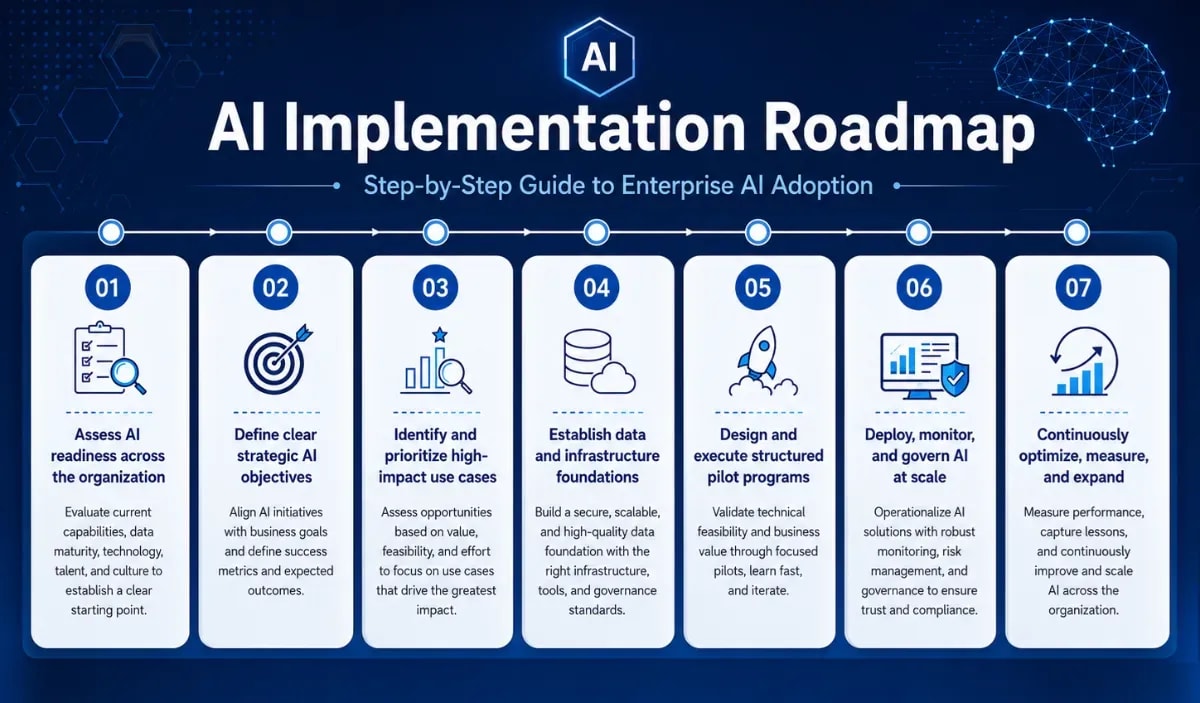
Building an AI implementation roadmap means turning an AI ambition into a sequence of actions. Enterprises must assess readiness, define objectives, prioritize use cases, build foundations, run pilots, govern deployment, and measure results.
Step 1: Assess organizational AI readiness
Evaluate data quality, technical infrastructure, cloud maturity, security, governance, talent, leadership commitment, and process readiness. This assessment reveals gaps that may delay implementation, increase costs, or weaken business outcomes, especially in the context of enterprise AI enablement.
Step 2: Define strategic AI objectives
Clarify what the enterprise wants AI to accomplish. Strong objectives are specific, measurable, and tied to priorities such as operational efficiency, revenue growth, risk reduction, customer experience, forecasting accuracy, or productivity.
Step 3: Prioritize and select use cases
Score AI use cases by business value, technical feasibility, data availability, risk, complexity, and stakeholder readiness. Prioritize fewer high-impact initiatives instead of spreading resources across too many disconnected experiments.
Step 4: Build data and infrastructure foundations
Prepare data pipelines, governance layers, cloud or hybrid environments, model development tools, APIs, security controls, and monitoring systems. Strong foundations help AI move from prototype to production with fewer disruptions.
Step 5: Design and run structured pilots
Design pilots with clear hypotheses, success metrics, users, timelines, risk controls, and go/no-go criteria. A strong pilot proves not only technical feasibility but also operational fit and measurable business value.
Step 6: Deploy, monitor, and govern at scale
Move successful pilots into production with workflow integration, security testing, user training, model monitoring, audit trails, human oversight, and incident response. Scaled AI requires continuous governance, not one-time approval.
Step 7: Iterate, measure, and expand
Track adoption, accuracy, cost, productivity, risk, revenue impact, and user feedback after deployment. Expand AI only when the solution proves reliable, valuable, compliant, and suitable for broader enterprise use.
Operationalize Your AI Roadmap End to End
We help enterprises convert AI strategies into scalable, production-grade systems with measurable impact.
Start Your AI Roadmap Execution
How to conduct an AI readiness assessment before building your roadmap?
An AI readiness assessment evaluates whether the enterprise has the data, infrastructure, skills, processes, governance, and leadership support needed to implement AI responsibly, securely, and profitably across business operations.
Audit your data quality
Review data accuracy, completeness, consistency, freshness, ownership, labeling, accessibility, lineage, and security. Poor data quality can create unreliable AI outputs, biased results, compliance issues, and low user trust.
Evaluate technical infrastructure gaps
Assess cloud capacity, data platforms, APIs, cybersecurity, model hosting, integration with legacy systems, observability, and MLOps tooling. Enterprise AI needs infrastructure that supports scale, reliability, performance, and security.
Map team skills and capabilities
Identify gaps in data science, data engineering, AI product management, compliance, security, UX, change management, and domain expertise. These capabilities are essential for moving AI from experimentation to production.
Assess business process alignment
Map how AI will fit into current workflows. Determine whether processes are standardized, measurable, digitized, and ready for automation or augmentation before adding AI to inefficient or unclear operations.
Score governance and compliance readiness
Evaluate policies for privacy, security, auditability, risk classification, vendor review, human oversight, legal compliance, and model monitoring. Strong governance readiness helps enterprises deploy AI confidently and responsibly.
“The biggest difference between an AI pilot and a successful enterprise rollout is execution discipline. Clear milestones, stakeholder alignment, agile delivery, measurable KPIs, and change management turn AI ideas into sustainable business outcomes.” - Muhammad Nasir - Senior Project Manager
Enterprise AI roadmap timeline: What to expect
An enterprise AI roadmap timeline defines how long strategy, readiness, pilots, deployment, and scaling may take. Timelines depend on AI maturity, data complexity, regulatory requirements, integration needs, and organizational alignment.
Realistic phase-by-phase timelines
Enterprises may spend 4–8 weeks on readiness and strategy, 8–16 weeks on pilot design, 3–6 months on production rollout, and ongoing time on optimization, monitoring, and expansion.
Maturity-stage expectations
Early-stage enterprises should begin with readiness, governance, and one or two narrow use cases. Mature organizations can build reusable platforms, AI centers of excellence, and multi-department deployment models.
Budget planning benchmarks
AI budgets should include data preparation, infrastructure, software, security, compliance, talent, consulting, change management, monitoring, and ongoing support. Treat AI as an enterprise capability, not a one-time project.
Common mistakes in AI roadmap building
AI roadmap mistakes usually happen when enterprises rush toward tools without preparing data, governance, processes, people, and business ownership. Avoiding these mistakes improves scalability, trust, adoption, and measurable return on investment in proven AI strategies.
Skipping the readiness assessment
Skipping readiness causes late discovery of data gaps, weak infrastructure, talent shortages, legal risks, and limited sponsorship. These issues become more expensive and disruptive once AI pilots are already underway.
Too many use cases at once
Launching too many AI initiatives divides attention, funding, data access, and technical resources. Enterprises should focus on a prioritized portfolio that balances quick wins with strategic long-term value.
Treating governance as optional
Governance is not a delay mechanism; it enables responsible scaling. Without governance, enterprises face higher risks around privacy, compliance, bias, security, accountability, user trust, and long-term AI performance.
Confusing pilots with production
A successful AI demo does not prove production readiness. Production requires uptime, integration, user support, monitoring, retraining plans, security, compliance, workflow adoption, and measurable business outcomes.
AI programs struggle when leadership treats them as technical experiments. Executive sponsors must define priorities, fund foundations, remove blockers, align departments, support adoption, and hold teams accountable for value.
Conclusion
An AI implementation roadmap gives enterprises the structure needed to move from scattered experimentation to measurable transformation. The roadmap should begin with readiness, align with business goals, prioritize valuable use cases, prepare data and infrastructure, embed governance, run disciplined pilots, and scale only after value is proven.
Enterprises that treat AI as a strategic operating capability will be better positioned to improve productivity, reduce risk, enhance customer experiences, and create competitive advantage. The next step is to assess readiness, select high-value use cases, and build a practical roadmap that connects AI ambition with enterprise execution.
Frequently asked questions
What's the difference between an AI implementation roadmap and a traditional IT project plan?
AI roadmaps embrace experimentation and iteration while traditional IT follows predictable timelines with defined requirements. Data readiness becomes the foundation instead of infrastructure readiness. Success metrics combine technical performance (model accuracy) with business impact (ROI). Governance addresses AI-specific risks like bias, data drift, and model degradation, requiring 30-40% timeline buffers for experimental phases.
How long does it typically take to build and implement an enterprise AI roadmap from start to production?
Most enterprises require 12-18 months from assessment to production deployment. The timeline includes readiness assessment (4-6 weeks), strategy (3-4 weeks), pilot selection (2-3 weeks), pilot implementation (10-12 weeks), scaling (4-6 weeks), enterprise rollout (6-12 weeks), and stabilization (4-8 weeks). Small businesses compress this to 6-9 months, while global enterprises with legacy systems may extend to 24 months.
What should be the top priority when starting an AI implementation roadmap?
Conduct a rigorous readiness assessment before committing resources to pilots. This prevents pursuing initiatives without foundational capabilities—the primary reason 42% of companies abandoned AI projects in 2025. Assess data readiness (90%+ completeness, 12-24 months history), technical infrastructure (cloud, GPU, APIs), organizational skills, and business objective alignment to identify dependencies upfront.
Which use cases are easiest to implement in an enterprise AI roadmap?
Ideal first pilots combine 12+ months historical data, 85%+ data quality, supervised learning problems with labeled ground truth, single data sources, and ROI measurable within 90 days. Best candidates: customer churn prediction, demand forecasting, document classification, anomaly detection, and lead scoring. Avoid real-time recommendations, computer vision, and generative AI for first pilots due to complexity and infrastructure requirements.
Executive sponsorship is the #1 success factor—organizations with committed sponsors achieve 3x higher success rates. Connect AI initiatives to board-level objectives with quantified 2-3x ROI projections over 3 years. Structure phased funding tied to milestones (pilot gates on assessment completion, scale gates on pilot ROI). Maintain monthly sponsor engagement with transparent progress tracking to prevent disengagement.
What governance framework should enterprises implement alongside an AI implementation roadmap?
AI governance must run parallel to technical implementation with six pillars: model governance (registry, monitoring, retraining triggers), data governance (quality standards, lineage), ethics/bias governance (fairness metrics, appeal mechanisms), compliance governance (audit trails, regulatory mapping), operational governance (incident management, cost tracking), and organizational governance (steering committee, model ownership). Mature governance reduces model risks by 70% and enables 3x faster scaling.
How should enterprises measure success and ROI throughout the AI implementation roadmap?
Track three parallel metric categories: technical (accuracy, latency, uptime), operational (user adoption, satisfaction, integration success), and business (cost savings, revenue impact, ROI %). Phase-specific metrics differ—assessment tracks readiness gaps, pilots track performance convergence and business impact, scaling tracks multi-use-case ROI. Establish baselines before implementation and review weekly during pilots, monthly with executives, and quarterly strategically.
How does organizational change management impact AI implementation roadmap success?
Change management is critical as technology execution. Organizations that invest in change achieve 2-3x higher adoption and 6-month faster value realization. Key practices: clear communication about AI capabilities, stakeholder engagement in pilot design, role-specific training, phased rollouts with early adopters, celebrating wins, and transparent governance. Change management isn't overhead—it's the accelerator enabling technical capabilities to deliver business impact.