Enterprise AI is no longer a side experiment. In 2026, most organizations are already using AI in at least one business function, but far fewer have turned that activity into repeatable, enterprise-wide value. McKinsey found that while 88% of respondents report regular AI use in at least one function, only about one-third say their organizations have begun to scale AI.
That is where many initiatives fall short. Companies often invest in AI before they are fully ready to support it, leading to challenges around data quality, governance, infrastructure, talent, and execution. AI does not fail because the technology lacks promise. It fails when the organization is not prepared to use it effectively at scale.
This guide gives you a practical AI readiness checklist to assess where your organization stands today. Whether you are launching a first pilot or expanding generative AI across the enterprise, it will help you identify the gaps that matter most before moving forward.
What Is AI Readiness? And Why It Matters in 2026
AI readiness is your organization’s ability to adopt, govern, deploy, and scale AI successfully across people, processes, data, and technology. It is not just about having access to models or buying a platform. It is about whether your business can support AI operationally, strategically, and responsibly. Folio3 defines AI enablement in similar terms, covering readiness assessments, strategy, workforce training, governance frameworks, and production deployment.
That matters more in 2026 because enterprise AI is colliding with two realities at once. First, leadership teams expect measurable value, not isolated proofs of concept. McKinsey found that only 39% of respondents report EBIT impact at the enterprise level, even though AI use is now common. Second, governance expectations are becoming more concrete.
So if you are asking, “Are we ready for AI?” the better question is this: “Are we ready to create value from AI repeatedly, safely, and at scale?”
The Complete AI Readiness Checklist for Enterprises
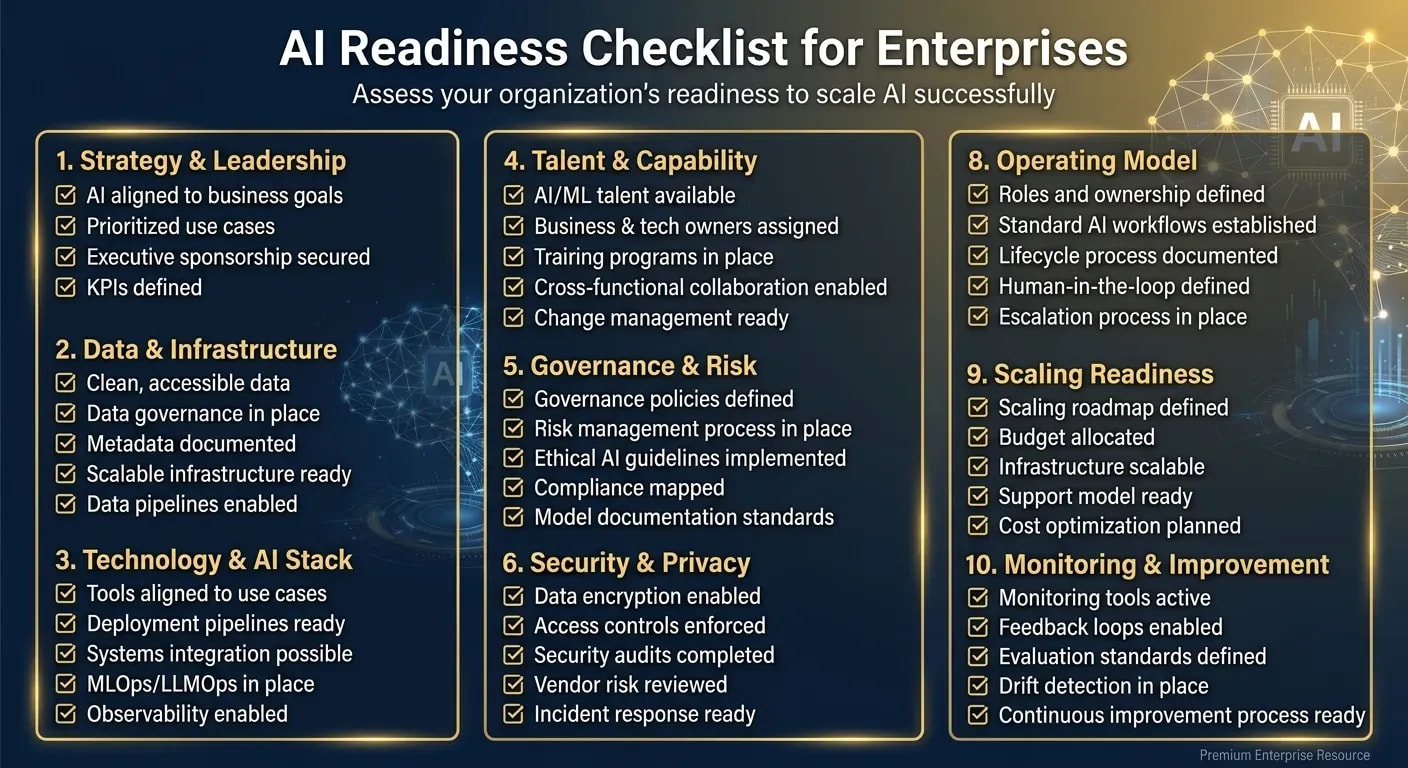
Below is a practical AI readiness checklist for business teams operating at enterprise scale. Use it as an AI readiness assessment checklist to evaluate your current capabilities, identify gaps, and prioritize the actions needed before scaling AI across the organization. This is a critical step in achieving successful enterprise AI enablement, ensuring that strategy, data, and operations are aligned before deployment.
1. Strategy and Leadership Alignment
Every successful AI initiative starts with a clear business direction. If your AI efforts are not tied to measurable goals, they can quickly become disconnected experiments with limited long-term value. Strong leadership alignment helps ensure AI investments support broader business priorities, secure internal buy-in, and move forward with clear ownership.
Ask:
- Are your AI initiatives linked to business goals?
- Have you prioritized use cases based on value and feasibility?
- Is there executive support to guide funding, governance, and adoption?
Checklist
☐ AI strategy documented
☐ Priority use cases identified and ranked
☐ KPIs defined for each use case
☐ Executive sponsorship secured
☐ Budget owner and decision-maker assigned
A useful starting point is to connect every AI use case to one clear business objective. Working with dedicated AI strategy services can make your AI checklist for readiness assessment more actionable and keeps teams focused on outcomes that matter.
2. Data Readiness and Infrastructure
Data readiness is one of the most important parts of any AI readiness assessment checklist. Even the most advanced AI systems depend on clean, accessible, and well-governed data. If your data is fragmented, outdated, or difficult to access, AI projects will struggle to produce reliable results.
Ask:
- Is the data clean, structured, and accessible?
- Do you know where your source-of-truth data lives?
- Can your infrastructure support training, inference, and retrieval workflows?
Checklist
☐ Data is clean, structured, and accessible
☐ Data governance policies exist
☐ Metadata and lineage are documented
☐ Data pipelines support AI use cases
☐ Scalable infrastructure is in place
For many organizations, AI readiness begins with fixing data quality, reducing silos, and building a stronger foundation for future AI use cases.
3. Technology and AI Stack Readiness
Once strategy and data are in place, the next step is making sure your technology stack can support your AI goals. Many enterprises invest in tools too early, without confirming whether those tools fit their use cases, systems, or operating environment. A strong stack should support development, deployment, integration, and long-term management.
Ask:
- Do your AI tools align with actual business needs?
- Can you deploy and manage models reliably?
- Can the solution integrate with existing enterprise systems?
Checklist
☐ AI tools are aligned with use cases
☐ MLOps or LLMOps capabilities exist
☐ Deployment pipelines are established
☐ Systems integration is feasible
☐ Observability and version control are in place
A practical AI readiness checklist for business should always evaluate whether your stack supports both experimentation and production.
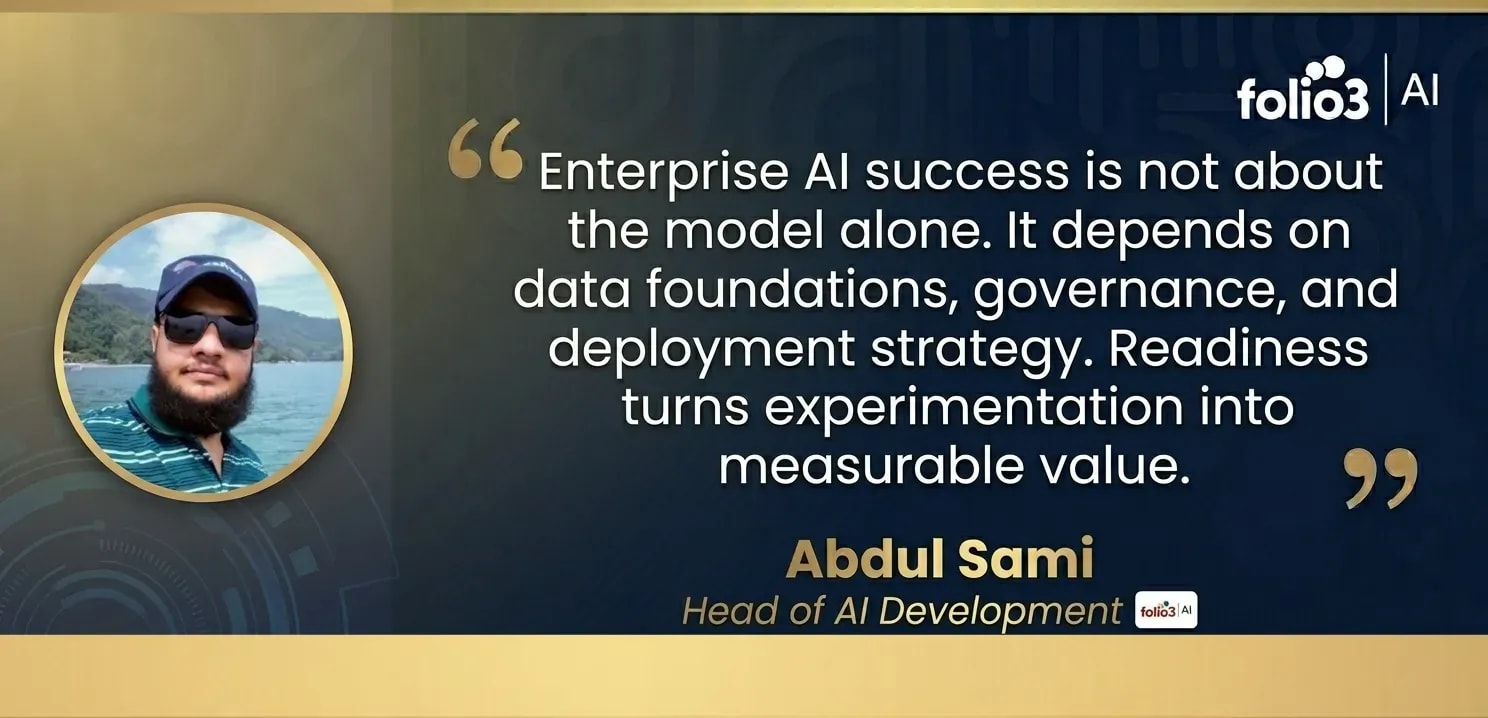
Abdul Sami, Head of AI Development, said:
“Enterprise AI success rarely depends on the model alone. It depends on whether the business has the right data foundation, governance, and deployment strategy to support AI at scale. Readiness is what turns experimentation into measurable value.”
4. Talent and Organizational Capability
AI readiness is not only about technology. It also depends on whether your teams have the right skills, structure, and support to use AI effectively. Many organizations have a strong interest in AI but lack the internal expertise needed to move from planning to execution.
Ask:
- Do you have the right technical and business talent in place?
- Are legal, security, compliance, and operations teams involved early?
- Do employees understand how AI will be used in their workflows?
Checklist
☐ Data scientists or ML engineers are available
☐ Business and technical owners are assigned
☐ AI literacy or training programs are in place
☐ Cross-functional collaboration is enabled
☐ Change management plan exists
A strong AI checklist for readiness assessment should include both internal skill gaps and the AI workforce training program support needed to close them.
5. Governance, Risk, and Compliance
As AI becomes more embedded in business operations, governance becomes essential. Organizations need clear policies for how AI is selected, deployed, monitored, and reviewed. Without this structure, teams may face unnecessary risk, inconsistent practices, and compliance concerns.
Ask:
- Do you have clear ownership of AI governance?
- Can you document models, vendors, and use-case decisions?
- Are risk, bias, oversight, and compliance considerations built into the process?
Checklist
☐ AI governance policies are defined
☐ Risk assessment processes exist
☐ Model documentation standards exist
☐ Ethical AI guidelines are implemented
☐ Regulatory obligations are mapped by use case
This part of the AI readiness assessment checklist helps ensure AI adoption is responsible, controlled, and aligned with enterprise requirements.
Get a Clear Score Across All AI Readiness Pillars
Identify gaps in data, talent, governance, and scaling with a detailed AI readiness report.
Check AI Readiness
6. Security and Privacy Readiness
AI systems introduce new security and privacy considerations, especially when sensitive data, third-party platforms, and automated outputs are involved. Enterprises need to evaluate not only model performance, but also how data is protected throughout the AI lifecycle.
Ask:
- Can you prevent sensitive data exposure in prompts, pipelines, and outputs?
- Are access controls, encryption, and monitoring in place?
- Do you assess vendors for security and privacy risks?
Checklist
☐ Security audits have been conducted
☐ Data encryption is implemented
☐ Access controls are enforced
☐ Vendor and model risk reviews are in place
☐ Logging and incident response processes exist
A complete AI readiness checklist for business should treat security and privacy as core readiness factors, not secondary considerations.
7. AI Use Case and Pilot Execution
A pilot-first approach can be effective, but only when the use case is practical, measurable, and aligned with business needs. The right pilot should help your team learn quickly, prove value clearly, and create a path toward broader implementation.
Ask:
- Is the use case focused enough for a first phase?
- Can you measure value and ROI clearly?
- Will the pilot support future scaling if successful?
Checklist
☐ Pilot use case identified
☐ Success metrics and ROI are defined
☐ Human review process is clear
☐ Learnings are documented
☐ Production path is considered from day one
In any AI checklist for readiness assessment, pilot planning should focus on business fit, not just technical feasibility.
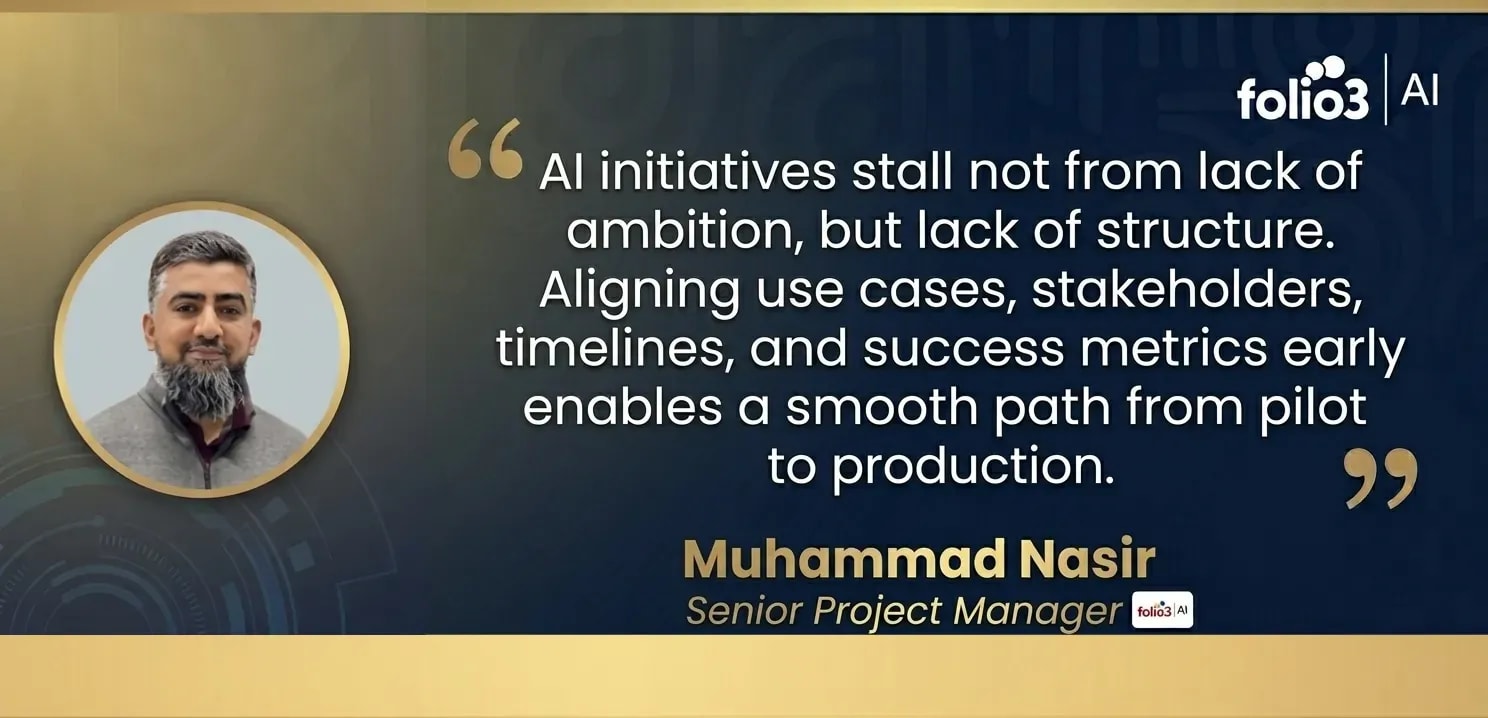
Muhammad Nasir, Senior Project Manager, AI/ML & Generative AI Initiatives, said:
“One of the biggest reasons AI initiatives stall is not a lack of ambition, but a lack of structure. When organizations align use cases, stakeholders, timelines, and success metrics early, they create a much smoother path from pilot to production.”
8. AI Operating Model and Processes
AI cannot scale well when every team works differently. A clear operating model helps define who owns what, how decisions are made, and how AI moves from idea to deployment. Without this structure, progress becomes inconsistent and hard to repeat, which is why it is a critical component of any ai readiness assessment for enterprise environments.
Ask:
- Have you defined roles across business, data, engineering, and risk teams?
- Do you have standard workflows for review, approval, and deployment?
- Is there a repeatable process for managing AI initiatives?
Checklist
☐ AI workflows are standardized
☐ Roles and responsibilities are defined
☐ Lifecycle processes are documented
☐ Human-in-the-loop review points are set
☐ Escalation and exception handling exist
This is one of the most overlooked parts of an AI readiness assessment checklist, especially in larger enterprises.
9. Scaling and Deployment Readiness
Many organizations can launch a pilot, but far fewer are ready to scale AI across departments, users, and workflows. Scaling requires more than technical success. It depends on budget, infrastructure, support, ownership, and operational planning, all of which should be guided by a clear AI enablement roadmap to ensure structured and sustainable growth.
Ask:
- Can your infrastructure support increased demand and usage?
- Do you have a roadmap for rollout beyond the first use case?
- Are the budget, support, and operations teams prepared for scale?
Checklist
☐ Scaling roadmap is defined
☐ Budget allocation is planned
☐ Infrastructure is scalable
☐ Support model is ready
☐ Cost optimization is considered
A realistic AI readiness checklist for business should evaluate whether your organization can support AI beyond the pilot stage.
10. Monitoring, Evaluation, and Continuous Improvement
AI readiness does not end at deployment. Models, data, and user behavior change over time, which means ongoing monitoring is essential. Organizations need clear ways to evaluate performance, collect feedback, and improve systems after launch.
Ask:
- Are you tracking quality, accuracy, cost, and user feedback?
- Can you detect drift, bias, or misuse over time?
- Do you have a process for improving models, prompts, and workflows?
Checklist
☐ Monitoring tools are implemented
☐ Feedback loops exist
☐ Model evaluation standards are defined
☐ Drift and incident thresholds are set☐ Continuous improvement process is documented
A strong AI checklist for readiness assessment should always include post-deployment review, not just launch readiness.
Common AI Readiness Gaps and How to Fix Them
Data silos
Challenge: Disconnected systems limit access to reliable, unified data for AI.
Fix: Build governed pipelines, standardize metadata, and improve observability so teams can trust and scale data usage.
Talent gaps
Challenge: Teams often lack AI, data, and change management expertise.
Fix: Upskill internal staff, assign clear ownership, and bring in external specialists or AI Enablement services to accelerate execution where needed.
Weak governance
Challenge: AI initiatives stall or create risk without clear oversight.
Fix: Establish a governance framework covering approvals, vendor reviews, documentation, human oversight, and compliance responsibilities across teams.
Organizations without internal expertise often turn to AI governance consulting partners to accelerate this process and avoid common structural mistakes.
Pilot paralysis
Challenge: Many pilots never move beyond experimentation or prove business value.
Fix: Start with one feasible, high-impact use case with measurable ROI and a clear production rollout path.
No operating model
Challenge: AI efforts stay fragmented when roles and workflows are undefined.
Fix: Standardize intake, prioritization, risk review, deployment, and monitoring processes so initiatives scale consistently across the enterprise.
Final Thoughts: AI Success Starts With Readiness
In 2026, the winners in enterprise AI will not be the companies running the most pilots. They will be the companies that can connect AI strategy to business outcomes, build on trustworthy data, govern risk, equip teams, and scale responsibly. The market has already moved past experimentation. The new competitive edge is operational readiness. McKinsey’s high performers stand out not just because they use AI, but because they redesign workflows, assign leadership ownership, invest in capabilities, and build the management practices that turn AI into measurable value.
If your organization wants to move from curiosity to confidence, start with a structured AI readiness checklist for business. And if you want a faster, expert-led view of where you stand today, talk to the team at Folio3 AI.
Turn Readiness Into Real AI Outcomes
Build the systems, governance, and processes needed to move from AI pilots to scalable, production-grade deployment.
Explore AI Enablement
Frequently asked questions
What is an AI readiness checklist?
An AI readiness checklist is a structured framework used to evaluate whether an organization has the strategy, data, technology, governance, talent, security, and processes needed to adopt AI successfully. It helps identify gaps before major investments are made.
What’s the minimum data quality required for a pilot?
There is no universal threshold, but pilot data should be relevant to the use case, accessible, representative, governed, and clean enough to support reliable outputs. Gartner emphasizes that AI-ready data must be defined by the use case and continuously monitored.
How do you assess AI readiness in an enterprise?
You assess AI readiness by reviewing business alignment, data readiness, infrastructure, stack fit, talent, governance, security, pilot design, operating model, scaling ability, and monitoring capability. A formal AI readiness assessment checklist makes the process repeatable.
What are the key pillars of AI readiness?
The key pillars are strategy, data, technology, talent, governance, security, execution, operating model, scaling, and continuous improvement. McKinsey’s research similarly points to strategy, talent, operating model, technology, data, and adoption/scaling as core value drivers.
Why do AI projects fail without readiness?
They fail because the organization is not prepared to support them. Common reasons include poor data quality, unclear business value, weak governance, lack of ownership, integration problems, and inability to scale. Gartner and Deloitte both point to these operational barriers as central causes of failure.
How long does it take to become AI-ready?
It depends on organizational size and maturity. Folio3 notes that initial assessments and strategy workshops can be completed in 4 to 6 weeks, while full enablement programs often run 6 to 18 months.
How does AI readiness differ for generative AI vs. predictive AI?
Generative AI readiness requires extra attention to prompt security, model behavior, unstructured data, RAG architecture, content transparency, human review, and third-party model governance. NIST’s Generative AI Profile exists because GenAI introduces distinct risks beyond traditional predictive systems.
What is the difference between AI readiness and AI maturity?
AI readiness is about whether you can begin or scale AI effectively right now. AI maturity describes how advanced and embedded your AI capabilities already are over time.
Who should be responsible for AI readiness?
Responsibility should be shared, but ownership should be explicit. Executive leadership should sponsor it, while data, engineering, security, legal, risk, and business teams should each own their part of the operating model. McKinsey’s research shows that strong senior leadership ownership is a major differentiator for high performers.