Key takeaways
Coca-Cola has launched a new AI-generated holiday commercial for 2025, returning to the controversial technology that sparked significant backlash just one year ago.
The beverage giant released the updated version of its classic advertisement on Monday, November 3, working once again with Los Angeles-based AI studio Secret Level.
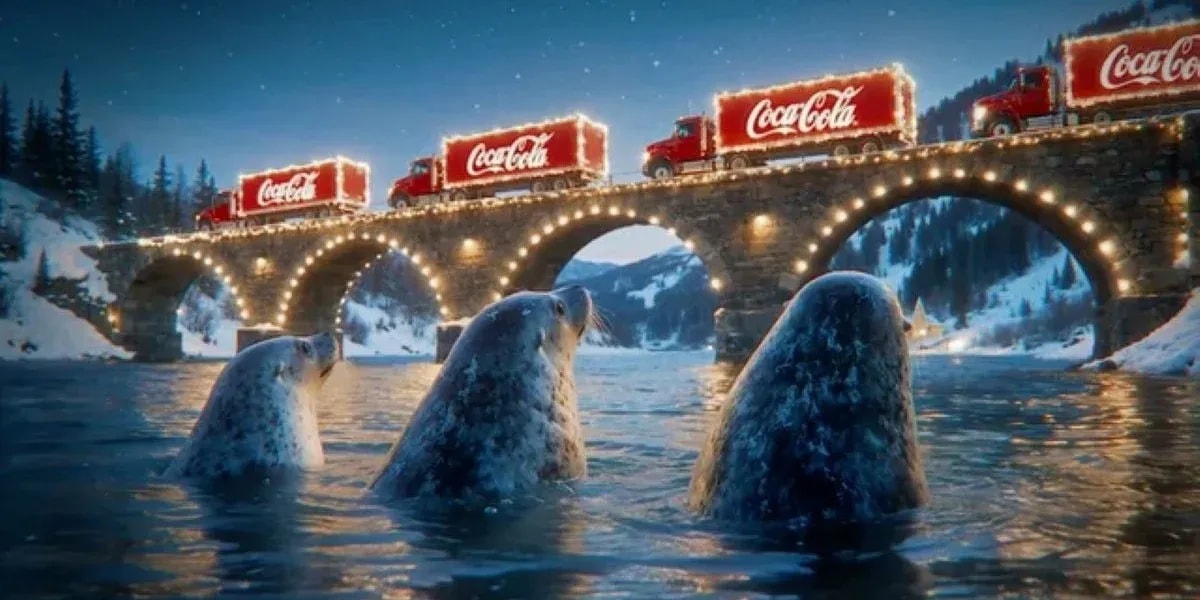
The new 60-second spot features Coca-Cola's signature red trucks traveling through snowy landscapes, but this time the ad showcases only animated animals, including polar bears, seals, penguins, and squirrels, watching the vehicles pass.
The only human character is Santa Claus, who appears at the end of the commercial drinking a Coke. The Santa imagery was generated exclusively from archival paintings by Haddon Sundblom, the artist who created Coca-Cola's iconic depiction of Santa Claus in the 1930s.
Technology improvements and production changes
Company executives maintain that significant technological advances over the past year justify their renewed commitment to AI-generated advertising.
Pratik Thakar, Coca-Cola's global vice president and head of generative AI, defended the decision in an interview with The Hollywood Reporter.
"Last year people criticized the craftsmanship. But this year the craftsmanship is ten times better," Thakar stated. "There will be people who criticize — we cannot keep everyone 100 percent happy. But if the majority of consumers see it in a positive way it's worth going forward."
Jason Zada, founder and chief creative officer of Secret Level, explained the strategic shift away from human characters.
"Last year it was difficult to get those expressions from animals so we had to use human faces. Now technology has evolved to where we can," Zada told The Hollywood Reporter. He added that his team hopes viewers cannot distinguish the spot from a traditional Hollywood animated movie, saying the best compliment would be when people cannot tell it was AI-generated.
The production required approximately 20 people on the team, according to Zada. A traditional animated spot with similar detail would typically employ 50 or more workers.
Mixed public reaction and industry debate
Despite Coca-Cola's confidence in the improved quality, early responses to the 2025 campaign have been divided.
According to media intelligence firm CARMA, since the campaign's launch, 10.2% of online conversations were positive and 32% were negative.
Data from Truescope indicated that most discussions, 93.8%, remained neutral and focused on the broader trend of AI in advertising.
Social media comments reflected the split opinion. On YouTube, one viewer criticized the ad, stating it still looks terrible despite a year of AI development.
Another commenter expressed disappointment that a company of Coca-Cola's size would rely on AI for commercial production.
However, some defended the approach, arguing that the ad was created by creative professionals using AI as a tool, similar to how 3D animators use software.
Islam ElDessouky, global vice president of creative strategy and content at Coca-Cola, emphasized the campaign's intentions in a statement. "Building on last year's campaign, this evolution truly embodies our commitment to inspiring human connection and uplifting moments, especially during the holiday season," ElDessouky said.
Broader campaign strategy
The 2025 holiday campaign, titled "Refresh Your Holidays," extends beyond the AI-generated spot.
The initiative includes a traditionally produced 30-second television commercial called "A Holiday Memory," which will run in North America, Latin America, and Asia-Pacific markets.
This spot centers on a woman decorating for the holidays who finds a snow globe and remembers a festive gathering featuring a performance of "Feliz Navidad."
The campaign was developed by WPP Open X, led by VML and supported by EssenceMediacom, Ogilvy, and Burson.
It will run across multiple channels, including television, online video, digital platforms, out-of-home advertising, social media, in-store displays, and product packaging.
The brand is also bringing back its iconic Christmas truck tour in November and December.
Thakar described the AI-powered ads as pushing boundaries in technical precision and cinematic storytelling.
"Last year we set a global milestone with the world's first entirely GenAI-created film on broadcast media — a bold leap that broke new ground," he stated in materials shared with Marketing Dive. "This year's campaign is another proof point in our journey of using emerging technology to rethink how we create and scale content."
Read more: