Key Takeaways
Elon Musk's artificial intelligence company xAI officially launched Grokipedia on Monday, October 27, 2025, positioning the platform as a less biased alternative to Wikipedia.
The site went live with approximately 885,000 AI-generated articles but experienced technical difficulties within an hour of its debut.
The launch represents Musk's latest effort to challenge what he characterizes as institutional bias in mainstream information sources.
Musk announced that version 0.1 represents just the beginning of the platform's development. On X, he wrote: "https://grokipedia.com/ version 0.1 is now live. Version 1.0 will be 10X better, but even at 0.1 it's better than Wikipedia imo."
https://t.co/op5s4ZiSwh version 0.1 is now live.
Rocky debut and technical challenges
Grokipedia's launch encountered immediate obstacles. The site became inaccessible shortly after going live, though it returned online later Monday evening. When asked about the crash, an xAI representative responded to media inquiries with "Legacy Media Lies" but did not provide further explanation for the technical issues.
Musk had delayed the platform's original October 20 launch date, posting on X: "Postponing Grokipedia v0.1 launch to the end of the week. We need to do more work to purge out the propaganda."
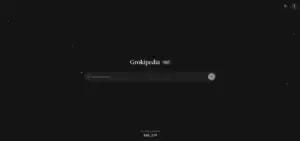
The platform features a minimalist interface with a dark background and a simple search bar, closely resembling Wikipedia's layout. At launch, the homepage displayed "Grokipedia v0.1" along with an article counter showing 885,279 entries—significantly fewer than Wikipedia's more than seven million English-language articles.
Heavy reliance on Wikipedia content
Despite Musk's criticism of Wikipedia, early analysis revealed that numerous Grokipedia articles are nearly identical to their Wikipedia counterparts. Many pages include disclaimers stating "The content is adapted from Wikipedia, licensed under Creative Commons Attribution-ShareAlike 4.0 License."
Lauren Dickinson, a spokesperson for the Wikimedia Foundation, responded to the launch by stating: "Even Grokipedia needs Wikipedia to exist."
In a statement, Dickinson emphasized that "Wikipedia's knowledge is – and always will be – human.
Through open collaboration and consensus, people from all backgrounds build a neutral, living record of human understanding – one that reflects our diversity and collective curiosity. This human-created knowledge is what AI companies rely on to generate content."
Different approach to content presentation
While many articles mirror Wikipedia's structure, Grokipedia presents certain topics through a different ideological lens.
Musk's own Grokipedia page includes a section titled "Recognition and Long-Term Vision" rather than Wikipedia's "Accolades" section.
The entry states: "His long-term vision prioritizes safeguarding human consciousness against existential threats, emphasizing the establishment of a self-sustaining multi-planetary civilization as a hedge against planetary-scale catastrophes on Earth."
An entry on former President Joe Biden includes what Grokipedia describes as "severe empirical setbacks" during his presidency—language that differs substantially from Wikipedia's framing of the same period.
Unlike Wikipedia's community-editing model, Grokipedia does not allow users to directly edit articles. Instead, users can submit correction requests through Grok, xAI's AI chatbot, which then evaluates and responds to the requests.
Wikipedia founder responds with skepticism
Jimmy Wales, Wikipedia's co-founder, expressed doubt about Grokipedia's potential to match Wikipedia's accuracy. Speaking to The Washington Post, Wales said AI language models "aren't sophisticated enough" and predicted "there will be a lot of errors."
In a recent interview with BBC Science Focus, Wales rejected Musk's characterization of Wikipedia as biased, calling the claim "just factually wrong." He stated: "The idea we've become some sort of crazy left-wing activists is just incorrect – factually incorrect."
Wales also noted that Musk's attacks on Wikipedia may have an unintended consequence. In an interview with The New York Times, Wales observed that public reaction to the criticism has been largely negative, suggesting it may actually help Wikipedia's fundraising efforts.
Grokipedia is powered by xAI's Grok AI model, which uses computational resources to generate, verify, and update content. The platform claims to provide real-time AI analysis for content verification and bias detection, with articles marked as "fact-checked by Grok."
The project emerged after Musk amplified criticism from tech investor David Sacks, who had called Wikipedia "hopelessly biased" and claimed it was maintained by "an army of left-wing activists."
Musk has been a vocal critic of Wikipedia throughout 2024 and 2025, previously urging his followers to stop donating to the platform and referring to it as "Wokepedia."
The launch of Grokipedia adds another dimension to ongoing debates about the role of artificial intelligence in curating information and the challenges of maintaining neutrality in knowledge platforms.
Read more: