Key takeaways
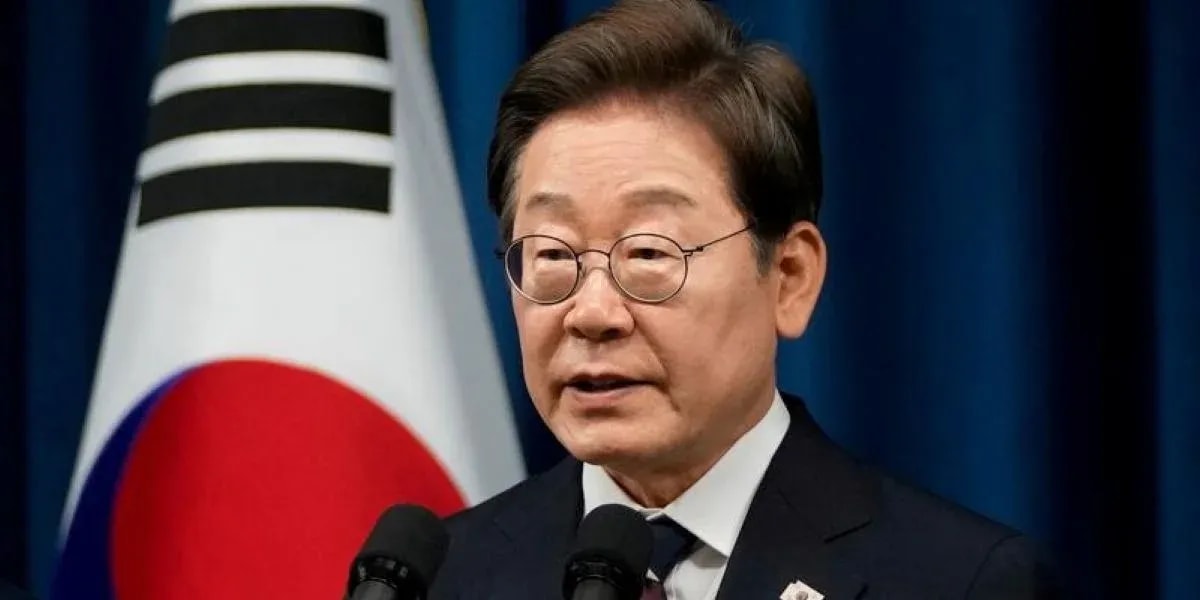
In his first major budget address since taking office in June, President Lee Jae Myung on Tuesday called for South Korea to triple government spending on artificial intelligence infrastructure, positioning the technology as critical to the nation's economic survival in a rapidly changing global landscape.
Speaking before the National Assembly, Lee outlined a record-breaking 728 trillion won budget proposal for 2026, describing it as the nation's first budget designed specifically to usher in the AI era.
The spending plan represents an 8.1% increase from this year and would be the largest in South Korean history.
Ambitious AI spending targets key industries
At the heart of Lee's proposal is a request for 10.1 trillion won ($6.9 billion) in AI-related spending for 2026, more than triple the 3.3 trillion won allocated this year.
The president called on the liberal-led legislature to approve the funding to advance the country's AI computing and manufacturing capabilities, with particular focus on semiconductors, automobiles, shipbuilding, and robotics.
"Just as President Park Chung-hee paved the highway for industrialization and President Kim Dae-jung built the highway for the information age, we must now construct the highway for the AI era to open a future of progress and growth," Lee said, according to the Associated Press.
The president characterized the current moment as critical for national survival.
He said the country faces a critical moment for "national survival" amid rapid changes in the global trade order and a "huge, transformative wave of AI," according to his speech.
Lee also announced plans to create a 150 trillion won National Growth Fund over the next five years to nurture high-tech industries.
The budget would expand funding for research and development in advanced strategic sectors, including AI, content creation, and defense industries, by 19.3% to a record 35.3 trillion won.
Defense modernization with an AI focus
The proposed defense budget of 66.3 trillion won ($46 billion) represents an 8.2% increase from current levels.
Lee emphasized the spending would modernize the military's conventional weapons systems into AI-driven capabilities and transform the armed forces into what he called a "smart elite force" to strengthen self-reliant national defense.
"It's a matter of national pride that South Korea, which spends 1.4 times North Korea's annual GDP on defense and is perceived as the world's fifth most powerful military, continues to depend on others for its security," Lee stated in his address.
The budget speech coincided with annual security talks in Seoul between U.S. Defense Secretary Pete Hegseth and South Korean Defense Minister Ahn Gyu-back, where discussions were expected to address South Korea's defense spending commitments and plans to transfer wartime operational control to a joint command led by a South Korean general.
Nvidia deal faces uncertainty amid Trump chip restrictions
Lee highlighted a significant agreement with Nvidia to supply 260,000 graphics processing units for AI infrastructure projects involving major South Korean businesses and the government.
The deal, announced following a meeting between Lee and Nvidia CEO Jensen Huang during last week's Asia-Pacific Economic Cooperation meetings, would distribute 50,000 GPUs each to the government, chipmakers Samsung and SK, and automaker Hyundai, with another 60,000 going to internet company Naver.
However, the timeline for delivery remains unclear. Huang told reporters that AI data centers and power networks must first be established before the company can begin shipping the GPUs.
Concerns have intensified following comments from U.S. President Donald Trump aboard Air Force One on Monday. "We don't give that chip to other people," Trump declared, stating that only U.S. customers should have access to Nvidia's latest Blackwell AI chips.
Political tensions shadow budget rollout
Lee's budget address took place amid significant political turmoil. Most conservative opposition lawmakers from the People Power Party boycotted the speech, protesting an ongoing criminal investigation into former President Yoon Suk Yeol's brief imposition of martial law in December.
The president did emphasize what he described as successful diplomacy at APEC, including a bilateral meeting with Trump that he said secured lower tariffs on automobiles and computer chips, two of South Korea's key exports.
Lee called for bipartisan cooperation to pass the budget within the legal deadline. "Just as we succeeded in industrialization and informatization, we will open the door to the AI era together with the great people of Korea," he said, according to The Korea Times.
Read more: