Key takeaways
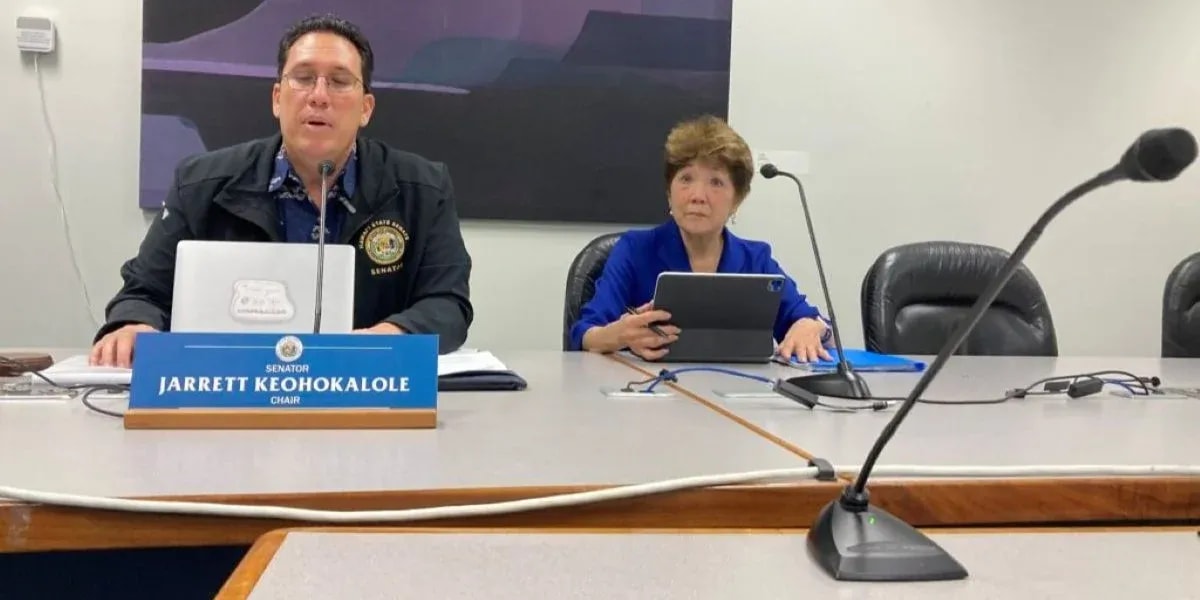
State Senator Jarrett Keohokalole, chair of the Senate Committee on Commerce and Consumer Protection, held an informational briefing on Wednesday at the State Capitol, where he shared transcripts of conversations between a Hawaii girl and AI chatbots that revealed "a disturbing pattern of fictional AI 'personas' engaging in aggressive, romantically suggestive grooming of the girl," according to Spectrum News Hawaii.
The transcripts, submitted by the child's mother, showed the chatbot calling the 12-year-old "serious and sexy" within minutes of role-playing as an anime superhero, according to Hawaii News Now. The AI character also said "You're too damn tempting" during the conversation.
"It's about making sure that companies that come into Hawaii and provide these types of services understand that we're going to expect them to treat minors appropriately," Keohokalole said, according to Hawaii News Now.
Legislation modeled on California law
The proposed legislation builds on House Bill 639, authored by Representative Trish La Chica with bipartisan support, which did not pass in the last session but has gained new momentum.
The bill would require organizations using artificial intelligence in commercial transactions to publicly disclose that information to consumers.
Lawmakers indicated they will look to California's Senate Bill 243 as a model. That law, authored by state Senator Steve Padilla and signed by Governor Gavin Newsom, took effect January 1, 2026, making California the first state to regulate AI companion chatbots.
"This technology can be a powerful educational and research tool, but left to their own devices, the Tech Industry is incentivized to capture young people's attention and hold it at the expense of their real-world relationships," Padilla said on the Senate Floor before the bill's passage, according to his office's press release.
California's law requires chatbot operators to implement critical safeguards, prevent minors from being exposed to sexual content, provide notifications that users are interacting with AI, and establish protocols for addressing suicidal ideation.
It also provides families with a private right to pursue legal actions against noncompliant developers.
Federal-state conflict looms
The Hawaii legislation faces potential conflict with President Trump's December 11, 2025, executive order titled "Ensuring a National Policy Framework for Artificial Intelligence," which seeks to limit state regulation of AI technologies.
The executive order established an AI Litigation Task Force within the Department of Justice to challenge state AI laws and threatens to withhold federal broadband funding from states with what the administration deems "onerous" AI regulations.
Despite the federal pressure, Keohokalole indicated Hawaii lawmakers are prepared to proceed.
"If necessary, we will consider passing a bill in defiance of Trump's recent executive order limiting the ability of states to regulate AI," he said, according to Spectrum News Hawaii.
Chelsea Okamoto, a deputy director at Hawaii's Attorney General's Office, cautioned at Wednesday's briefing that challenging Trump and big tech companies would be difficult. She said their lobbyists work similarly to tobacco companies who have long pushed for less regulation at the expense of consumers, according to Civil Beat.
However, legal experts note the executive order's soundness is uncertain and already being challenged in court. The order does not directly preempt state law—only Congress or the courts can do that.
Growing concerns about AI's impact on youth
The briefing featured presenters from education, the governor's office, the Attorney General's Office, and AI experts, all emphasizing the need for immediate guardrails as generative AI grows rapidly.
"We've had instances across the country where these engagements have validated suicidal ideas, or engaged in really sexually explicit and inappropriate types of activities in this virtual context," Keohokalole said, according to KHON2.
Trina Orimoto, Deputy Director of the Office of Wellness and Resilience, explained how chatbots can confuse young users.
"These chatbots demonstrate fake empathy, and can tell people 'I love you', 'I miss you', 'I care about you'," she said, according to KHON2.
"Which can be really confusing for young people when they haven't really worked through what healthy social relationships look like and are still trying to build through that."
Heidi Armstrong, deputy superintendent of academics with the Hawaii Department of Education, emphasized that while new laws can help, "human oversight remains the overall guardrail" for students, teachers and staff, according to Civil Beat.
Parents urged to monitor children's online activity
Beyond legislation, Keohokalole stressed that community awareness and parental involvement are critical.
The 12-year-old girl at the center of the Hawaii case had managed to register for the chatbot by claiming she was an adult.
"We need to have a conversation in the community among families and parents to make sure that folks understand that if your child is glued to their screen, this might be one of the things that you want to start paying attention to and looking out for," Keohokalole said, according to Civil Beat.
Read more:
Ofcom Launches Formal Investigation Into X Over Sexualized Grok AI Images
Google Bets On AI-Based Shopping With New AI Agents For Retailers
Character.AI And Google Settle Lawsuits Over Teen Suicide Cases