Key Takeaways
Microsoft announced Wednesday its most ambitious AI infrastructure project to date: a massive data center campus in Mount Pleasant, Wisconsin, dubbed "Fairwater," which the company claims will be "the world's most powerful AI datacenter."
The announcement marks a significant escalation in the AI infrastructure arms race as tech giants compete to build the computing power necessary for next-generation artificial intelligence models.
Unprecedented scale and technical specifications
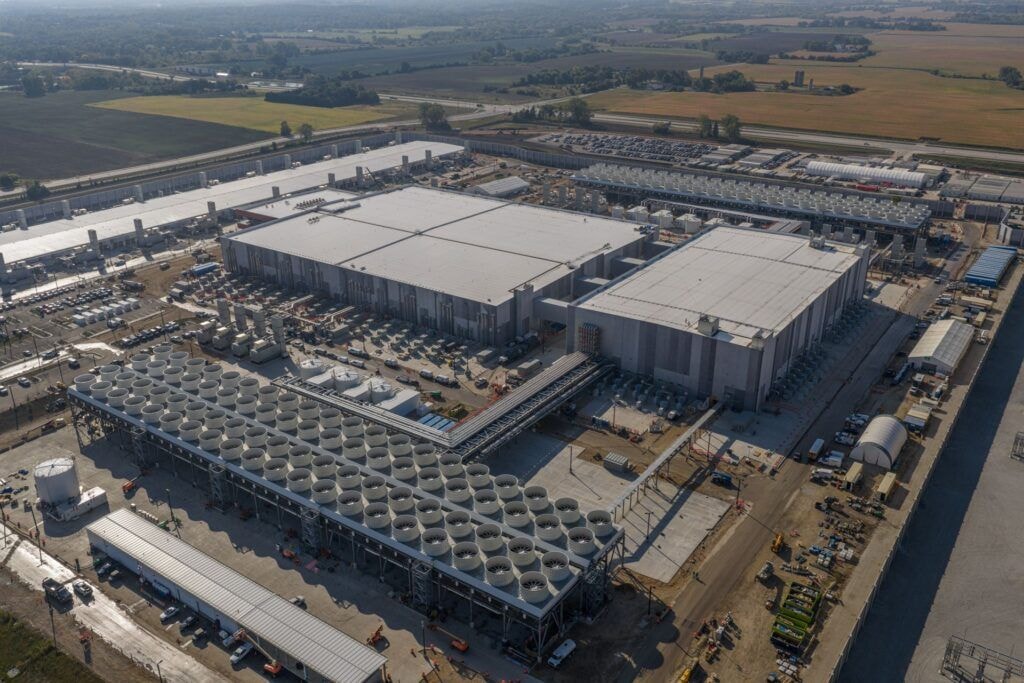
The Fairwater facility represents a remarkable feat of engineering, covering 315 acres and housing three massive buildings with a combined 1.2 million square feet under roofs.
The construction has required "46.6 miles of deep foundation piles, 26.5 million pounds of structural steel, 120 miles of medium-voltage underground cable and 72.6 miles of mechanical piping."
At the heart of the facility will be "hundreds of thousands" of NVIDIA GB200 servers, connected by an extraordinary network infrastructure. Microsoft CEO Satya Nadella revealed on social media that the GPUs will be "connected by enough fiber to circle the Earth 4.5 times" and said that they will deliver ten times more performance than today's fastest supercomputer.
The datacenter's storage systems alone are "five football fields" long, demonstrating the massive scale required to support frontier AI model training and deployment.
[caption id="attachment_31412" align="aligncenter" width="800"]
Revolutionary cooling technology and environmental design
Unlike typical cloud datacenters, which are optimized to run many smaller, independent workloads such as hosting websites, email or business applications, this datacenter is built to work as one massive AI supercomputer using a single flat networking interconnecting hundreds of thousands of the latest NVIDIA GPUs.
This design necessitates advanced cooling solutions that go far beyond conventional air cooling systems.
Microsoft has implemented a closed-loop liquid cooling system that the company suggests will have "zero water waste," with all of the water supplied once, at construction.
The facility is supported by what Microsoft describes as "the second largest water-cooled chiller plant on the planet" and features 172 20-foot fans that chill and recirculate the water back to the datacenter.
Over 90% of the datacenter capacity uses this closed-loop system, requiring water only once during construction and continually reusing it with no evaporation losses. The remaining 10% of traditional servers use outdoor air for cooling, switching to water "only during the hottest days."
Major economic investment and job creation
Microsoft's commitment to Wisconsin has grown substantially since the project's initial announcement.
The company first pledged $3.3 billion for the initial data center in 2023, but announced an additional $4 billion investment for a second facility of similar size and scale, bringing the total investment to more than $7 billion.
Wisconsin Governor Tony Evers praised the investment, stating: "Microsoft's investment puts Wisconsin on the very cutting edge of AI power, not just in the U.S., but throughout the world, while creating good, family-supporting jobs, growing our communities, and bolstering our critical biohealth, personalized medicine, and advanced manufacturing sectors here at home."
The project has already created significant employment opportunities. According to the governor's office, building the first Microsoft datacenter created almost 10,000 "family-sustaining" jobs, which included more than 3,000 construction workers.
The first data center is expected to employ around 500 full-time employees, growing to 800 once the second data center is complete.
National AI infrastructure strategy
The Wisconsin facility is part of Microsoft's broader strategy to establish multiple AI data centers across the United States. Executive vice president of Cloud and AI, Scott Guthrie, wrote that several identical Fairwater data centers are under construction elsewhere in the United States.
Microsoft President Brad Smith emphasized the facility's global significance, stating: "This is where the most advanced AI models are going to be built for the world. It's an extraordinary resource for this community and state, but for the country, and for the world, as far as what we believe AI has the potential to do: to solve the problems that need to be solved."
The project supports Microsoft's broader AI partnerships, particularly with OpenAI, and positions the company to compete effectively against other tech giants making massive infrastructure investments in AI computing capacity.
Timeline and workforce development
The first Fairwater facility is scheduled to be operational early next year, while the second datacenter will be of similar size and scale and be built in the same area in Racine County. It will be operational by the end of 2028.
To support the specialized workforce needs of these facilities, Microsoft has partnered with Gateway Technical College in nearby Racine to create "the Datacenter Academy" for training workers in data center operations and maintenance.