Key takeaways
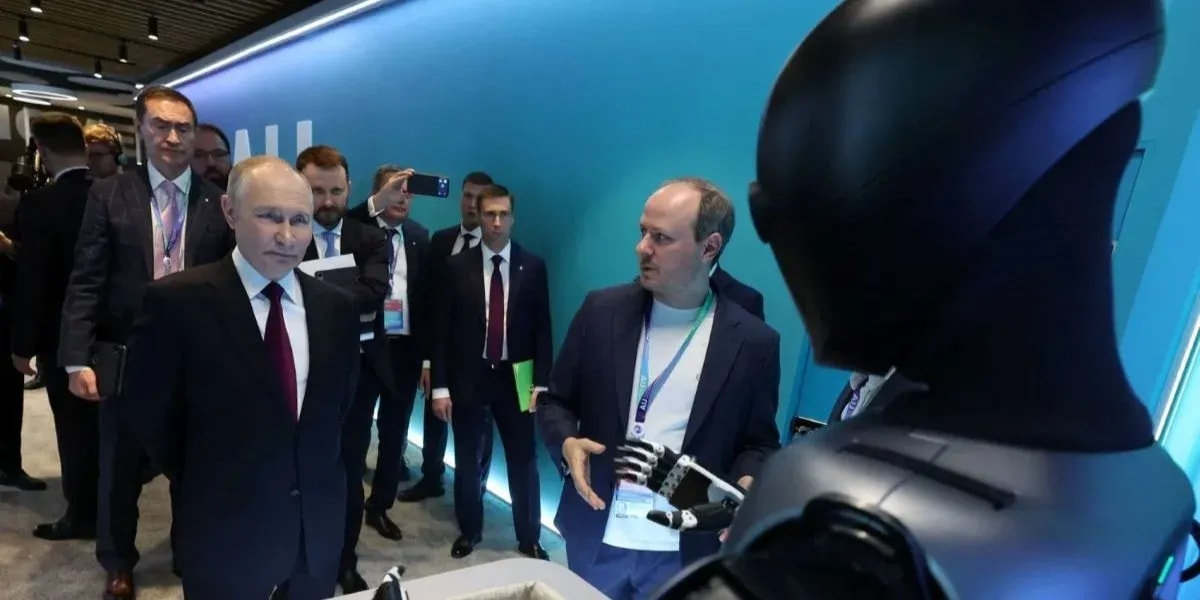
Russian President Vladimir Putin was treated to an unusual demonstration at the AI Journey conference in Moscow on Wednesday, November 19, when an AI-powered humanoid robot named Green danced for the Kremlin leader at an exhibition organized by Sberbank, Russia's largest bank.
The robot introduced itself to Putin before launching into its performance.
Video Source: Times Now
"My name is Green. I am the first Russian humanoid robot with embedded artificial intelligence," the robot told Putin in Russian, according to footage broadcast on state television. "This means that I am not just a program on a screen but a physical embodiment of technology."
Green explained its technical capabilities to the president, stating that over 40 motors and numerous sensors allow it to move smoothly, maintain balance confidently, and interact safely with people.
The robot then requested that a virtual assistant play its favorite track before performing a dance routine to the folk-pop song "The Sun Rose High."
Security concerns overshadow technological showcase
Throughout the demonstration, Putin's bodyguards maintained close watch over the interaction.
Security personnel visibly moved to position themselves between the robot and the Russian leader after the performance to ensure the machine maintained a safe distance.
One bodyguard remained stationed between Putin and Green as the robot attempted to continue the conversation.
Following the performance, Putin offered a brief assessment. "Very beautiful," he said, according to Reuters reports. "Thank you."
Russia's robotics challenges highlighted by recent failures
The demonstration took on added significance coming just days after another Russian AI-powered robot, Aidol, suffered an embarrassing malfunction during its public unveiling at the Yarovit Hall Congress Center in Moscow on November 11.
According to Fortune, Aidol walked onto the stage to the theme from Rocky, waved to the audience, took a few steps, then lost its balance and toppled over. Event staff rushed to cover the fallen robot with a black cloth and carried it from the stage.
The contrasting demonstrations underscore the challenges Russia faces in competing with established leaders in AI and robotics technology.
Western sanctions on microchips have limited Russia's capacity to scale up computing infrastructure, while the country has experienced a brain drain of top innovators since the full-scale invasion of Ukraine.
Putin pushes for AI sovereignty
At the AI Journey conference, which ran from November 19 to 21 at Sberbank's headquarters, Putin emphasized the strategic importance of developing domestic AI capabilities.
According to official Kremlin transcripts, he stated: "We cannot allow critical dependence on foreign systems. For Russia, this is a question of state, technological, and, one could say, value sovereignty."
The Russian president called for the creation of a national task force to advance work on homegrown generative AI models and urged companies to develop national language models.
"Russia must possess its own generative AI technologies and products," Putin said during the event.
Herman Gref, Sberbank's CEO and Chairman of the Executive Board, who moderated discussions with Putin at the conference, emphasized the rapid pace of technological change.
"We are very rapidly entering a fundamentally new era of human existence," Gref said, according to official conference proceedings. "The Industrial Revolution lasted 200 years, while this revolution will be 10 times faster."
Sberbank announced that Green, which was developed and assembled entirely in-house by the bank's Robotics Center, would be integrated into parts of its business operations through a pilot program.
The company stated that the robot's software will be constantly upgraded and that it has the potential to perform physical tasks, including object manipulation, sorting, and navigation through unfamiliar environments.
The AI Journey conference also featured other technological demonstrations, including smart cash machines equipped with cameras that can provide customers with health readings based on indicators such as pulse and blood pressure.
Read more: