Key Takeaways
Russia's ambitious entry into the global humanoid robotics race hit an early setback this week when its first AI-powered humanoid robot collapsed on stage during its highly anticipated public debut in Moscow.
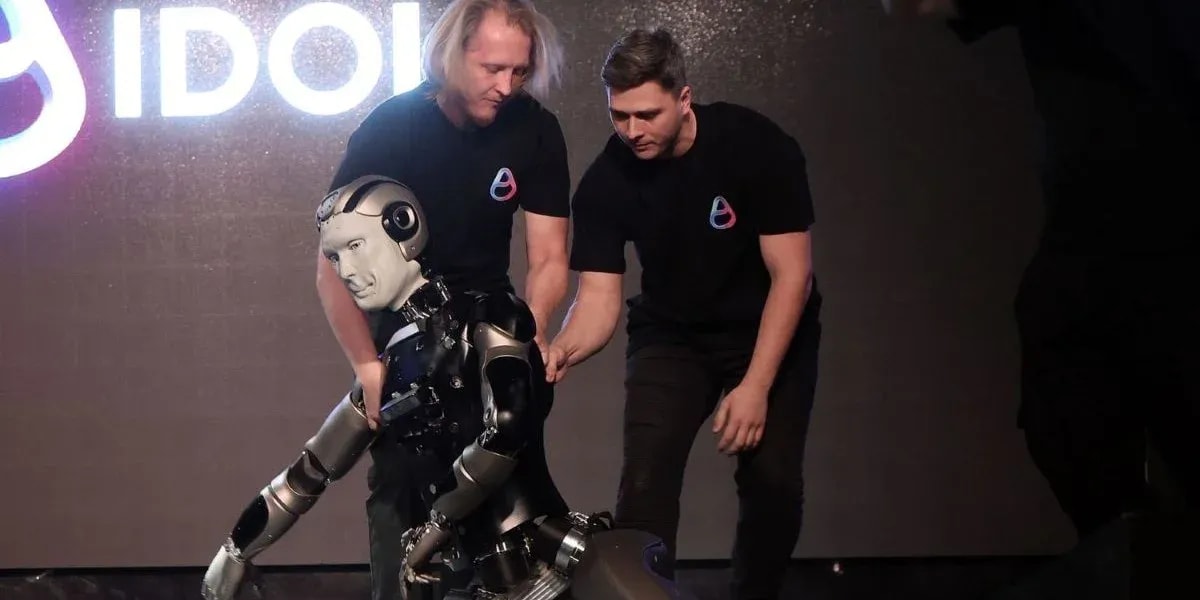
The robot, named AIDOL—short for Artificial Intelligence Doll—tumbled face-first just seconds after walking onto the stage at the Yarovit Hall Congress Center on November 11.
Video Source: New York Post
Video footage shows the machine, accompanied by two handlers, wobbling onto the stage to the triumphant theme song "Gonna Fly Now" from the 1976 film "Rocky." As the robot attempted to wave its right hand to the crowd of journalists and guests, it lost its balance and toppled forward, cutting the presentation short.
Event staff immediately rushed to shield the fallen robot from view using black curtains before carrying it off the stage.
According to reports from the Moscow News Agency, the incident occurred at a technology event organized by the New Technology Coalition, designed to showcase Russia's advances in domestically produced artificial intelligence and robotics.
CEO attributes the mishap to technical calibration issues
Vladimir Vitukhin, CEO of the Moscow-based startup Idol that developed AIDOL, explained that the fall resulted from calibration problems.
He told journalists that the robot's stereo cameras were overly sensitive to the lighting conditions in the hall, which was darker than anticipated.
Despite the embarrassing debut, Vitukhin maintained an optimistic stance about the incident.
"This is real-time learning, when a good mistake turns into knowledge, and a bad mistake turns into experience," he said during the presentation, according to multiple news outlets. "I hope that this mistake will turn into an experience."
The CEO insisted that AIDOL sustained no damage from the fall. The robot was later brought back onstage and managed to remain upright with assistance from handlers during a second appearance.
AIDOL's capabilities and specifications
According to its developers, AIDOL is designed to perform three main functions: walking on two legs, manipulating objects, and communicating with people.
The humanoid robot is powered by a 48-volt battery that provides up to six hours of autonomous operation, with all systems functioning offline.
The robot features 19 servomotors that enable it to display more than a dozen basic emotions and hundreds of micro-expressions through its flexible silicone skin, which is engineered to replicate human facial expressions.
"The robot can smile, think, and be surprised—just like a person," Vitukhin said during the presentation.
AIDOL is composed of 77 percent Russian-made components, a figure the company aims to increase to 93 percent when the robot enters mass production.
The developers envision deploying AIDOL in manufacturing, logistics, and public-service sectors, including banks and airports.
However, the company has not disclosed which specific AI system powers the robot or when mass production is expected to begin.
Russia's uphill battle in the global robotics competition
The mishap underscores the significant challenges Russia faces in competing with more established leaders in AI and robotics development, particularly the United States and China.
Russia's robotics sector has struggled considerably since the country's invasion of Ukraine, when major international manufacturers exited the Russian market in response to Western sanctions.
These sanctions have restricted Russia's access to advanced electronics, semiconductor components, and other critical technologies needed for robotics development.
Meanwhile, international competitors have made substantial advances. Boston Dynamics' Atlas robot can perform parkour and manipulate objects autonomously, while Chinese manufacturers have rapidly developed sophisticated humanoid robots. Tesla CEO Elon Musk recently stated that "Tesla and China companies will dominate the [robotics] market."
Journalist Dmitry Filonov noted that Alexey Yuzhakov, head of Russia's National Technological Coalition, had previously warned that AIDOL's developers had invested insufficient resources in improving the robot's walking capability.
President Vladimir Putin has long positioned artificial intelligence and robotics as critical to Russia's global standing and national security objectives.
The public debut of AIDOL represents Russia's attempt to demonstrate progress in this strategic technology sector despite the constraints imposed by international isolation.
The video of AIDOL's fall has since gone viral on social media platforms, drawing widespread attention and criticism on Russian tech forums about whether the country's robotics sector is ready to compete internationally.
Read more: