Key takeaways:
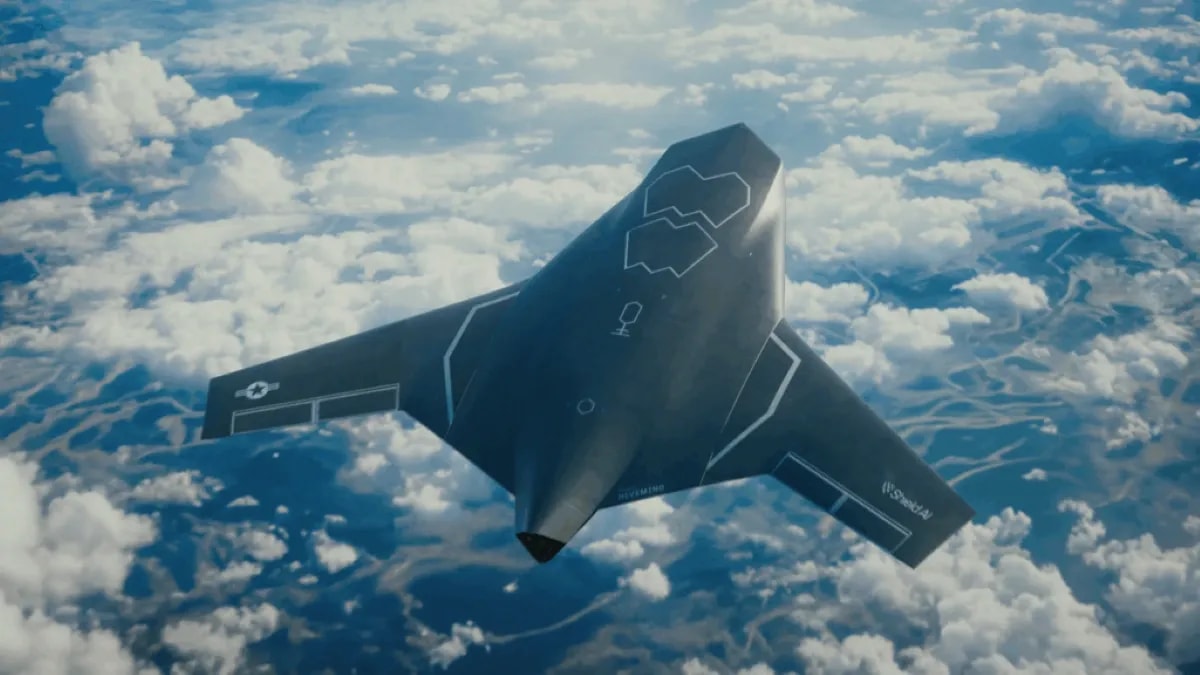
Defense technology startup Shield AI has introduced plans for the X-BAT, an autonomous fighter jet that combines artificial intelligence with vertical takeoff and landing capabilities, positioning the aircraft as a potential game-changer in military aviation.
The San Diego-based company revealed the unmanned aircraft during a private event in Washington, D.C., on Tuesday, showcasing its first foray into the fighter jet category.
The X-BAT represents a significant expansion for Shield AI, which has built its reputation developing autonomous software for military aircraft.
Breakthrough technology without runways
The X-BAT's defining feature is its ability to take off and land vertically while maintaining the performance characteristics of a traditional fighter jet.
The aircraft measures 26 feet in length with a 39-foot wingspan and is designed to operate from ships, remote islands, or improvised forward locations without conventional runway infrastructure.
Brandon Tseng, Shield AI president and co-founder, emphasized the unparalleled nature of the technology.
According to CNBC, he stated that while both AI-piloted aircraft and vertical takeoff capabilities have existed separately, "those two things — AI piloted and vertical takeoff launch and land — have never come together in the form of a next generation aircraft."
The aircraft features a fighter-class engine, either the GE Aerospace F110 or Pratt & Whitney F100 from the Air Force F-16, and incorporates thrust-vectoring technology. Shield AI says the X-BAT will have a range exceeding 2,000 nautical miles and can reach altitudes up to 50,000 feet.
Autonomous operations at scale
At the heart of the X-BAT is Shield AI's Hivemind software, which enables the aircraft to plan and execute missions autonomously without continuous human control.
The same AI system has already flown F-16s, various drones, and other aircraft platforms.
Gary Steele, Shield AI's CEO, told CNBC that the software is fundamental to the company's strategy. "The software is a cornerstone and foundation for everything we do," Steele said. "It will ultimately be the long-term growth driver of this business because it enables the development of this next-generation aircraft."
The aircraft can function either as a standalone platform or as a collaborative wingman alongside manned aircraft.
Armor Harris, senior vice president of aircraft at Shield AI, said in a press release that the X-BAT's "ability to autonomously operate standalone or collaboratively allows it to project power when other assets aren't around and simplifies kill chains."
Cost-effective alternative to traditional fighters
Shield AI projects the X-BAT will cost approximately $27 million per unit—a fraction of the price of advanced manned fighters.
The F-35, by comparison, exceeds $100 million per aircraft, making the autonomous option potentially attractive for military forces seeking to expand their air power capacity without corresponding increases in pilot risk or budget.
The company designed the aircraft with space efficiency in mind.
According to Shield AI's promotional materials, three X-BAT units can fit in the deck space occupied by a single traditional fighter or helicopter, potentially allowing aircraft carriers and other platforms to deploy larger numbers of autonomous aircraft.
Testing timeline and market competition
Shield AI spokesperson Lily Hinz confirmed the company plans to conduct initial vertical takeoff and landing tests by fall 2026, with comprehensive flight testing scheduled for 2028.
While Shield AI has not identified specific customers for the X-BAT, the company indicated that the aircraft integrates with current and future Air Force and Navy operational concepts.
The announcement positions Shield AI among several defense contractors developing autonomous vertical-takeoff aircraft.
Boeing and Lockheed Martin's Sikorsky unit both revealed their own unmanned VTOL platforms this month. Meanwhile, the Navy and Air Force are actively fielding Collaborative Combat Aircraft programs, with General Atomics recently selected by the Navy for conceptual design work.
Shield AI's track record includes notable achievements in autonomous flight technology.
In 2024, Air Force Secretary Frank Kendall flew in an X-62A VISTA aircraft piloted by Shield AI software during a simulated dogfight against a manned F-16.
The company has also deployed its smaller V-BAT reconnaissance drones with U.S. Marines and Ukrainian forces.
Founded in 2015, Shield AI has grown rapidly to reach a valuation of $5.3 billion following a $240 million funding round.
Read more: