Key takeaways
Italian luxury fashion house Valentino is facing intense public criticism after posting artificial intelligence-generated advertisements for its new DeVain handbag on Instagram.
The campaign, which the brand labeled as a "digital creative project" involving collaboration with digital artists, has been met with widespread disapproval from followers who view the use of AI as inappropriate for a high-end couture brand.
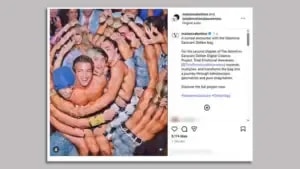
The Instagram post, published on Monday and clearly labeled as AI-generated content, features surreal imagery showing models spliced between Valentino logos and the DeVain bag.
In one sequence, models appear to emerge from an ornate gold version of the handbag. In another, the brand's logo transforms into human arms before morphing into a swirling mass of bodies.
The advertisement generated hundreds of critical comments from Instagram users who questioned why a luxury fashion house would resort to artificial intelligence for its marketing campaigns.
[caption id="attachment_33109" align="aligncenter" width="800"]
Image Source: BBC[/caption]
One user commented directly on the video: "Disappointing from a couture fashion house. Advertising campaigns are an opportunity to put talented creatives centre stage. AI in this instance is lazy at best."
Other commenters accused the brand's marketing department of failing to "read the room" regarding current sentiment around AI in creative industries.
Some likened the content to "AI slop" and accused the company of "rage-baiting" its audience. The BBC has approached Valentino for comment but has not yet received a response.
Industry expert weighs in on cultural tensions
Anne-Liese Prem, head of cultural insights and trends at creative digital agency Loop, told the BBC that while Valentino demonstrated "the right instinct" by transparently disclosing its use of generative AI, the backlash reveals significant underlying issues.
"The main issue is not the technology itself - it is the perception of what the technology replaces," Prem explained. "When AI enters the visual identity of a brand, people worry that the brand is choosing efficiency over artistry. Even if the execution is creative, audiences often read it as cost-saving disguised as innovation."
Broader concerns about AI in fashion
The controversy surrounding Valentino's campaign reflects growing unease within the fashion industry about the rapid adoption of AI tools.
The fashion sector, like many creative industries, has increasingly turned to generative AI technologies that can produce images and videos in seconds as a way to reduce production and promotional expenses.
However, this technological shift has raised serious concerns about the displacement of human workers and potential quality degradation in fashion products.
Swedish retailer H&M previously faced criticism for using AI to create "digital twins" of models for advertisements and social media posts, with concerns raised about the impact on human models, photographers, and makeup artists who traditionally play essential roles in photo shoots.
Earlier this year, an AI-generated model featured in a Guess advertisement in Vogue magazine sparked additional debate about AI's influence on female beauty standards and the replacement of real talent in fashion campaigns.
The fashion industry continues to grapple with balancing technological innovation against preserving the human artistry and craftsmanship that have traditionally defined luxury brands.
Read more:
California Prosecutors Admit Using Flawed AI In Criminal Filings
Bezos’s Project Prometheus acquires AI startup General Agents
Alibaba launches Quark AI glasses in China