Organizations worldwide are implementing AI solutions that extend beyond simple automation capabilities. Furthermore, traditional chatbots and rule-based systems cannot meet the complex demands of modern enterprises, requiring intelligent agents for collaborative decision-making and specialized task execution. Consequently, the best platforms for custom role-based AI agents 2025 are revolutionizing organizational workflows by enabling ai teams that mirror human organizational structures.
The AI agent market reached $5.4 billion in 2024 and is projected to grow at 45.8% annually through 2030, with role-based multi-agent systems driving much of this explosive growth. These sophisticated platforms allow businesses to create AI teams where each agent has distinct responsibilities, expertise areas, and collaboration patterns.
From customer service hierarchies to sales operations, role-based agents are transforming how enterprises approach automation, delivering efficiency and scalability across diverse industry applications.
1. Google Vertex AI + Gemini
Google's Vertex AI combined with Gemini represents a powerful enterprise solution for role-based AI agents. The platform offers deep integration with Google Cloud services and advanced multimodal capabilities. Furthermore, it excels in handling text, images, and voice inputs simultaneously, making it ideal for complex customer service scenarios where agents need to process multiple data types. Vertex AI's Agent Builder provides intuitive tools for creating specialized agents with defined roles and permissions.
Pros:
Native Google Cloud integration
Multimodal processing capabilities
Scalable infrastructure
Enterprise-grade security
Comprehensive MLOps tools
Cons:
Steep learning curve
Google ecosystem dependency
Higher costs for small businesses
Limited third-party integrations
Best Use Cases: Customer support with document analysis, healthcare diagnostics, financial document processing, and supply chain optimization with visual inspection.
2. OpenAI GPTs & API
OpenAI's GPT platform offers the most accessible entry point for role-based AI agents, featuring custom instructions, plugin capabilities, and robust enterprise controls. The platform's strength lies in its simplicity and powerful language understanding. Consequently, organizations can quickly deploy specialized agents for various business functions. Custom GPTs can be configured with specific roles, knowledge bases, and behavioral guidelines.
Pros:
Easy implementation process
Extensive documentation available
Strong community support
Flexible pricing models
Excellent language capabilities
Cons:
Limited multimodal features
API rate limits
Potential data privacy concerns
Dependency on OpenAI infrastructure
Best Use Cases: Content creation teams, customer service automation, internal knowledge management, sales support, educational applications.
3. Microsoft Copilot Studio
Microsoft's solution combines Copilot Studio with Azure OpenAI services, providing seamless integration with the Microsoft 365 ecosystem. Additionally, enterprise-grade security features make it ideal for organizations already using Microsoft tools. The platform excels in creating role-based agents that work within familiar Microsoft environments, offering natural integration with Teams, SharePoint, and Office applications.
Pros:
Deep Microsoft 365 integration
Enterprise security features
Familiar user interface
Comprehensive compliance standards
Hybrid cloud deployment
Cons:
Microsoft ecosystem lock-in
Complex licensing structure
Limited customization options
Higher enterprise costs
Best Use Cases: Office productivity automation, HR workflow management, document processing, team collaboration enhancement.
4. Anthropic Claude & Workflows
Anthropic's Claude platform emphasizes safety-first design with constitutional AI principles. This makes it ideal for organizations requiring reliable, ethical AI agents. Furthermore, the platform's workflow capabilities enable sophisticated multi-agent coordination while maintaining strict safety guardrails and transparent decision-making processes.
Pros:
Safety-first design approach
Constitutional AI principles
Transparent decision making
Excellent reasoning capabilities
Strong ethical guardrails
Cons:
Best Use Cases: Legal document review, compliance monitoring, ethical decision support, risk assessment, sensitive data processing.
5. LangChain + LangGraph
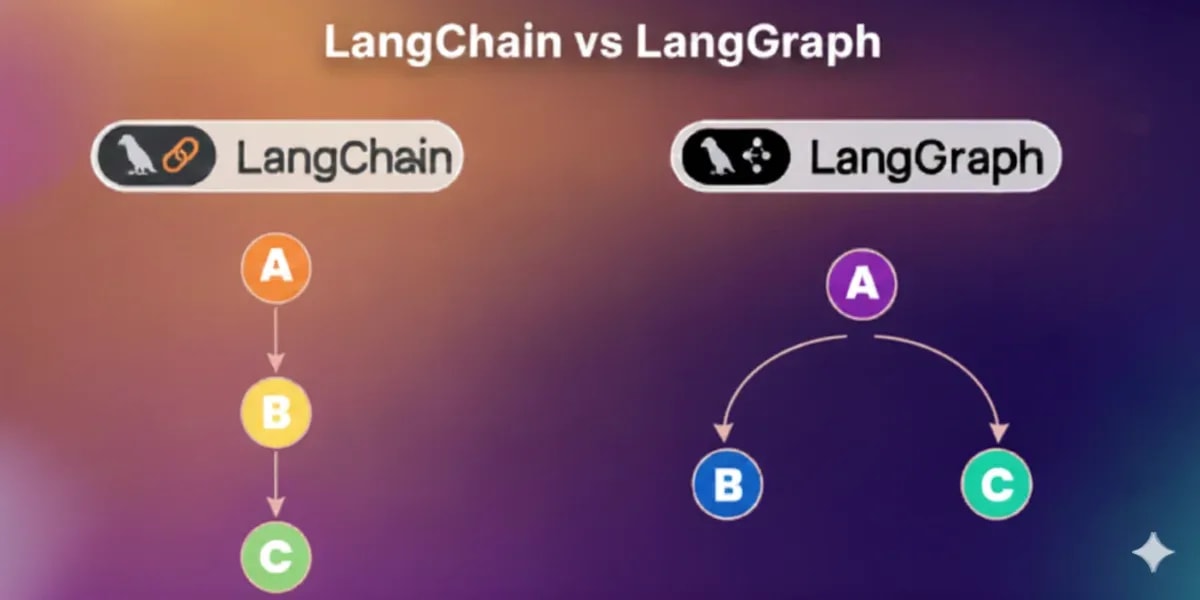
LangChain with LangGraph provides the most flexible open-source solution for building role-based AI agents. Additionally, it offers extensive customization options and programmatic control over agent behavior. The platform excels in creating complex multi-agent workflows with sophisticated orchestration patterns and seamless integration with various LLM providers.
Pros:
Open-source flexibility
Extensive customization options
Multiple LLM provider support
Strong developer community
Cost-effective solution
Cons:
Best Use Cases: Custom enterprise solutions, research applications, complex workflow automation, specialized industry requirements.
6. CrewAI Framework
CrewAI specializes in creating collaborative AI agent teams with role-based architectures that mirror human organizational structures. The platform enables seamless coordination between agents with different specializations. Therefore, it's ideal for complex business processes requiring multiple expertise areas.
Pros:
Role-based team structures
Collaborative agent workflows
Simple implementation process
Strong multi-agent coordination
Active development community
Cons:
Best Use Cases: Content marketing teams, research coordination, customer service hierarchies, sales process automation.
7. Amazon Bedrock Agents
Amazon Bedrock provides access to multiple foundation models through a unified interface. Organizations can build role-based agents that leverage different AI providers. Moreover, the platform offers excellent integration with AWS services and provides robust security and compliance features for enterprise deployments.
Pros:
Cons:
Best Use Cases: Multi-cloud environments, enterprise data processing, scalable automation workflows, AWS-native applications.
Lindy offers a no-code approach to building role-based AI agents with extensive integration capabilities. The platform features user-friendly visual builders and excels in business automation scenarios. Subsequently, non-technical users can create sophisticated agent workflows quickly and efficiently.
Pros:
Cons:
Limited customization depth
Higher pricing for features
Newer platform ecosystem
Basic enterprise controls
Best Use Cases: Business process automation, customer relationship management, marketing workflow automation, sales support systems.
What are role-based AI agents?
Role-based AI agents are like having a team of AI specialists working together, where each AI has a specific job to do. Think of it as hiring different experts, one AI handles customer service, another manages data analysis, and another focuses on scheduling.
Instead of one AI trying to do everything poorly, you get multiple AIs that are really good at their specific tasks. They can work together on projects, just like human teams do. For example, when processing a customer order, the sales AI captures the request, the inventory AI checks stock levels, and the shipping AI arranges delivery.
This approach means businesses can automate complex workflows while keeping everything organized and secure. Each AI agent only has access to what it needs for its role, making the system more reliable and easier to manage than traditional one-size-fits-all AI solutions.
Essential features of role-based AI systems
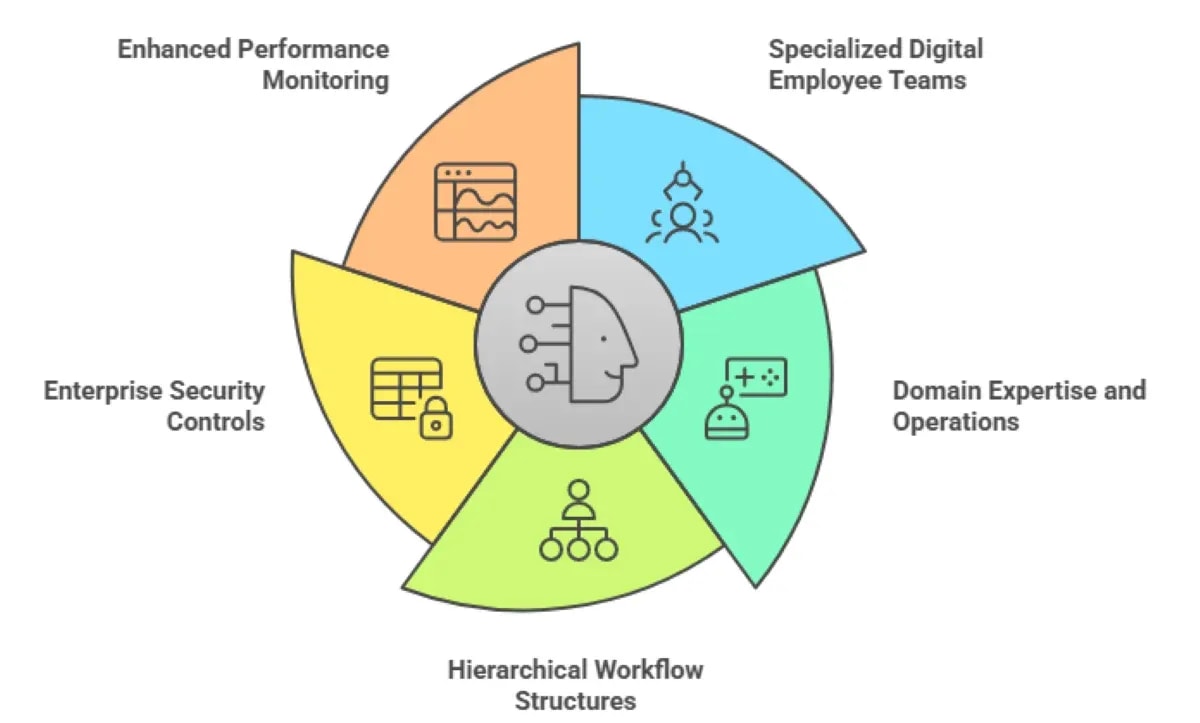
Modern role-based AI platforms incorporate specialized capabilities that distinguish them from traditional automation tools, offering structured collaboration, domain-specific expertise, and enterprise-grade security for comprehensive organizational transformation.
Specialized digital employee teams
Role-based AI agents function as specialized digital employees, each assigned specific duties, decision-making authority, and collaborative responsibilities within larger organizational workflows. Moreover, this approach enhances operational efficiency and streamlines business processes through targeted specialization.
Domain expertise and operations
Specialized agents develop deep expertise in assigned domains, delivering more accurate results than generalist AI while maintaining consistency across operations. Subsequently, this enables seamless scaling opportunities for growing businesses seeking enhanced automation capabilities.
Hierarchical workflow structures
Organizations can dynamically add new agent roles or expand existing teams without disrupting current workflows. This creates flexible systems that adapt to business growth and increasing operational complexity through structured agent coordination.
Enterprise security controls
Each agent operates within predefined access levels and capabilities, ensuring sensitive data protection while maintaining operational efficiency. These granular permission controls and comprehensive compliance frameworks provide essential security measures for enterprise environments.
Role-based architectures enable precise tracking of agent actions and decisions, facilitating comprehensive audit trails. Additionally, performance optimization across all organizational levels and critical business functions ensures transparency and accountability.
Selecting optimal platforms requires assessment of technical capabilities, integration potential, and security features. Therefore, organizations must evaluate alignment with specific needs and long-term strategic objectives for successful implementation.
Multi-agent architecture management
Platforms must support complex organizational structures with clear role definitions and hierarchical relationships. Furthermore, sophisticated inter-agent communication protocols enable effective collaboration and workflow orchestration across business departments.
No-code development capabilities
Modern platforms offer intuitive drag-and-drop interfaces, pre-built templates, and visual workflow designers. Consequently, non-technical teams can create sophisticated agents without programming expertise or technical dependencies.
AI model integration
Top platforms support multiple language models and enable custom fine-tuning for specific domains. Additionally, seamless switching between AI providers allows optimal performance and cost-effectiveness for diverse business requirements.
Enterprise integration connectivity
Effective platforms provide robust coordination mechanisms, enabling agents to share information and delegate tasks. Moreover, complex multi-step workflows execute collaboratively across existing systems and enterprise applications.
Security and compliance
Enterprise-grade platforms ensure comprehensive compliance with industry regulations while providing granular access controls. Subsequently, data protection mechanisms safeguard sensitive operations and regulatory requirements across industries.
Thorough evaluation frameworks help organizations assess platforms across multiple dimensions including pricing models, feature sets, integration capabilities, and industry-specific requirements for informed strategic decision-making.
Feature comparison matrix
Detailed feature matrices enable direct comparison of platform capabilities, including agent types, orchestration features, and integration options. Furthermore, this comparison across leading solutions supports informed decision-making and strategic planning for organizations evaluating different platforms.
Pricing models comparison
Understanding different pricing structures from credit-based systems to enterprise subscriptions helps organizations budget effectively. Additionally, this includes agent deployment, scaling, and long-term operational costs across business units for comprehensive financial planning.
Each platform offers unique strengths, whether in ease of use, technical flexibility, or industry focus. These specific capabilities set them apart from competitors in the marketplace and help organizations choose the most suitable solution.
Industry-specific recommendations
Platform recommendations vary significantly by industry based on specific compliance requirements and integration needs. Moreover, typical workflow patterns within different business sectors influence the optimal platform choice for each organization.
Evaluation includes platform performance under various loads, scaling capabilities, and reliability metrics. These factors are crucial for enterprise deployment, long-term success, and operational sustainability across growing organizations.
Real-world use cases of role-based AI agents
Real-world implementation examples demonstrate how organizations successfully deploy role-based agents across different business functions. Additionally, these scenarios showcase operational applications and industry-specific use cases for measurable results and competitive advantages.
Customer service teams
Hierarchical customer service implementations feature lead agents for initial triage and specialist agents for technical issues. Furthermore, escalation agents handle complex problems requiring human intervention or specialized expertise, creating efficient support structures.
Sales pipeline management
Sales teams deploy specialized agents for lead generation, qualification processes, and proposal development. Additionally, closing support agents optimize conversion rates and revenue generation across all sales activities through coordinated workflows.
Marketing content automation
Marketing departments utilize agent teams for content research, writing, and SEO optimization. Moreover, social media management agents maintain consistent brand messaging across channels and maximize engagement through coordinated campaigns.
Development code workflows
Technical implementation examples demonstrate how to configure role-based agents using popular frameworks. This includes setup, configuration, deployment patterns, and maintenance procedures for development teams seeking efficient automation solutions.
Multi-agent workflow orchestration
Advanced examples show how multiple agents coordinate across complex workflows, sharing information and delegating tasks. Subsequently, this achieves sophisticated business objectives and measurable outcomes efficiently through collaborative automation.
Best practices for industry-specific AI agent deployment
Different industries have unique requirements for AI agent deployment, including regulatory compliance and data sensitivity. Furthermore, specialized workflow patterns and specific operational challenges require tailored approaches and solutions for successful implementation.
Healthcare implementation standards
Healthcare organizations must ensure agents meet strict privacy regulations while handling sensitive patient data. Additionally, maintaining detailed audit trails for regulatory compliance and patient safety requires specialized healthcare AI chatbot solutions designed for medical environments.
Financial services requirements
Financial institutions require agents capable of handling complex risk assessments and regulatory compliance. Moreover, detailed reporting for multiple oversight bodies and auditing requirements across operations demands robust security and compliance frameworks.
Manufacturing process optimization
Manufacturing environments benefit from agents that coordinate supply chains and predict equipment failures. Additionally, optimizing production schedules across multiple facilities and operational centers enhances efficiency through coordinated automation systems.
Government security standards
Government agencies need agents that operate within security frameworks while maintaining transparency requirements. Furthermore, handling classified information appropriately and securely across sensitive operations requires specialized compliance measures and security protocols.
Emerging trends in role-based AI agents
The AI agent landscape continues evolving rapidly with new capabilities and integration patterns. Additionally, deployment models and technological advances emerging throughout 2025 and beyond enhance functionality for diverse business applications.
Advanced collaboration patterns
Advanced coordination mechanisms enable more sophisticated agent interactions, including consensus building and competitive scenarios. Moreover, hierarchical decision-making processes support complex organizational structures and business requirements through enhanced collaboration frameworks.
Multimodal agent integration
Next-generation agents integrate voice, visual, and text capabilities for more natural interactions. Subsequently, expanded use cases across different communication channels and user interfaces improve experiences through comprehensive multimodal support.
The market shows increasing tension between flexible open-source solutions and feature-rich proprietary platforms. Each offers distinct advantages for different organizational needs and technical requirements, creating diverse options for implementation.
Modern platforms prioritize seamless integration with existing enterprise software including CRMs, ERPs, and productivity suites. This enables comprehensive workflow automation and operational efficiency across departments through coordinated system integration.
Enhanced security frameworks
Enhanced security features include advanced authentication, audit trails, and governance tools. These meet evolving enterprise and regulatory requirements for data protection and compliance management across diverse industry sectors.
Roadmap to successful AI agent deployment
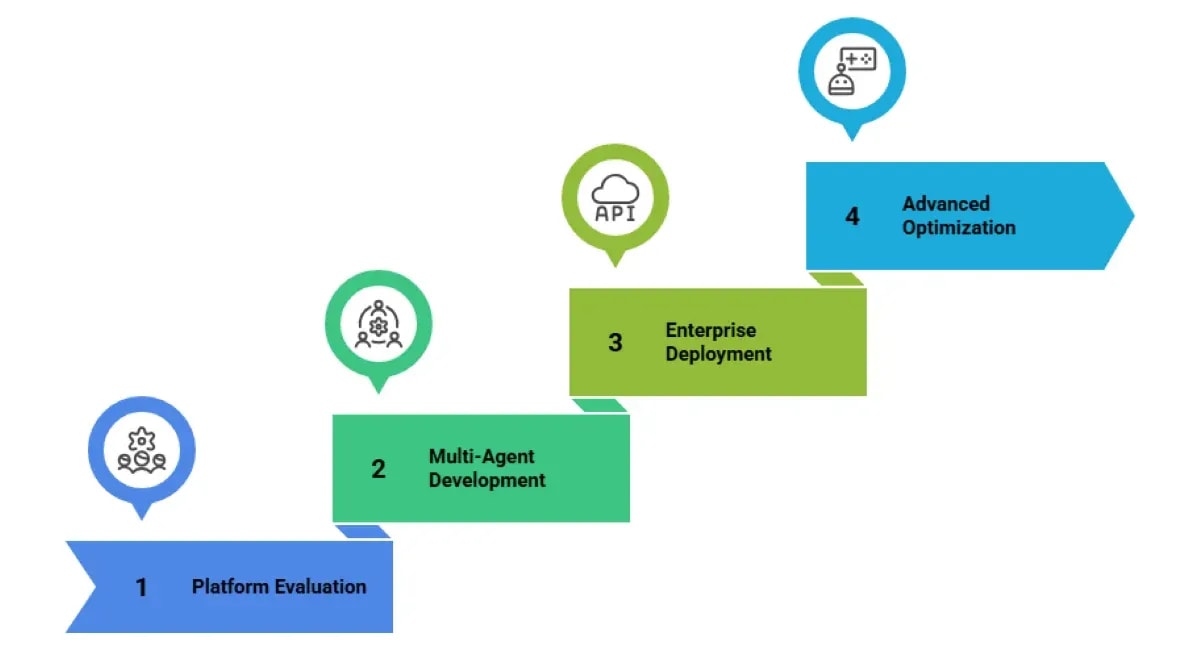
Successful agent deployment requires structured planning from initial pilot projects through full-scale enterprise implementation. Additionally, ongoing optimization and continuous improvement ensure long-term success and value realization for organizations investing in AI agent technology.
Initial implementation focuses on platform evaluation, pilot agent development, and proof-of-concept validation. This establishes technical feasibility and demonstrates measurable business value for stakeholders considering AI agent adoption.
Phase 2: Multi-agent development
Expansion phase involves creating specialized agent roles and establishing communication patterns. Furthermore, developing collaborative workflows for specific business functions and operational requirements across departments ensures coordinated automation implementation.
Phase 3: Enterprise deployment
Full deployment includes integration with enterprise systems, comprehensive user training, and performance monitoring. Additionally, scaling across multiple departments and diverse use cases supports organizational transformation through widespread AI agent adoption.
Phase 4: Advanced optimization
Mature implementations focus on optimizing agent interactions and implementing advanced orchestration patterns. Moreover, continuous improvement of agent performance, capabilities, and operational efficiency provides a competitive advantage through refined automation systems.
Should you build or buy AI agents
Organizations must evaluate their technical capabilities, resource availability, and strategic objectives. This evaluation determines whether to pursue internal development, platform adoption, or expert partnerships for optimal outcomes and success in AI agent implementation.
Internal development scenarios
Organizations with strong AI expertise and specific requirements may benefit from custom development. This approach works when existing platforms cannot meet unique needs or operational constraints effectively, requiring specialized solutions.
Standard business requirements and limited technical resources often favor platform-based solutions. These accelerate time-to-value and reduce development complexity and resource requirements for organizations seeking efficient implementation.
Expert partnership value
Large-scale implementations with complex integration needs benefit from specialized partner expertise. Organizations with regulatory requirements or limited internal expertise gain from proven methodologies for successful deployments and ongoing support.
Risk assessment strategies
Each approach carries distinct risks including technical debt, vendor lock-in, and implementation challenges. Therefore, careful evaluation and comprehensive mitigation planning ensures long-term success and sustainable AI agent operations.
Total ownership analysis
Comprehensive cost analysis includes platform fees, development resources, and ongoing maintenance costs. Additionally, scaling expenses across multi-year implementation horizons support accurate budget planning and financial forecasting for AI agent investments.
Why choose Folio3 AI for AI agent development services?
Organizations benefit from comprehensive expertise across all major platforms while ensuring successful implementation. Professional services align with specific organizational needs, compliance requirements, and long-term strategic objectives for optimal results and measurable business outcomes.
Comprehensive AI agent development services
We build AI agents using advanced platforms like AutoGen, LangChain & CrewAI powered by GPT-4, Claude, and other leading LLMs that are tailored to fit your business needs and operational requirements for maximum effectiveness through custom AI development services.
AI agent strategy & roadmapping
Unlock new efficiencies with a clear AI adoption strategy. We assess your business, recommend the right agents, and define a roadmap for scalable implementation across your organization ensuring strategic alignment and successful deployment.
Custom AI agent development
Build intelligent agents that adapt to your workflows, designed with flexibility, performance, and real-time decision-making in mind for enhanced operational efficiency and competitive advantage through specialized development.
AI agent integration services
Seamlessly plug AI agents into your tech stack. We ensure smooth data exchange, compatibility, and security across all platforms while maintaining existing operational workflows and enhancing automation capabilities.
Maintenance & optimization support
From updates to continuous tuning, we ensure your agents remain high-performing and aligned with your evolving needs through comprehensive monitoring and optimization services that provide ongoing value enhancement.
Frequently asked questions
1. What is a role-based AI agent?
A role-based AI agent is a specialized AI system assigned specific responsibilities, permissions, and expertise areas within a larger multi-agent team. This enables collaborative automation that mirrors human organizational structures for enhanced efficiency.
2. How do role-based agents differ from traditional chatbots?
Unlike traditional chatbots that operate independently, role-based agents work in teams with defined roles. They can delegate tasks, share information, and collaborate on complex workflows requiring multiple expertise areas for comprehensive automation.
Top platforms include Google Vertex AI for enterprise multimodal capabilities, OpenAI GPTs for accessibility, Microsoft Copilot Studio for enterprise integration, and LangChain for open-source flexibility depending on specific requirements.
4. How does Google Vertex AI support role-based agent development?
Google Vertex AI provides Agent Builder tools, multimodal processing capabilities, and role-based permissions. Additionally, seamless integration with Google Cloud services enables enterprise-grade agent deployment with comprehensive management features.
Key factors include multi-agent orchestration capabilities, security and compliance features, and integration options. Furthermore, pricing models, technical requirements, and alignment with existing technology infrastructure influence platform selection decisions.
6. Can multiple AI agents collaborate across different roles?
Yes, modern platforms enable sophisticated multi-agent collaboration through message passing and task delegation. Additionally, hierarchical structures and shared workflows mirror human team dynamics for effective collaborative automation.
7. What industries benefit most from custom role-based AI agents?
Healthcare, financial services, manufacturing, customer service, sales, and marketing sectors benefit significantly. Government organizations also gain from complex workflows requiring specialized expertise and regulatory compliance through targeted AI agent implementation.
8. How do security and compliance work with enterprise AI agents?
Enterprise platforms provide role-based access controls, audit trails, and data encryption. Additionally, regulatory compliance features (HIPAA, SOC2, GDPR) and granular permissions ensure secure operations for sensitive business processes.
9. What are the cost considerations for deploying custom AI agents?
Costs include platform licensing, development resources, integration efforts, and ongoing maintenance expenses. Additionally, training and scaling costs vary significantly based on complexity and deployment scope, requiring careful financial planning.
10. Why partner with professional AI development services?
Professional services offer platform-agnostic expertise, enterprise compliance specialization, and end-to-end delivery. Moreover, proven success stories and long-term partnership services ensure optimal implementation outcomes and continued success for AI agent deployments.