Industrial inspections have undergone a massive transformation over the past decades. Previously, maintenance teams scaled dangerous infrastructure or relied on costly helicopter surveys. However, with the introduction of BVLOS 2025 drone regulations, they now have access to revolutionary technology that promises safer, faster, and more cost-effective solutions.
Furthermore, the drone industry reached a pivotal moment in August 2025 when the FAA published its comprehensive Part 108 Notice of Proposed Rulemaking, establishing the framework for routine Beyond Visual Line of Sight (BVLOS) operations.
This 647-page regulatory breakthrough eliminates the need for individual waivers that previously limited commercial drone applications. Additionally, FAA Part 108 BVLOS regulations 2025 represent more than policy updates; they signal the beginning of the autonomous industrial inspection era.
Moreover, companies can now deploy drones across vast infrastructure networks, from transmission lines spanning hundreds of miles to remote pipeline systems, fundamentally changing how critical assets are monitored and maintained.
What are BVLOS drone operations?
Beyond Visual Line of Sight (BVLOS) drone operations allow unmanned aircraft to fly beyond the pilot's direct visual contact, enabling autonomous flights over vast distances. Unlike traditional drone operations requiring constant visual monitoring, BVLOS uses advanced technology, including GPS navigation, automated flight planning, and real-time communication systems. This revolutionary capability transforms industries by enabling large-scale infrastructure inspections, long-distance deliveries, and comprehensive surveillance missions previously impossible with standard drone operations.
Three operation types
Modern drone operations are classified into three distinct categories based on pilot visibility and operational range, each offering different capabilities and regulatory requirements.
Visual Line of Sight (VLOS)
Standard drone operations require pilots to maintain direct visual contact with the aircraft at all times. The maximum range is typically limited to 500 meters with clear weather conditions.
Extended Visual Line of Sight (EVLOS)
Operations using trained visual observers positioned strategically to extend operational range beyond the pilot's direct sight. Enables coverage of larger areas while maintaining human oversight.
Beyond Visual Line of Sight (BVLOS)
Fully autonomous operations where drones fly beyond any human visual contact, using advanced navigation systems, automated collision avoidance, and real-time data transmission for remote monitoring.
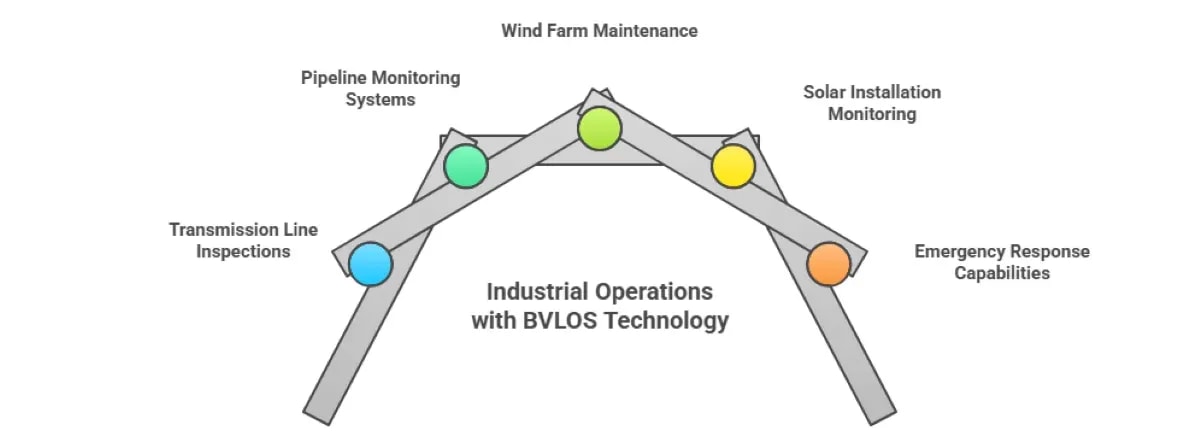
Why does BVLOS matter for industrial assets?
BVLOS technology addresses critical challenges in industrial infrastructure management, offering unparalleled capabilities for monitoring vast, remote, and dangerous operational environments across multiple sectors.
Transmission line inspections
Power companies manage thousands of miles of transmission lines across remote terrain. BVLOS drones provide comprehensive inspections without endangering personnel or requiring expensive helicopter surveys.
Pipeline monitoring systems
Oil and gas pipeline networks span continents through inaccessible areas. Autonomous drones detect leaks, corrosion, and unauthorized activities while reducing inspection costs by 60%.
Wind farm maintenance
Offshore and remote wind installations require regular turbine blade inspections. BVLOS operations eliminate weather-dependent helicopter access and reduce maintenance downtime significantly.
Solar installation monitoring
Large-scale solar farms covering thousands of acres need continuous performance monitoring. Thermal imaging drones identify panel defects and efficiency issues without manual ground inspections.
Emergency response capabilities
Natural disasters and emergencies require rapid assessment across large areas. BVLOS drones provide real-time situational awareness for first responders and disaster management teams.
FAA Part 108 regulatory changes
The path to routine BVLOS operations required years of persistent industry advocacy, regulatory development, and sustained political momentum. Consequently, this overcame entrenched bureaucratic obstacles and established standardized operational frameworks for commercial drone deployments.
Trump administration milestone: June 2025 executive order
The Trump administration strategically advanced BVLOS rules through Executive Order 14307, signed June 6, 2025, titled "Unleashing American Drone Dominance." This executive order signaled renewed federal commitment and priority focus after years of frustrating regulatory delays and industry stagnation.
August 2025 breakthrough: FAA Part 108 NPRM publication
FAA released the comprehensive 647-page Part 108 framework establishing specific technical requirements for aircraft specifications. Moreover, detailed operational limits, safety protocols, and compliance procedures for nationwide commercial drone operations and industrial applications were included.
Current waiver system limitations and industry frustration
Individual waiver applications created operational bottlenecks, requiring months for regulatory approval. Meanwhile, international competitors in countries like China deployed advanced BVLOS operations at a commercial scale, threatening American competitiveness.
Part 108 implementation timeline ahead
Industry stakeholders have a critical opportunity to influence final regulations through public comments before implementation. Additionally, final rules are expected by February 2026, creating an immediate need for strategic preparation and compliance planning.
Part 108 technical requirements and specifications
Part 108 establishes specific technical and operational requirements that fundamentally reshape how commercial drones operate in American airspace systems. Furthermore, this creates standardized pathways for routine BVLOS operations across multiple industry sectors and applications.
Aircraft specifications
Drones up to 1,320 pounds with wingspans under 25 feet and ground speeds up to 87 knots qualify for Part 108 operations. Notably, this covers most commercial and industrial aircraft currently deployed nationwide.
Operational limits
Operations must remain below 400 feet above ground level, primarily in uncontrolled airspace. Additionally, specific provisions for controlled airspace coordination through air traffic control and established safety protocols for manned aircraft interaction are included.
Airworthiness revolution
Manufacturers submit compliance declarations using established industry standards rather than obtaining traditional FAA type certificates. Consequently, this significantly accelerates market entry while maintaining rigorous safety standards and operational reliability requirements for commercial deployments.
Right-of-way rules and ADS-B requirements
Drones must yield right-of-way to manned aircraft unless operating in designated shielded environments. Furthermore, mandatory Automatic Dependent Surveillance-Broadcast In systems are required for cooperative traffic detection and collision avoidance protocols.
Population density categories for operational areas
Part 108 defines operational permissions based on population density classifications. Moreover, this establishes different safety requirements for sparse, moderate, and densely populated regions, affecting where and how BVLOS operations can be conducted legally.
US and Canadian drone regulations 2025
North American regulatory alignment creates opportunities for cross-border BVLOS operations. Additionally, this establishes the world's most advanced commercial drone framework and enables seamless operational coordination between the United States and Canadian airspace systems for enterprises.
United States: Part 108 framework and industry feedback
Commercial Drone Alliance stakeholder summits reveal persistent industry concerns about altitude restrictions, population density categories, and equipment requirements for practical implementation. Furthermore, this highlights the need for continued regulatory refinement and industry collaboration.
Canada's breakthrough: Transport Canada November 2025 framework
Transport Canada implements new BVLOS regulations on November 4, 2025, eliminating Special Flight Operations Certificates for routine BVLOS operations under 330 pounds in sparsely populated areas. Consequently, this creates streamlined approval processes and operational flexibility for commercial operators.
BVLOS industrial applications and case studies
Leading enterprises demonstrate BVLOS operations' transformative potential through successful deployments across energy, infrastructure, construction, and emergency response sectors. Moreover, this proves commercial viability and establishes best practices for industry-wide adoption and implementation.
Energy sector success stories
Southern Company earned a historic FAA Part 91 BVLOS waiver for critical infrastructure inspection operations, becoming the first utility approved for such operations. Meanwhile, PG&E implemented comprehensive automated compliance systems for extensive transmission networks, demonstrating measurable operational efficiency and cost reduction benefits.
Oil & gas innovations
Chevron deployed Percepto's advanced drone-in-a-box solutions across West Texas and Colorado facilities for autonomous inspections. Additionally, revolutionary nested drone systems enable continuous pipeline monitoring operations without traditional battery limitations or personnel requirements.
Construction & infrastructure applications
Norway's Lillestrøm municipality conducted the world's first 5G-enabled remote construction inspection operation. Furthermore, this demonstrated real-time streaming capabilities for project management, quality control, and safety monitoring across large-scale development projects and infrastructure installations.
Emergency response applications
BVLOS drones provide rapid disaster assessment capabilities, coordinated search and rescue operations, and comprehensive fire detection across vast wilderness areas during critical response situations. Consequently, this significantly improves response times and personnel safety.
Drone solar panel inspection solution delivered by Folio3 AI
Folio3 AI developed an advanced anomaly detection system for a European visual inspection company, processing thermal images from solar panel farms with over 90% accuracy through customized machine learning algorithms.
Client background
European visual inspection company specializing in wind turbines, solar PV, transmission lines, rooftop and building inspections. Required AI partner for automated anomaly detection system.
Project challenge
Client needed AI application to detect anomalies in solar panel farm images uploaded to their customer portal. Required solution for efficient analysis and reporting capabilities.
Technical solution
Folio3 AI built custom AI-powered application processing thermal images through fine-tuned machine learning models. Integrated seamlessly with existing client portal for automated anomaly detection.
Key features delivered
Customized AI Model: Fine-tuned algorithm trained on client-specific data for accurate anomaly detection and precise thermal image analysis
AI Anomaly Detection: Automated identification of diode failures and hotspot anomalies in uploaded solar panel thermal images
Overlapping Image Exclusion: Smart filtering system removes duplicate images captured from different drone positions for accurate counting
Boundary Detection: Advanced algorithm excludes images outside solar panel boundaries to maintain detection accuracy regardless of environmental factors
Real-time Processing: Instant analysis and reporting capabilities integrated directly into client's existing customer portal system
Project results
We have successfully deployed the solution, achieving 90% model accuracy on client platform. Also, we have completed a 6-week project using machine learning, computer vision, and deep learning technologies with a 4-member team.
BVLOS technology requirements and challenges
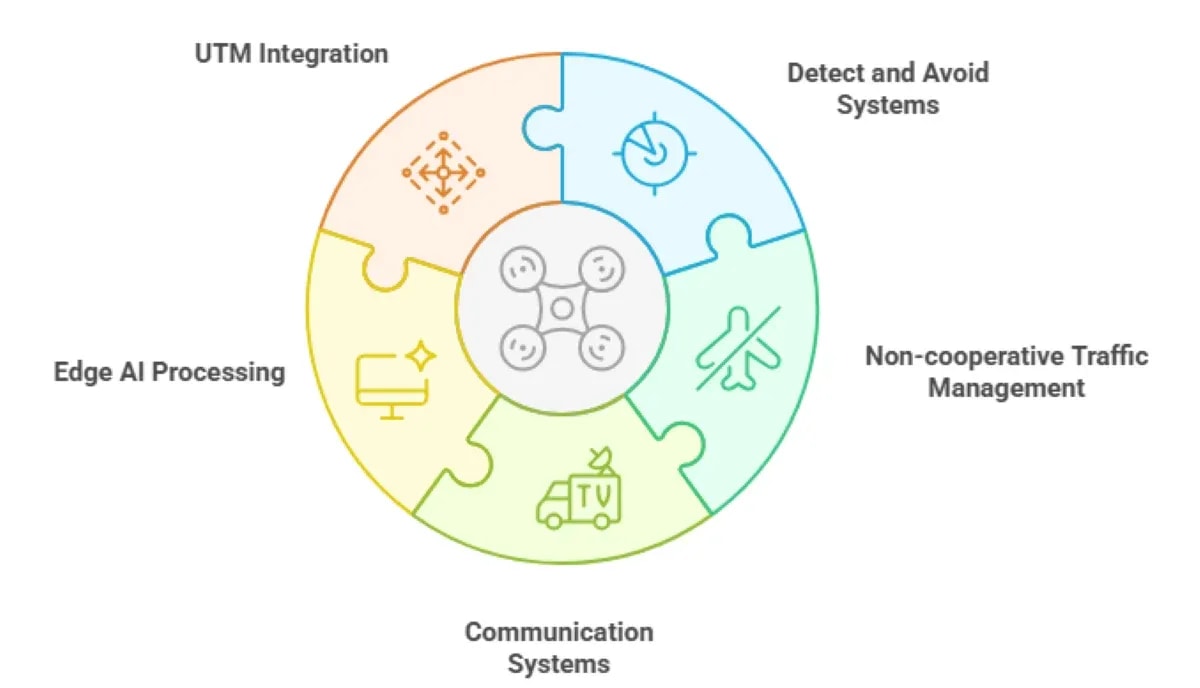
The technical complexity of BVLOS operations requires sophisticated systems integration, addressing detection limitations, communication requirements, and airspace management coordination. Furthermore, ensuring safety, reliability, and regulatory compliance across diverse operational environments and challenging conditions remains essential.
Detect and avoid system limitations
Current DAA systems provide forward-facing detection capabilities but lack comprehensive 360-degree coverage. Therefore, this creates vulnerability gaps for aircraft approaching from above or sides, requiring continued technological development and enhanced sensor integration solutions.
Non-cooperative traffic management challenges
Managing aircraft without ADS-B equipment remains technologically challenging and operationally complex. Additionally, radar-based solutions prove expensive and difficult to implement effectively across diverse operational environments and varying terrain conditions.
Communication systems for BVLOS operations
Robust multilink communication platforms ensure uninterrupted video transmission and reliable drone control from command centers located miles from operational areas. Moreover, this requires redundant systems and advanced networking capabilities for mission-critical applications.
Edge AI processing capabilities
Onboard modules like Manifold 3 enable real-time decision-making, sophisticated object detection, and autonomous mission execution without constant ground control intervention. Furthermore, this reduces bandwidth requirements and improves operational reliability and response times.
UTM integration and service suppliers
Unmanned Traffic Management systems coordinate with specialized UAS Service Suppliers to provide comprehensive airspace deconfliction, surveillance capabilities, and operational support services. Additionally, this ensures safe integration with existing air traffic management infrastructure.
BVLOS enterprise preparation strategy
Strategic preparation ensures organizations maximize Part 108 opportunities while maintaining compliance, safety standards, and competitive advantages in emerging markets. Furthermore, this requires comprehensive planning, resource allocation, and stakeholder coordination across multiple organizational departments and operational functions.
Participate actively in public comment periods, systematically identify low-risk operational scenarios for early approval consideration, and begin comprehensive fleet transition planning for compliance requirements. Additionally, this includes equipment upgrades and personnel training programs.
Comprehensive compliance checklist
Evaluate existing equipment specifications against Part 108 requirements, establish pilot certification pathways and training programs, and secure appropriate insurance coverage for expanded operations. Moreover, develop detailed operational procedures meeting new regulatory standards.
Data governance and industry engagement
Implement robust cybersecurity protocols and data protection systems, and establish comprehensive privacy frameworks for collected information. Furthermore, engage actively with the Commercial Drone Alliance and industry stakeholders for regulatory influence and best practices.
AI automation in BVLOS compliance
Artificial intelligence transforms BVLOS operations from manual processes into autonomous systems. Additionally, this ensures regulatory compliance while maximizing operational efficiency and safety through advanced algorithms, machine learning capabilities, and real-time decision-making systems for enhanced performance.
Automated flight planning and risk mitigation
AI algorithms analyze weather patterns, airspace restrictions, and terrain data to optimize flight paths. Furthermore, this minimizes operational risks and ensures regulatory compliance while maximizing mission efficiency and reducing human error in planning processes.
Real-time obstacle detection systems
Computer vision and sensor fusion technologies provide continuous environmental awareness. Moreover, this enables autonomous navigation around unexpected obstacles and hazards while maintaining safe distances from structures, terrain features, and other aircraft in operational airspace.
Predictive maintenance and fleet management
Machine learning systems monitor aircraft health parameters, predict maintenance needs based on usage patterns, and track compliance documentation across entire drone fleets automatically. Consequently, this reduces downtime and ensures regulatory adherence through proactive maintenance.
Autonomous inspection workflows
AI-powered systems identify defects, anomalies, and maintenance issues without human intervention. Additionally, this generates detailed reports and actionable recommendations while maintaining consistent quality standards and reducing inspection time and operational costs significantly.
Multi-sensor integration capabilities
Advanced platforms combine thermal, visual, and LiDAR data streams with IoT sensors and smart-city infrastructure for comprehensive situational awareness. Furthermore, this enables complex decision-making and enhanced operational capabilities across diverse industrial applications and environments.
Folio3 AI drone solutions for BVLOS operations
Folio3 AI delivers comprehensive BVLOS-ready solutions that integrate advanced artificial intelligence with regulatory compliance requirements. Moreover, this ensures seamless transition to autonomous operations while maximizing operational efficiency, safety standards, and return on investment for enterprises.
Enhanced aerial inspections
Credentialed pilots deploy visual, thermal, LiDAR, or multispectral sensors to collect comprehensive data about your critical assets and infrastructure. Furthermore, this ensures thorough coverage and detailed analysis for informed decision-making and maintenance planning.
Aerial data collection
Advanced data processing utilizes custom-made AI algorithms that interpret collected information and provide complete analytical reports through intuitive dashboard interfaces. Additionally, this enables stakeholders to access actionable insights and make data-driven operational decisions efficiently.
Delivering action
AI automation empowers drones to perform independent tasks based on comprehensive data analysis, reducing human intervention requirements while maintaining strict safety and compliance standards. Consequently, this optimizes operational efficiency and reduces costs for commercial applications.
Frequently asked questions
What is FAA Part 108, and how does it change BVLOS operations?
FAA Part 108 establishes standardized regulations for Beyond Visual Line of Sight drone operations, replacing the current waiver system with routine operational permissions. Therefore, this framework enables commercial operators to fly drones beyond pilot visibility without individual case-by-case approvals.
What aircraft specifications are required under Part 108?
Part 108 covers drones weighing up to 1,320 pounds with wingspans less than 25 feet and ground speeds up to 87 knots. Additionally, operations must remain below 400 feet above ground level, primarily in uncontrolled airspace.
How do shielded BVLOS operations work, and what are the benefits?
Shielded operations use physical structures like buildings, terrain, or infrastructure as collision barriers to mitigate airspace risks. Furthermore, drones must operate within 100 feet laterally of the shielding object, enabling safer BVLOS operations near critical infrastructure.
What's the difference between visual observer and no-visual observer operations?
Visual observer operations require additional personnel to maintain sight of the aircraft, increasing operational costs. In contrast, no visual observer operations eliminate this requirement, enabling true scalability and economic viability for commercial drone programs.
What are the new airworthiness requirements vs. traditional FAA certification?
Part 108 introduces manufacturer-led compliance declarations using industry standards rather than traditional FAA type certification. Consequently, this streamlined approach significantly reduces time-to-market for new drone technologies while maintaining safety standards.
How will Part 108 affect current BVLOS waiver holders?
Existing waiver holders may transition to Part 108 operations once the final rule takes effect, potentially expanding their operational capabilities. Meanwhile, current waivers remain valid during the transition period, providing operational continuity.
What detect-and-avoid systems meet Part 108 requirements?
Part 108 requires robust detect-and-avoid systems, though specific technical standards are still being refined through industry feedback. Additionally, current systems include radar, electro-optical sensors, and ADS-B In receivers for aircraft detection.
How should enterprises prepare their fleets for Part 108 compliance?
Enterprises should evaluate current equipment against Part 108 specifications, develop pilot training programs, and establish compliance documentation systems. Furthermore, early preparation includes participating in public comment periods and identifying suitable operational scenarios.
What role does ADS-B In play in BVLOS right-of-way rules?
ADS-B In systems provide real-time aircraft position information, enabling drones to detect and avoid cooperative traffic. Moreover, Part 108 requires drones to yield right-of-way to manned aircraft unless operating in designated shielded environments.
Which industries benefit most from Part 108 BVLOS operations?
Energy utilities, oil and gas companies, construction firms, and emergency response organizations gain significant advantages from BVLOS operations. Additionally, these industries manage extensive infrastructure requiring regular inspection across vast geographic areas.
How can AI technology ensure Part 108 compliance and safety?
AI systems automate flight planning, obstacle detection, and compliance documentation while providing real-time decision-making capabilities. Furthermore, machine learning algorithms continuously improve safety protocols and operational efficiency based on operational data.
Why choose Folio3.ai for AI-driven BVLOS inspection solutions?
Folio3.ai combines deep AI expertise with a comprehensive understanding of Part 108 requirements, delivering custom solutions that ensure regulatory compliance while maximizing operational efficiency. Moreover, our platform integrates seamlessly with existing enterprise systems and provides scalable automation capabilities.