Decision makers in businesses and organizations face a critical decision between two distinct automation approaches: next-generation AI agents vs traditional automation systems. Each technology offers unique advantages, cost structures, and implementation challenges that significantly impact long-term business outcomes.
According to recent industry research, businesses are averaging $3.50 in value for every $1 spent on AI, while traditional automation continues to deliver reliable returns for specific use cases. However, the choice between these technologies requires careful analysis of costs, capabilities, and organizational readiness.
This comprehensive comparison examines both approaches across cost structures, implementation timelines, ROI potential, and strategic value to guide your automation investment decisions in 2025.
Understanding both automation approaches
Modern businesses and organizations must evaluate two fundamentally different automation philosophies. Traditional automation excels in structured environments, while AI agents thrive in dynamic, complex scenarios requiring adaptive intelligence.
What are next-generation AI agents?
AI agents are autonomous systems combining machine learning, natural language processing, and decision-making capabilities. Furthermore, they handle complex, dynamic tasks without pre-programmed rules, adapting continuously to changing business conditions through machine learning algorithms.
Core capabilities of AI agents
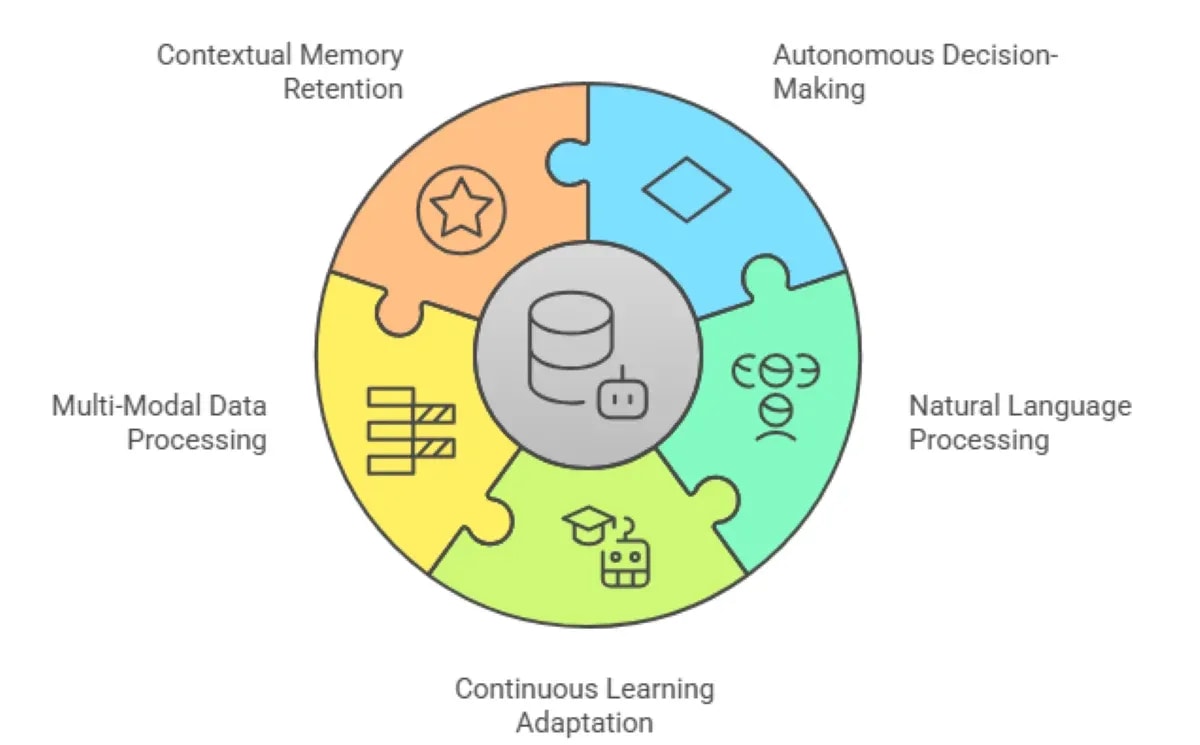
Modern AI agents possess five fundamental capabilities that distinguish them from traditional automation systems, enabling autonomous decision-making and continuous learning across complex business environments.
Autonomous decision-making
AI agents analyze situations independently and make informed choices without human intervention, processing multiple variables simultaneously to determine optimal actions.
Natural language processing
Advanced language understanding enables AI agents to interpret human communication, respond contextually, and engage in meaningful conversations across various business scenarios.
Continuous learning adaptation
Machine learning algorithms allow agents to improve performance over time, learning from interactions and outcomes to enhance future decision-making capabilities automatically.
Multi-modal data processing
AI agents integrate information from various sources, including text, images, voice, and structured data, to create a comprehensive understanding for complex tasks.
Contextual memory retention
Sophisticated memory systems enable agents to maintain conversation history, user preferences, and situational context across multiple interactions for personalized experiences.
What is traditional automation?
Traditional automation refers to rule-based systems that execute predetermined processes through scripted workflows and conditional logic. These systems, including Robotic Process Automation (RPA) and workflow engines, follow fixed instructions to automate repetitive tasks. While effective for standardized processes, traditional automation requires manual programming for each scenario and cannot adapt to new situations without human intervention, making it suitable primarily for stable, well-defined business processes.
Features of traditional automation
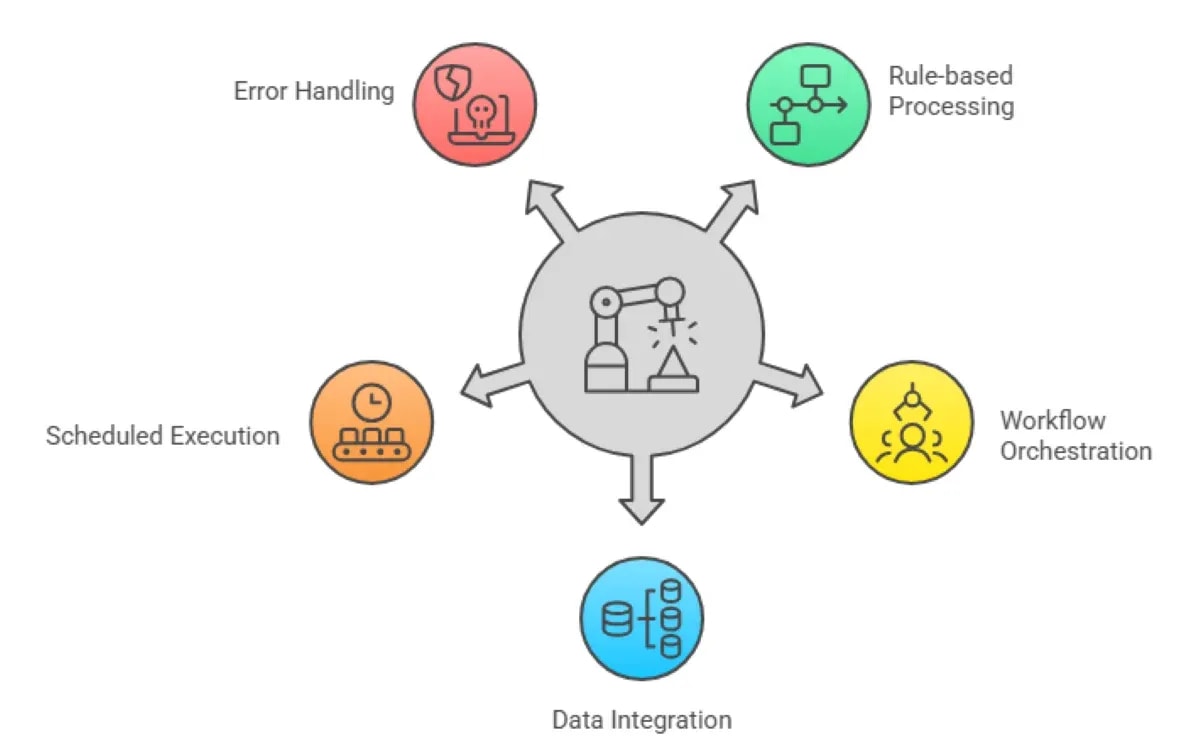
Traditional automation systems rely on five core features that enable consistent execution of predefined processes, offering reliability and predictability for structured business workflows.
Rule-based processing
Systems execute tasks following predetermined conditional logic and decision trees, ensuring consistent outcomes but requiring manual updates for process changes.
Workflow orchestration
Automated sequence management coordinates multiple tasks across different systems, maintaining process flow according to predefined business rules and dependencies.
Data integration capabilities
Connects disparate systems and databases to transfer information automatically, enabling seamless data flow between applications without manual data entry.
Scheduled execution
Triggers automated processes at predetermined times or based on specific events, ensuring consistent task execution without human intervention requirements.
Error handling mechanisms
Built-in exception management identifies process failures and implements predefined responses, maintaining system stability through structured error recovery procedures.
Next-Generation AI Agents Vs Traditional Automation: Direct Comparison
FeatureNext-Generation AI AgentsTraditional AutomationLearning CapabilityContinuous learning and adaptation from dataFixed rules requiring manual updatesDecision MakingAutonomous contextual decisionsPre-programmed conditional logicFlexibilityHandles exceptions and new scenariosBreaks when encountering unexpected situationsImplementationRequires training data and model developmentRule-based configuration and scriptingMaintenanceSelf-optimizing with minimal interventionRegular manual updates and rule modificationsScalabilityImproves performance with more dataLinear scaling requiring additional programmingCost StructureHigher initial investment, lower long-term costsLower upfront costs, higher maintenance expensesUse CasesComplex, dynamic, cognitive tasksRepetitive, structured, rule-based processesHuman InteractionNatural language communicationLimited to predefined interfacesAdaptabilityReal-time adaptation to changing conditionsManual reconfiguration for process changesROI TimelineLonger initial period (12-18 months) but delivers exponential long-term returnsFaster initial ROI (3-12 months) but linear scaling limitationsROI PatternCompounding returns with continuous improvementPredictable returns with maintenance overheadValue CreationStrategic and tactical benefits through adaptive intelligencePrimarily tactical cost savings through task automationLong-term EconomicsDecreasing marginal costs as system learns and optimizesIncreasing costs for maintenance and system updates
Cost structure analysis: AI agents vs traditional automation
Understanding the complete financial impact requires examining both immediate and long-term costs across different automation approaches. Each technology presents distinct investment patterns that affect total cost of ownership.
AI agent cost structure
Initial investment requirements
AI agents demand substantial upfront investment ranging from $200,000 to $2M+ for enterprise deployments. This includes data preparation, model development, integration costs, and specialized talent acquisition.
Ongoing operational costs
Despite higher initial costs, AI agents require moderate annual maintenance through automated learning features. Self-optimization capabilities reduce manual intervention needs, resulting in lower long-term operational expenses.
Hidden organizational expenses
Employee reskilling represents significant investment, typically requiring comprehensive training programs. Change management initiatives and process redesign add substantial costs during implementation phases.
Traditional automation cost structure
Lower initial investment
Traditional automation solutions typically require initial investments ranging from $50,000 to $500,000, making them accessible for organizations with limited budgets or specific use case requirements.
Higher maintenance overhead
Traditional systems demand continuous manual updates, script modifications, and exception handling. Technical teams must regularly reconfigure systems as business processes evolve, creating ongoing operational burdens.
Predictable cost patterns
Rule-based systems offer predictable cost structures with clear pricing models. However, scaling complexity increases costs proportionally, requiring additional programming resources for expansion initiatives.
ROI timeline comparison: When each approach delivers value
Different automation technologies generate returns on distinct timelines. Understanding these patterns helps organizations align technology choices with business objectives and financial expectations.
AI agent ROI development
Extended foundation period (0-12 months)
AI agents require longer initial development phases, including data collection, model training, and system integration. This extended timeline creates negative ROI during early implementation stages.
Accelerated value capture (12-24 months)
Once operational, AI agents demonstrate rapid value acceleration through continuous learning and adaptation. Performance improvements compound over time without additional programming investments.
Exponential scaling benefits (24+ months)
Mature AI agents deliver exponential returns through accumulated learning, expanded capabilities, and decreased marginal costs. Long-term value creation significantly exceeds initial investment requirements.
Traditional automation ROI patterns
Faster initial returns (3-12 months)
Traditional automation delivers quicker initial returns through immediate process standardization and labor cost reduction. Predictable implementation timelines enable faster break-even achievement.
Linear scaling challenges (12-24 months)
Growth requires proportional increases in programming resources and system complexity. Scaling costs increase linearly with expanded functionality and process requirements.
Maintenance cost accumulation (24+ months)
Long-term costs accumulate through continuous manual updates, exception handling, and system modifications. Aging systems require increasing maintenance investments to remain effective.
Industry application comparison
Both AI agents and traditional automation excel in different industry contexts. Understanding these applications helps organizations select appropriate technologies for specific business environments.
AI agents in industry applications
AI agents handle complex patient interactions, medical record analysis, and treatment recommendation systems. Natural language processing enables sophisticated communication with patients and healthcare providers.
Financial services innovation
Fraud detection, risk assessment, and customer service applications leverage AI agents' ability to process complex data patterns and adapt to evolving threats continuously.
Manufacturing intelligence
Predictive maintenance, quality control, and production optimization benefit from AI agents' learning capabilities and ability to process multiple data streams simultaneously.
Retail personalization
Customer service, dynamic pricing, and recommendation engines utilize AI agents' contextual understanding and personalization capabilities to enhance customer experiences significantly.
Traditional automation industry strengths
Financial processing excellence
Invoice processing, payroll management, and regulatory reporting benefit from traditional automation's reliability, audit trails, and predictable execution patterns.
Supply chain coordination
Inventory management, order processing, and logistics coordination leverage traditional automation's structured workflow capabilities and system integration strengths.
Compliance management
Regulatory reporting, document management, and approval workflows utilize traditional automation's rule-based processing and audit trail capabilities for compliance requirements.
Data migration projects
System integrations, data transfers, and batch processing operations benefit from traditional automation's predictable execution and error-handling mechanisms.
Strategic decision framework: Choosing the right approach
Organizations must evaluate multiple factors when selecting between AI agents and traditional automation. This framework provides structured criteria for making informed technology investment decisions.
When to choose AI agents
Complex decision requirements
Organizations facing dynamic business environments with frequent process changes benefit from AI agents' adaptive capabilities and autonomous decision-making features.
Customer interaction focus
Businesses prioritizing personalized customer experiences, natural language communication, and contextual understanding should consider AI agent implementations for superior engagement capabilities.
Data-rich environments
Organizations with substantial data assets can leverage AI agents' learning capabilities to extract insights, identify patterns, and continuously improve performance over time.
Innovation-driven culture
Companies emphasizing competitive differentiation through technology innovation find AI agents provide strategic advantages through advanced capabilities and market positioning benefits.
When to select traditional automation
Structured process environments
Organizations with well-defined, stable processes benefit from traditional automation's reliability, predictable execution, and established integration patterns for consistent operational excellence.
Budget-conscious implementations
Companies with limited initial investment capacity or specific ROI timeline requirements find traditional automation offers faster returns and lower upfront costs.
Regulatory compliance focus
Heavily regulated industries requiring detailed audit trails, predictable execution patterns, and compliance documentation benefit from traditional automation's structured approach and proven capabilities.
Technical skill constraints
Organizations with limited AI expertise or technical resources find traditional automation more accessible through established implementation methodologies and available talent pools.
Implementation strategies for each approach
Successful automation deployment requires tailored implementation strategies that align with each technology's characteristics and organizational requirements.
AI agent implementation methodology
Data preparation phase
Comprehensive data collection, cleaning, and preparation create a foundation for effective AI agent training. Quality data directly impacts agent performance and learning capabilities.
Pilot development stage
Limited-scope implementations demonstrate value while building organizational capabilities and confidence. Pilot success provides foundation for broader deployment initiatives and stakeholder buy-in.
Iterative refinement process
Continuous model training, performance monitoring, and capability enhancement ensure AI agents evolve with changing business requirements and improve operational effectiveness over time.
Change management integration
Comprehensive employee training, communication strategies, and cultural adaptation ensure successful AI agent adoption across organizational levels and business functions.
Traditional automation deployment approach
Process documentation phase
Detailed workflow mapping, rule definition, and exception identification create blueprints for automation development. Clear documentation ensures accurate system implementation and maintenance.
Structured development cycle
Sequential system configuration, testing, and deployment phases provide predictable implementation timelines and quality assurance throughout development processes.
Integration testing emphasis
Comprehensive system integration testing ensures seamless operation with existing technology infrastructure and business applications before production deployment.
User training programs
Focused training on system operation, exception handling, and maintenance procedures ensures effective ongoing management of traditional automation systems.
Risk analysis for both approaches
Each automation technology presents distinct risk profiles that organizations must evaluate and mitigate through appropriate strategies and preparation.
AI agent risks and mitigation
Model accuracy challenges
AI agents may produce unexpected results or biased decisions without proper training and validation. Implement comprehensive testing protocols and human oversight mechanisms.
Data dependency issues
Poor data quality directly impacts AI agent performance and reliability. Establish robust data governance, quality assurance processes, and continuous monitoring systems.
Explainability concerns
Complex AI decision-making processes may lack transparency for regulatory or business requirements. Implement explainable AI techniques and decision audit trails.
Technology complexity risks
Advanced AI systems require specialized expertise for maintenance and optimization. Develop internal capabilities or establish reliable vendor partnerships for ongoing support.
Traditional automation risks and mitigation
Process rigidity limitations
Fixed rule-based systems break when encountering unexpected scenarios or process changes. Implement comprehensive exception handling and regular system updates.
Maintenance cost escalation
Aging systems require increasing maintenance investments and technical resources. Plan for lifecycle management and periodic system modernization initiatives.
Integration complexity challenges
Legacy system integrations create technical dependencies and potential failure points. Design robust integration architectures with appropriate redundancy and monitoring.
Skill dependency issues
Traditional automation requires specialized technical knowledge for ongoing maintenance. Maintain adequate technical resources and documentation for system sustainability.
Future outlook and strategic recommendations
Technology evolution continues reshaping automation landscapes. Organizations must consider long-term trends when making current investment decisions.
Market evolution trends
The AI market size is estimated at $97.2 billion in 2025 and forecast to reach $229.3 billion by 2030, indicating substantial growth in AI adoption across industries.
Meanwhile, traditional automation markets continue serving specific industry needs while vendors add AI capabilities to existing platforms, creating hybrid solutions that combine both approaches.
Strategic recommendations
Organizations must carefully evaluate their specific requirements, organizational capabilities, and long-term objectives to select the most appropriate automation technology for sustainable business success.
Hybrid approach consideration
Many organizations benefit from combining both technologies strategically. Use traditional automation for structured processes while deploying AI agents for complex, dynamic requirements.
Gradual transition planning
Organizations can start with traditional automation for immediate needs while building capabilities and preparing for AI agent implementation in appropriate areas.
Capability development focus
Invest in developing internal expertise for chosen technologies. Whether pursuing AI agents or traditional automation, internal capabilities ensure sustainable long-term success.
Vendor partnership evaluation
Select technology partners with proven experience in your chosen approach. Strong partnerships provide crucial support during implementation and ongoing operations.
How Folio3 AI can help with Custom AI agent solutions
Our comprehensive AI agent development expertise transforms business operations through intelligent automation solutions. Additionally, we deliver measurable ROI and sustainable competitive advantages across diverse industry verticals and organizational contexts.
Comprehensive AI agent development services
We build sophisticated AI agents using advanced platforms like AutoGen, LangChain & CrewAI powered by cutting-edge language models including GPT-4 and Claude. Furthermore, solutions are specifically tailored to address unique business requirements and operational challenges across various industries.
AI agent strategy & roadmapping
Unlock operational efficiencies through clear AI adoption strategies developed via a comprehensive business assessment. Moreover, our intelligent agent recommendations and detailed, scalable implementation roadmaps align technology capabilities with strategic business objectives for maximum impact.
Custom AI agent development
Build highly intelligent agents that seamlessly adapt to existing workflows and business processes. Additionally, our solutions emphasize flexibility, exceptional performance, and sophisticated real-time decision-making capabilities designed to maximize business impact and operational efficiency.
AI agent integration
Seamlessly integrate AI agents into existing technology stack while ensuring smooth data exchange and complete platform compatibility. Furthermore, enterprise-grade security standards across all systems and business applications throughout your organization ensure reliable, secure operations.
Maintenance & optimization
Comprehensive support services, including regular system updates and continuous performance tuning ensure optimal performance. Moreover, AI agents remain perfectly aligned with evolving business requirements, changing market conditions, and organizational growth throughout their operational lifecycle.
Frequently asked questions
1. What is the difference between traditional automation and AI agents?
Traditional automation follows pre-programmed rules and requires manual updates when processes change, while AI agents learn continuously and adapt to new situations autonomously. AI agents can handle complex decision-making and exceptions that would break traditional rule-based systems, providing superior flexibility and long-term value creation through intelligent adaptation.
2. How much does it cost to deploy enterprise-grade AI agents in 2025?
Enterprise AI agent deployments typically require substantial initial investment ranging from moderate to significant costs, depending on scope and complexity. Total implementation expenses include technology licensing, infrastructure setup, integration costs, and organizational change management, with hidden costs often representing the majority of total investment requiring careful budget planning.
3. What is the average ROI timeline for AI agent adoption?
AI agents typically achieve break-even within six to twelve months compared to traditional automation's longer timeline through rapid adaptation capabilities. Full ROI realization follows four predictable phases: initial foundation building, value capture emergence, scaling optimization, and transformation with exponential returns, providing faster value realization than conventional approaches.
4. How do maintenance costs compare between AI agents and RPA bots?
AI agents require moderate annual maintenance costs through automated learning and self-optimization capabilities, while traditional RPA systems demand significantly higher ongoing expenses. RPA maintenance involves frequent manual reconfigurations, script updates, and extensive exception handling requirements from dedicated technical teams, making AI agents more cost-effective long-term.
5. Which industries gain the highest ROI from next-generation AI agents?
Manufacturing achieves superior ROI through predictive maintenance and quality control automation, healthcare gains through patient triage and administrative efficiency, retail benefits from dynamic pricing and personalized customer service. Financial services prevent substantial fraud losses while improving compliance, though success depends more on strategic use case selection than industry vertical.
6. Can AI agents integrate with existing RPA or legacy automation systems?
Yes, AI agents excel at integrating with existing automation infrastructure through sophisticated API connections and workflow orchestration capabilities. This hybrid approach effectively leverages previous technology investments while adding intelligent decision-making capabilities, often delivering superior ROI compared to complete system replacement while minimizing organizational disruption.
7. What infrastructure is required for large-scale AI agent deployment?
Infrastructure requirements include robust cloud computing resources, sophisticated data pipelines for real-time processing, comprehensive API integration capabilities, and enterprise security frameworks. Modern cloud-native architectures enable scalable deployment with managed services, significantly reducing implementation complexity while providing the computational power and storage necessary for intelligent automation.
8. How does Folio3 AI help reduce the cost of implementing AI agents?
Folio3.ai reduces implementation costs through proven methodologies, pre-built development frameworks, and accelerated development using advanced platforms like AutoGen and LangChain. Our comprehensive approach includes change management support, ongoing optimization services, and strategic guidance that typically reduces total implementation time while ensuring higher success rates and sustained value creation.
9. Are there security or compliance risks unique to AI agents?
AI agents introduce specific risks including model bias, data privacy concerns, decision transparency requirements, and potential system manipulation vulnerabilities. However, proper governance frameworks, comprehensive audit trails, and compliance monitoring actually reduce overall organizational risk compared to traditional automation through superior oversight capabilities and automated compliance checking.
10. What metrics should companies track to measure ROI from AI-driven automation?
Track leading indicators, including system usage patterns, data quality metrics, and user adoption rate,s alongside lagging indicators such as cost reduction, revenue enhancement, and customer satisfaction scores. Financial metrics should encompass direct savings, productivity gains, risk mitigation value, and strategic positioning benefits measured over multi-year periods for comprehensive ROI assessment.