Every contract that sits in your legal queue for review costs money. Not just in attorney hours—though those add up fast- but in delayed deals, frustrated business partners, and compliance gaps that slip through when reviewers are racing against the clock.
Here's the reality: creating a single contract with traditional methods costs approximately $7,000 on average. Multiply that by hundreds or thousands of contracts annually, and you're looking at millions in legal costs, not counting the hidden expenses of delayed deals, compliance risks, and missed opportunities.
NLP for contract analysis changes this equation completely. This AI-powered approach reads and understands legal documents the way your most experienced attorney would, but in seconds instead of hours. It's not about replacing lawyers; it's about freeing them from repetitive review work so they can focus on strategy, negotiation, and high-value decision-making.
What is NLP for contract analysis?
Natural Language Processing (NLP) for contract analysis is an artificial intelligence technology that reads, interprets, and extracts information from legal documents automatically. Unlike basic keyword search, NLP understands context, relationships, and meaning within contracts, identifying clauses, obligations, risks, and key terms without human intervention.
The technology works by applying machine learning algorithms to legal language patterns, enabling systems to recognize entities (parties, dates, payment terms), classify clause types (liability, termination, confidentiality), and flag potential issues based on your organization's specific requirements and risk tolerance levels.
Ready to Review Contracts Faster and Smarter?
Discover how NLP helps legal teams reduce manual review time, lower costs, and improve consistency across every contract.
Book a Demo
How does NLP reduce legal review time?
Contract review traditionally takes 92 minutes per document. NLP systems complete the same analysis in under 30 seconds, identifying critical clauses, extracting key terms, and flagging risks automatically. This acceleration transforms legal operations from a bottleneck into a competitive advantage.
Automated clause detection and categorization
NLP instantly identifies and labels every clause type in your contracts, confidentiality, liability, termination, indemnification, and force majeure. The system maps contract structure automatically, creating a searchable index that lets lawyers jump directly to relevant sections without reading entire documents.
The technology automatically pulls critical information like effective dates, renewal terms, payment schedules, performance obligations, and termination conditions. These extracted terms populate dashboards and alerts, ensuring your team never misses a deadline or obligation hidden in dense legal text.
Real-time risk scoring and anomaly detection
NLP compares each contract against your pre-defined standards and playbooks, assigning risk scores based on unfavorable terms, missing clauses, or non-standard language. It flags deviations immediately, like unlimited liability provisions or one-sided termination rights that require attorney review before signing.
Smart prioritization and workflow routing
The system automatically routes high-risk contracts to senior attorneys while clearing low-risk, standard agreements through accelerated workflows. AI prioritization means your most experienced lawyers focus on complex negotiations, not routine NDAs or standard vendor agreements that match approved templates.
Version comparison and redline tracking
NLP analyzes multiple contract versions simultaneously, highlighting every change between drafts—not just obvious edits but subtle modifications to terms, conditions, or obligations. This eliminates the manual line-by-line comparison that traditionally consumes hours of billable time during negotiations.
The financial impact goes far beyond faster document review. Organizations implementing NLP for contract analysis typically reduce legal spend by 60-70% while simultaneously improving accuracy, compliance, and risk management. This section breaks down where savings actually materialize.
Direct labor cost reduction
Your legal team stops spending 40+ hours weekly on manual contract review. If senior attorneys billing at $300-500/hour handle routine contracts, you're burning $60,000-100,000 monthly on work that NLP completes in minutes. Redirect this expertise to strategic negotiations, M&A support, or compliance initiatives.
Accelerated deal velocity and revenue capture
Contracts that once took 2-3 weeks for legal approval now clear in 2-3 days. Faster turnaround means closing deals before competitors, capitalizing on time-sensitive opportunities, and avoiding revenue delays caused by legal bottlenecks. Sales teams love you instead of routing around legal.
Compliance risk mitigation and penalty avoidance
NLP catches missed obligations, expired insurance requirements, or non-compliant clauses before they become regulatory violations or breach-of-contract lawsuits. A single missed compliance deadline can cost a lot in penalties, far exceeding any AI implementation investment.
Operational efficiency across the contract lifecycle
Beyond review, NLP extracts obligation data that feeds into automated monitoring systems, renewal alerts, and performance tracking dashboards. Your operations team knows exactly what's required when, eliminating manual contract administration overhead and the chaos of obligation tracking through spreadsheets.
Reduced external counsel dependency
In-house teams handle more contract volume internally with NLP assistance, cutting reliance on expensive outside law firms for routine matters. Reserve external counsel for truly complex negotiations, specialized expertise, or litigation—not standard contract reviews that AI handles efficiently.
Core NLP techniques that power contract AI
Modern contract analysis relies on several interconnected AI capabilities working together. Understanding these techniques helps you evaluate vendor solutions and set realistic expectations for what AI can accomplish with your specific contract types and legal requirements.
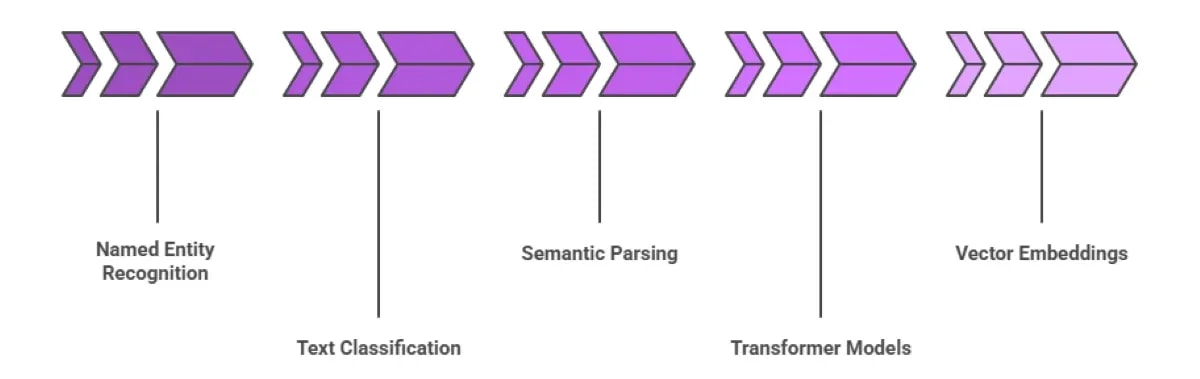
Named Entity Recognition (NER) for contract elements
NER identifies and categorizes specific entities within contracts, like party names, dollar amounts, dates, addresses, product descriptions, and territory definitions. The system tags each entity type consistently, enabling structured data extraction from unstructured legal text for reporting, analysis, and obligation management.
Text classification for clause identification
Machine learning models trained on thousands of contracts automatically classify paragraphs and sections by clause type, payment terms, warranties, indemnification, governing law, and dispute resolution. This classification creates a structured contract anatomy, making every agreement searchable and comparable across your entire repository.
Semantic parsing for relationship understanding
Beyond identifying individual terms, NLP maps relationships between contract elements, which obligations apply to which parties, how payment triggers connect to delivery milestones, and what conditions govern termination rights. This relational understanding enables the AI to answer complex queries about contractual logic.
Advanced NLP uses transformer architectures (like BERT or GPT variants) specifically fine-tuned on legal language. These models understand legal jargon, boilerplate variations, and clause interdependencies that generic AI misses. Fine-tuning on your organization's specific contract patterns improves accuracy for custom applications.
Vector embeddings for similarity search and precedent retrieval
NLP converts contract language into mathematical representations (vectors) that enable semantic similarity searches. Your team finds relevant precedent instantly, not through keyword matching but by conceptual similarity. Query "force majeure pandemic language," and the system surfaces every related clause across thousands of contracts.
High-impact use cases for enterprise legal teams
NLP delivers measurable value across multiple contract scenarios. These use cases represent where organizations see the fastest ROI and most dramatic operational improvements. Each addresses a specific pain point that traditional tools and manual processes can't solve at scale.
Automated NDA and vendor agreement processing
NDAs and standard vendor contracts represent 60-70% of legal volume but require minimal customization. NLP auto-approves agreements matching your standard terms, flags deviations for attorney review, and routes non-standard provisions to appropriate stakeholders, reducing NDA turnaround from 5 days to 5 hours.
Master service agreement analysis and compliance checking
MSAs contain hundreds of clauses spanning dozens of pages. NLP extracts all obligations, payment terms, SLA requirements, and compliance provisions into structured dashboards. Legal and operations teams monitor performance against commitments automatically, with alerts triggered when obligations approach due dates or require action.
Due diligence acceleration for M&A transactions
M&A due diligence involves reviewing thousands of contracts under tight deadlines. NLP analyzes entire contract portfolios in days instead of weeks, identifying change-of-control provisions, assignment restrictions, termination rights, and financial obligations that affect deal valuation, with comprehensive reports documenting every finding.
Lease and real estate contract management
Commercial leases contain complex rent escalation formulas, CAM charges, renewal options, and maintenance obligations buried in dense legal text. NLP extracts these financial terms and creates automated alerts for critical dates, like option exercise deadlines, rent adjustment calculations, and insurance certificate renewals.
Employment agreement and compliance monitoring
Employment contracts, offer letters, and severance agreements contain obligations around non-competes, benefits, equity vesting, and termination conditions. NLP tracks these commitments across your entire workforce, ensuring HR compliance with contractual promises and flagging issues before they become legal disputes or regulatory violations.
Custom vs. off-the-shelf: Choosing the right approach
Criteria | Off-the-Shelf SaaS Solutions | Custom NLP Development |
Implementation Timeline | 2-4 weeks for basic deployment | 8-16 weeks for a full custom build |
Upfront Cost | $10K-50K annual subscription | $75K-250K development investment |
Accuracy for Standard Contracts | 85-90% out of the box | 95-98% after training on your data |
Handling Complex/Unique Clauses | Limited; struggles with non-standard language | Excellent; trained specifically on your contract patterns |
Industry-Specific Requirements | Generic legal understanding | Deep customization for your industry's unique terms |
Integration Flexibility | Pre-built connectors for major platforms | Fully customizable APIs and data pipelines |
Data Privacy & Control | Cloud-based; vendor controls infrastructure | On-premise or private cloud; you control everything |
Ongoing Maintenance | Included in subscription | Requires dedicated resources or a support agreement |
Scalability | Elastic; pay as you grow | Fixed capacity; requires planning for scaling |
Best For | High-volume standard contracts (NDAs, vendor agreements) | Complex agreements, unique industries, strict security requirements |
Implementation and integration with existing systems
Successful NLP deployment requires careful integration with your current legal tech stack and business systems. The technology doesn't operate in isolation; it needs to receive contracts from multiple sources and deliver extracted data to downstream systems for action.
Your contract lifecycle management system becomes the central hub where NLP results flow automatically. The AI analyzes agreements stored in the CLM, populates metadata fields, triggers approval workflows based on risk scores, and updates contract status throughout the lifecycle, creating a seamless automated pipeline.
Document management system connectivity
NLP pulls contracts directly from SharePoint, Box, NetDocuments, or iManage repositories for analysis. It processes documents automatically upon upload, indexes extracted terms, and returns enriched files with AI-generated summaries and tags, eliminating manual classification and the chaos of poorly organized contract folders.
ERP and financial system data feeds
Extracted payment terms, pricing schedules, and financial obligations flow automatically into SAP, Oracle, or NetSuite systems. This integration ensures your finance team sees contractual commitments reflected in budgets, forecasts, and accounts payable workflows without manual data entry or reconciliation between legal and finance records.
CRM integration for sales contract tracking
Salesforce or HubSpot receives real-time updates on contract status, approval bottlenecks, and executed agreement details. Sales teams see exactly where each deal stands in legal review, what issues are blocking approval, and when contracts will be ready for signature.
API architecture for custom workflows
Modern NLP platforms expose RESTful APIs that let you build custom integrations with proprietary systems, legacy applications, or specialized tools unique to your organization. APIs enable automated contract ingestion, real-time analysis requests, and extraction of specific data points for whatever downstream applications require.
Challenges and best practices for successful deployment
Every organization implementing NLP for contract analysis encounters obstacles. Understanding these challenges upfront and following proven best practices dramatically improves your chances of successful adoption, user acceptance, and measurable ROI from the technology investment.
Data quality and historical contract cleanup
Your NLP system is only as good as the contracts you feed it. Scanned PDFs with poor OCR, handwritten annotations, inconsistent naming conventions, and missing documents create accuracy problems. Plan 4-6 weeks for contract cleanup before deployment, standardizing formats, organizing repositories, and remediating quality issues.
Model training with sufficient legal data volume
Generic NLP models struggle with your organization's specific contract language and clause variations. Accurate training requires 500-1,000 sample contracts representing your agreement types, industries, and jurisdictions. If you lack sufficient training data, consider starting with a narrower use case (like NDAs) before expanding.
Change management and attorney adoption resistance
Lawyers often resist AI tools, fearing job displacement or distrusting technology's legal analysis. Address this through transparent communication about AI's role (augmentation, not replacement), hands-on training demonstrating value, and involving attorneys in defining risk criteria and playbook rules the AI applies.
Continuous learning and feedback loop maintenance
NLP accuracy degrades over time as contract language evolves, regulations change, or new agreement types emerge. Establish a feedback process where attorneys correct AI errors, validate flagged issues, and approve new clause variations, creating continuous training data that keeps the system current and accurate.
Balancing automation with necessary human oversight
Not every contract should route through fully automated workflows. Define clear criteria for what requires attorney review (high dollar values, non-standard terms, strategic partners) versus what AI can approve independently. Start conservative, then expand automation as confidence grows and data proves accuracy.
Ready to Cut Contract Review Time and Costs?
See how NLP-powered contract analysis helps legal teams identify risks faster, reduce manual effort, and streamline every stage of review.
Book a Demo
How does Folio3 AI help with custom NLP for contract analysis?
Folio3 delivers custom NLP solutions specifically engineered for legal contract analysis at enterprise scale. Our approach combines advanced AI capabilities with a deep understanding of legal workflows, ensuring the technology enhances rather than disrupts your existing processes while maintaining the security and compliance enterprise legal teams require.
Custom model development for legal language precision
We fine-tune NLP models on your specific contract types, industry terminology, and organizational standards, not generic legal language. This customization achieves maximum accuracy for your unique agreements, handling complex clauses, jurisdiction-specific requirements, and proprietary terms that off-the-shelf solutions miss or misinterpret.
Hybrid AI architecture with human expertise integration
Our solutions implement human-in-the-loop validation where AI handles routine analysis but routes ambiguous situations to attorneys for review. This hybrid approach combines AI speed with human judgment, ensuring critical decisions receive appropriate oversight while still delivering dramatic efficiency improvements.
Secure deployment with enterprise data governance
Folio3 offers flexible deployment, like cloud, on-premise, or hybrid, meeting your data residency, security, and compliance requirements. We implement encryption, access controls, audit trails, and data governance frameworks aligned with CCPA, HIPAA, and industry-specific regulations protecting sensitive legal information.
Integration with the enterprise legal operations stack
We build custom connectors linking NLP capabilities with your CLM, DMS, ERP, CRM, and workflow systems. Our APIs enable seamless data flow across your legal tech ecosystem, ensuring extracted contract intelligence reaches every system and stakeholder who needs it for operations, compliance, or strategic decisions.
Continuous learning and model refinement programs
Post-deployment, we establish ongoing model improvement cycles incorporating attorney feedback, new contract patterns, and evolving legal standards. Your NLP system becomes more accurate over time, adapting to organizational changes, regulatory updates, and emerging contract types as your business grows and transforms.
Frequently asked questions
What is contract analysis in AI?
AI-powered contract analysis uses natural language processing to automatically read, understand, and extract critical information from legal documents, identifying clauses, obligations, risks, and key terms without manual human review of every page.
How much time can NLP save on legal reviews?
Depending on contract volume and complexity, NLP reduces review time by 60-80% on average. A contract requiring 90 minutes of attorney time drops to 15-20 minutes for final validation of AI findings.
Modern NLP systems achieve 95-98% accuracy when properly trained on your organization's contract types. Most implementations use human-in-the-loop validation where AI handles initial analysis, and attorneys review flagged issues before final approval.
What types of contracts can AI analyze effectively?
NLP handles NDAs, vendor agreements, MSAs, SLAs, employment contracts, leases, purchase orders, SOWs, licensing agreements, and most structured legal documents. Custom models can be trained for industry-specific agreements.
Can AI understand complex legal language and context?
Yes, with proper training. Advanced NLP models fine-tuned on legal language understand clause interdependencies, jurisdictional variations, and complex legal concepts—though truly novel or unprecedented situations may still require human legal judgment.
How does Folio3 integrate contract NLP into existing systems?
We build custom APIs and connectors linking NLP capabilities with your CLM, DMS, ERP, CRM, and workflow platforms. Integration ensures extracted contract data flows automatically to all systems requiring it for operations and compliance.
Is NLP contract analysis compliant with US privacy laws?
Yes, when deployed with appropriate data governance frameworks, encryption, access controls, and security measures. Folio3 designs implementations aligned with CCPA, HIPAA, and industry-specific regulations governing sensitive legal information.
What's the typical implementation timeline for contract NLP?
Off-the-shelf solutions deploy in 2-4 weeks for basic functionality. Custom NLP development takes 8-16 weeks, including model training, integration development, and testing, with pilot programs starting in 4-6 weeks.
How much does contract NLP implementation cost?
SaaS solutions typically charge based on contract volume and user count, with annual subscriptions scaling as your needs grow. Custom development requires upfront investment but offers greater control and customization. Most organizations achieve ROI within the first year through reduced legal spend and faster deal closure.
Can we start with a pilot before full deployment?
Absolutely. Most organizations pilot NLP on a single contract type (like NDAs or vendor agreements) to prove value before expanding. Pilots typically run 30-60 days, processing 100-500 contracts to demonstrate time savings and accuracy.