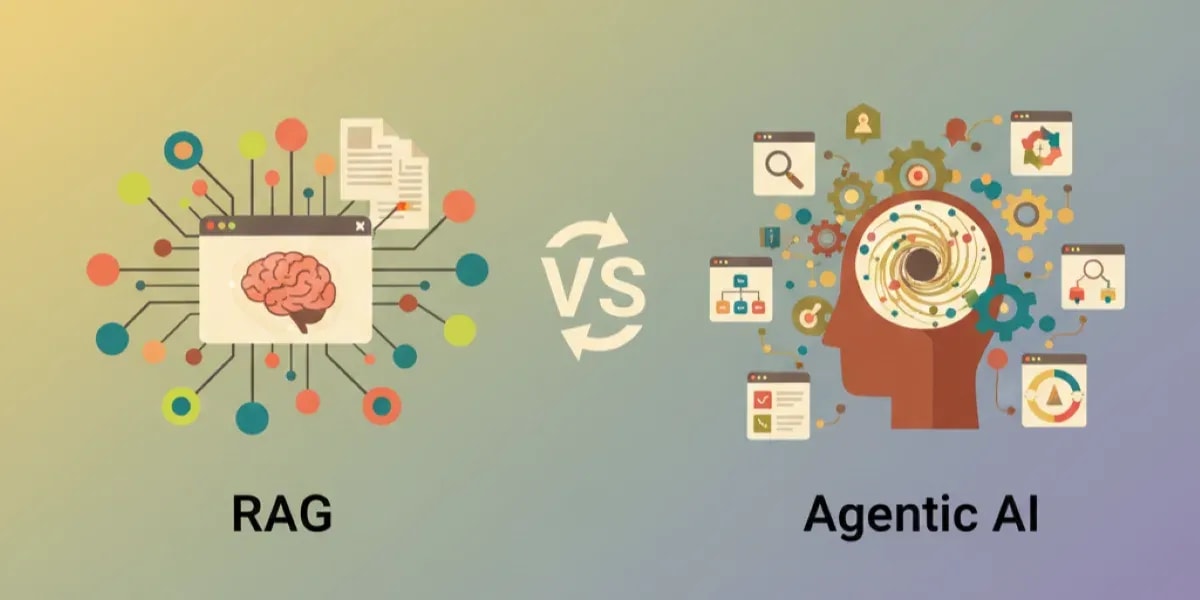
Enterprises evaluating AI for complex workflows often ask where Retrieval-Augmented Generation (RAG) ends, and agentic AI begins. The main difference: Retrieval-Augmented Generation (RAG) grounds large language model (LLM) outputs in relevant, up-to-date external data via a single retrieval step, while agentic AI adds autonomy, where agents can set subgoals, plan, call tools/APIs, and act iteratively to achieve an outcome.
A practical middle path, Agentic RAG, uses autonomous agents to orchestrate iterative retrievals and tool calls, improving accuracy and enabling multi-step tasks. Understanding RAG vs. agentic AI is essential for choosing the right pattern: use RAG for fast, fact-based Q&A; agentic AI for goal-driven process automation; and Agentic RAG when you need both grounded answers and adaptive, multi-step reasoning.
Understanding Retrieval-Augmented Generation (RAG)
RAG grounds generation by retrieving up-to-date, external context for LLMs, improving factuality and reducing hallucinations by injecting current sources at inference time. Traditional implementations follow a simple pipeline: embed documents, search for relevant chunks, and pass them to the model for a single-shot answer.
Simply put, “RAG grounds generation by retrieving up-to-date, external context for LLMs” and is typically a one-time retrieval query before generating a response, which makes it fast and straightforward but less flexible for complex workflows.
Where RAG excels:
- Instant, fact-based Q&A on policies, product catalogs, and SOPs
- Summarization or synthesis of known documents
- Policy lookups and compliance checks with clear, static criteria
- Basic “chat over data” with predictable latency and low operational overhead
Defining Agentic AI and Its Capabilities
Agentic AI describes autonomous, goal-directed components that perceive, plan, call tools/APIs, and act over multiple steps rather than returning a single output. Unlike reactive RAG pipelines, agents can decompose tasks, request clarifications, fetch missing data, and coordinate tools to accomplish business goals.
Why it matters for enterprises:
- Agents make decisions in real time, adapt to evolving data, and resolve ambiguity—key for unstructured, multi-step tasks.
- Examples:
Supply chain troubleshooting: diagnose stockouts, query ERP, re-route orders, and notify stakeholders.
- Dynamic customer support: triage, retrieve account data, process refunds via APIs, and follow up automatically.
- Adaptive analytics: run queries, validate anomalies, and generate executive-ready narratives with evidence.
What is Agentic RAG, and How Does It Combine Both Approaches?
Agentic RAG is a hybrid that embeds agents into the RAG pipeline for iterative retrieval, planning, and tool use. Instead of a static, one-and-done retrieval, agents orchestrate iterative retrievals, tool calls, and planning to refine answers or complete multi-step tasks. For example, in a loan approval workflow, an agent can repeatedly fetch new documents, call scoring APIs, confirm eligibility against policies, and escalate edge cases, delivering a decision with traceable evidence.
Key Feature Differences Between RAG and Agentic AI
Feature | RAG | Agentic AI | Agentic RAG |
Retrieval style | Single-shot retrieval before generation | Optional; focuses on actions and planning | Iterative, adaptive retrieval loops |
Planning | None; reactive Q&A | Autonomous goal decomposition and planning | Planning plus targeted retrieval refinement |
Tool/API calls | Typically, none beyond search | Yes, multi-tool orchestration and actions | Yes, tools plus retrieval-aware reasoning |
Memory | Stateless across turns | Stateful (short- and long-term memory) | Stateful with reflective retrieval |
Error handling | Limited; retry or re-rank | Self-checks, fallbacks, and corrective loops | Retrieval- and action-aware self-correction |
Observability | Simple logs/traces | Multi-step traces, more complex | Complex traces across retrieval and actions |
Typical latency | Low, predictable | Higher, varies by steps | Moderate–high; iterative by design |
Cost predictability | High | Variable (depends on steps/tools) | Variable; more retrieval and tokens |
Best fit | Fast Q&A over known data | Goal-driven process automation | Complex, grounded multi-step tasks |
Retrieval Process: Single vs Iterative
Traditional RAG typically performs a one-time retrieval query before generating a response, which works well for static, fact-based tasks. In contrast, Agentic RAG performs iterative, adaptive queries rather than a single static retrieval, allowing the agent to identify gaps, fetch missing context, and validate intermediate conclusions. Visualize it as linear retrieval (RAG) versus an iterative loop of “ask → retrieve → check → refine → act” (Agentic RAG).
Decision-Making: Reactive vs Autonomous Planning
RAG is reactive: it answers based on retrieved context and does not plan. Agentic AI enables autonomous orchestration and real-time decision-making, so agents proactively seek missing data, disambiguate requirements, and choose next-best actions, capabilities that underpin enterprise workflows requiring on-the-fly adjustments.
Agentic RAG can call external tools, APIs, and functions during reasoning, extending beyond document retrieval to action execution. RAG primarily retrieves from document stores or vector DBs; agentic systems chain tools, like inventory checks, scheduling, payments, and execute multi-step workflows end to end.
Memory and Context Management
RAG doesn’t retain memory between interactions, as each query is independent. Agentic AI can maintain conversational state, use scratchpads, and persist working memory for consistency across steps. Agentic RAG adds reflection on prior retrievals to iteratively improve answers and decisions. In practice, choose stateless RAG for atomic lookups and stateful agents for longitudinal cases like order management or case resolution.
Error Handling and Observability
Agentic RAG aims for higher reliability via self-checking and adaptive loops. For example, re-querying when retrieval is insufficient or validating tool outputs before proceeding. However, agentic systems are harder to debug than simple RAG due to added moving parts, requiring stronger tracing and monitoring. Structured evaluation and robust observability are essential to mitigate this trade-off.
Practical Trade-Offs for Enterprise Deployment
- Latency and throughput: Each additional retrieval or tool step adds a round-trip. Agentic RAG often delivers better accuracy on complex tasks, but at the cost of 2–3x latency versus basic RAG in many prototypes; teams should validate tolerances per workflow and user expectations.
- Cost and scale: More steps mean more tokens and tool calls. Budgets should account for LLM usage, orchestration infrastructure, and integration maintenance, not just licenses.
- Engineering and operations: Agentic pipelines introduce orchestration challenges, like timeouts, tool failures, and memory design, requiring dedicated engineering capacity and production-grade observability.
- Governance and risk: More autonomy increases the need for role-based access, auditable actions, and policy enforcement. Mature teams establish monitoring, guardrails, and iterative evaluation to manage safety and ROI.
Agentic RAG architectures can add latency; some use cases find them too slow, especially where user interactions demand sub-second responses. The trade-off is worthwhile when the task requires iterative validation (e.g., financial checks), but for simple fact lookups, stick to RAG. Profile each step, retrieval, planning, and tool calls, and remove or batch steps where possible.
Cost Implications of RAG and Agentic AI
More retrieval and generation steps in Agentic RAG increase token usage and cost. Ongoing expenses include LLM calls, vector storage, orchestration platforms, tool integration maintenance, and evaluation pipelines. Tooling choices matter: open-source options can reduce license costs, but the dominant expense still comes from LLM calls and retrieval scale.
Engineering Complexity and Maintenance
Agentic RAG introduces orchestration challenges: latency spikes, tool failures, memory handling, and dependency management. Plan for:
- An orchestration framework with retries, timeouts, and circuit breakers.
- Dataset and prompt versioning with offline/online evaluations.
- Monitoring/tracing across retrieval, reasoning, and actions.
- A change-management process for tools, schemas, and models.
Debugging and Pipeline Observability
Agentic systems have more moving parts, like multiple agents, shared state, validations, so debugging is inherently harder than RAG. Best practices include centralized logging, stepwise traces, proactive alerting, and workflows. For basic RAG, lightweight logs and retrieval diagnostics often suffice; for agents, invest in full pipeline observability.
When to Choose RAG, Agentic AI, or Agentic RAG for Business Workflows
Use these heuristics:
- Choose RAG for fast, document-grounded Q&A, policy lookup, and static summaries.
- Choose Agentic AI for goal-driven automations with tool execution (e.g., refunds, ticket routing).
- Choose Agentic RAG when you need both grounded knowledge and multi-step planning, such as claims processing or complex approvals.
Decision guide:
- Document search and research: RAG
- Regulatory compliance checks across systems: Agentic RAG
- Claims processing with data gathering and adjudication: Agentic RAG
- Dynamic scheduling and fulfillment with API actions: Agentic AI or Agentic RAG
- Executive analytics with validation loops: Agentic RAG
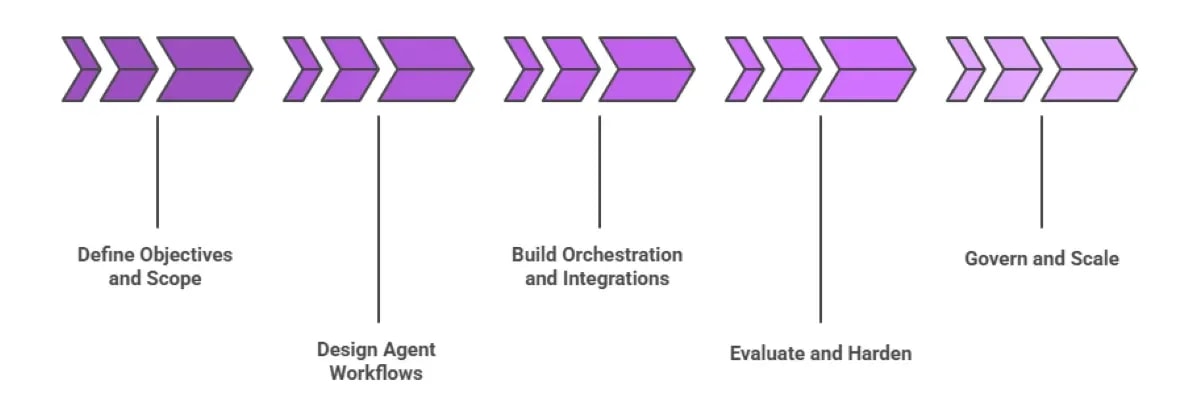
How to Deploy Agentic AI for Complex Business Workflows?
Adopt a phased, outcome-first approach that integrates with your systems and governance model.
Define objectives and scope
- Map each business workflow and define SMART goals (Specific, Measurable, Achievable, Relevant, Time-bound).
- Sample KPIs: cycle time reduction, first-contact resolution, cost per transaction, SLA adherence, and error rates.
Design agent workflows
- Break tasks into steps and decisions; align agent actions to systems of record (ERP, CRM, ITSM).
- Specify tools/APIs, retrieval sources, guardrails, and human-in-the-loop points.
Build orchestration and integrations
- Start with a single agent; add multi-agent patterns as complexity grows (sequential, parallel, task decomposition).
- Implement retries, timeouts, and strategies; maintain schema contracts.
- Multi-agent RAG systems can plan, fetch, and optimize context before LLM generation.
Evaluate and harden
- Offline: golden sets, factuality checks, robustness tests.
- Online: A/B tests, guardrail triggers, drift monitoring, and feedback loops.
Govern and scale
- Enforce role-based access, audit logs, and approvals for high-impact actions.
- Establish cost budgets and rate limits; standardize observability.
For organizations building on Microsoft Azure, leveraging established AI and data platforms can shorten time-to-value and simplify governance.
Defining Workflow Goals and Success Criteria
Map each workflow, define SMART goals, and tie them to KPIs like handle time, accuracy, escalation rate, and cost per case. For pilots, choose a bounded process with clear metrics and accessible data.
Designing and Integrating Autonomous Agents
Align agent capabilities to concrete steps, data sources, and user touchpoints. Use modular interfaces for tools/APIs, define clear preconditions/postconditions, and specify escalation paths. Typical integrations include ERP for inventory, CRM for accounts, and payment gateways.
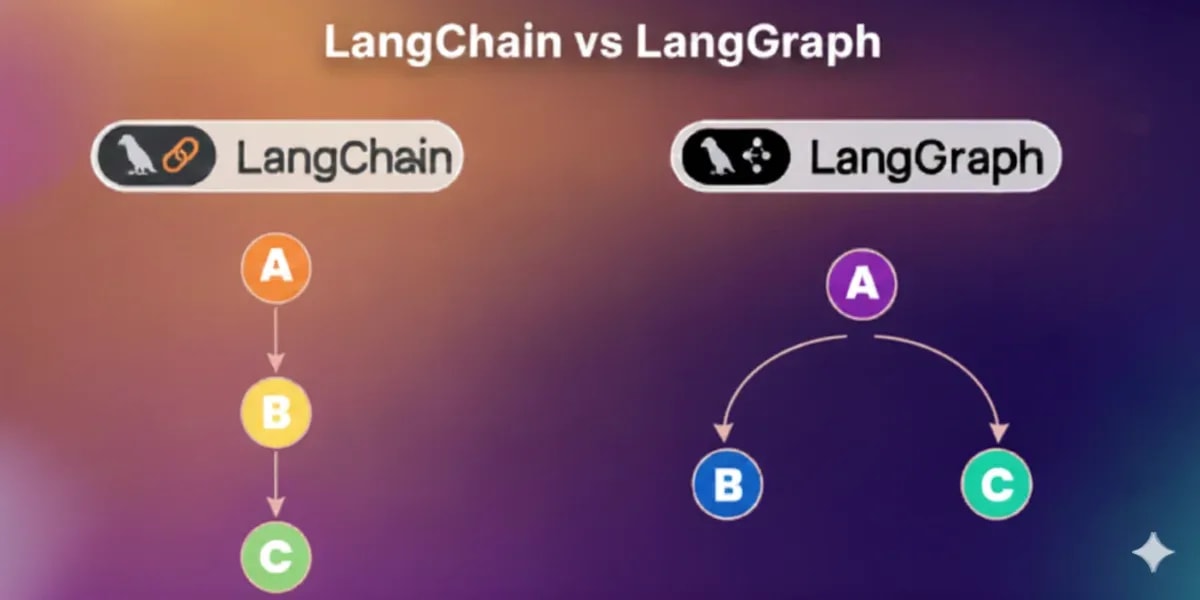
Orchestration and Multi-Agent Patterns
Orchestration manages workflows across agents, tools, and data. Common patterns:
- Sequential agents for staged tasks (triage → retrieve → decide → act).
- Parallel agents to fan out for retrieval or checks.
- Task decomposition with a planner agent and executor agents.
Open-source and platform options can reduce license costs, but the dominant expense still comes from LLM calls and retrieval scale. Assess tools on scalability, security, integration ease, and vendor lock-in risk.
Governance, Monitoring, and Iterative Improvement
Apply enterprise governance: role-based access, audit trails, PII controls, and compliance with HIPAA/GDPR where applicable. Monitor with real-time tracing, error alerting, and periodic performance audits. Iterate with feedback loops, prompt/data updates, and phased rollouts.
Frequently asked questions
What types of business workflows benefit most from agentic AI?
Agentic AI suits complex, multi-step workflows that require adaptive decisions, such as claims processing, supply chain management, and dynamic customer support.
How does agentic AI improve over traditional RAG in dynamic environments?
It plans and acts autonomously, adapting to new information in real-time to deliver more accurate, flexible outcomes than single-shot RAG.
What are the main challenges in scaling agentic AI solutions?
Increased latency, higher token and compute costs from iterative steps, and greater engineering complexity for orchestration and error handling.
How can enterprises manage the latency and cost of agentic AI deployments?
Optimize the number of steps, cache aggressively, choose efficient frameworks, and continuously monitor traces and costs to tune the pipeline.
What governance practices ensure safe and reliable AI agent operation?
Use role-based access, auditable actions, policy guardrails, and compliance controls, with ongoing monitoring and periodic audits.