Business owners today face mounting pressure to justify every technology investment with hard numbers. Fleet management decisions that once relied on experience now require detailed financial analysis to secure board approval. Understanding how to calculate ROI for AI fleet management solutions is now essential for making informed decisions and demonstrating the value of these investments.
With fuel costs, insurance premiums, and regulatory compliance creating constant pressure on profit margins, smart business leaders are turning to AI-powered fleet management solutions to gain a competitive edge.
According to Verizon Connect's 2025 fleet technology trends report, nearly half (47%) of GPS users achieved positive ROI in less than one year, with AI-enhanced systems showing even stronger performance metrics across multiple operational categories.
Why ROI matters in AI fleet management?
Understanding ROI for AI fleet management represents a fundamental shift in how modern businesses approach fleet operations and strategic planning. Fleet operations naturally generate massive amounts of data, from fuel consumption patterns to driver behavior metrics. AI transforms this raw information into actionable insights that drive measurable cost savings.
The financial case becomes clear when you consider documented results. Staker Parson, a construction materials company, achieved a 70% reduction in unsafe driving events and saved $2 million in equipment repair costs through AI-powered dash cam implementation and driver coaching programs.
Decision makers need ROI calculations because AI fleet management requires upfront investment in technology and training. Without clear financial projections, securing budget approval or measuring post-implementation success becomes impossible.
Understanding ROI in AI fleet management
ROI for AI fleet management measures the financial return gained from investing in artificial intelligence-powered solutions compared to traditional management approaches and manual processes.
Fleet operations typically involve several major cost categories: fuel expenses, maintenance and repairs, vehicle depreciation, insurance premiums, driver wages, and administrative overhead. According to Automotive Fleet research, fuel costs represent 60% of the total fleet operating budget, making them a primary target for AI optimization efforts.
The key difference with AI fleet solutions is their ability to identify cost-saving opportunities that human operators might miss. Traditional fleet management relies on historical data and reactive responses. AI systems process real-time information, predict future needs, and automatically optimize operations without manual intervention.
Key factors impacting ROI for AI-based fleet solutions
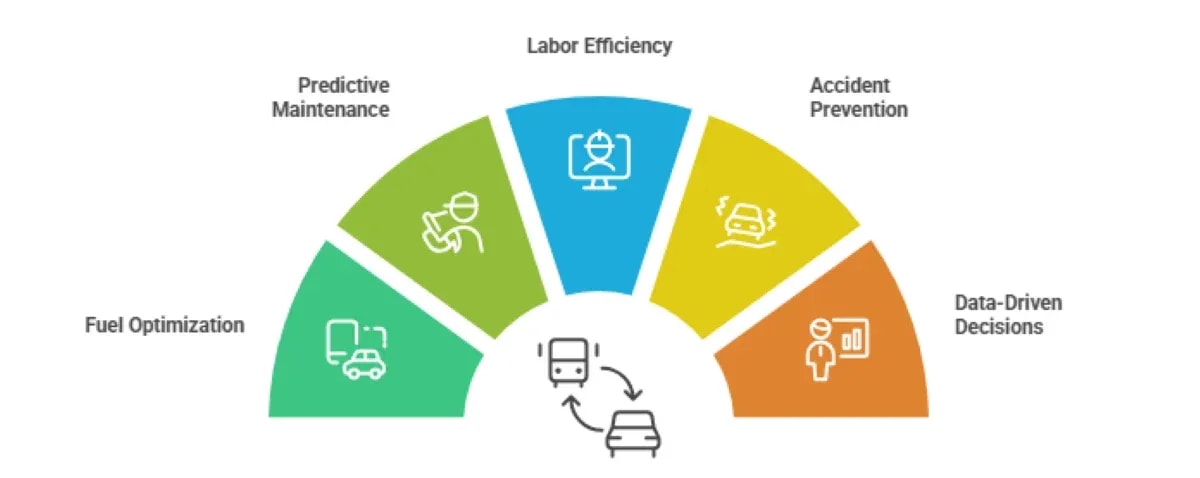
Several critical areas determine how much return your AI fleet investment will generate, each offering specific opportunities for cost reduction and operational improvement.
Fuel optimization through AI route planning
AI route optimization analyzes traffic patterns, weather conditions, and delivery requirements to create the most efficient paths. The 2025 Fleet Technology Trends Report shows that fuel savings from GPS tracking doubled from 8% to 16% between 2021 and 2025, demonstrating the growing effectiveness of AI-powered solutions.
Predictive maintenance reduces breakdowns
Machine learning algorithms monitor vehicle health indicators to predict failures before they occur. Industry research indicates that maintenance and repairs constitute up to 20% of total fleet costs, making predictive maintenance a major ROI driver that prevents expensive emergency repairs.
Labor efficiency through automation
AI systems automate routine tasks like scheduling and reporting while monitoring driver performance. A fleet manager spending 10 hours weekly on manual scheduling could redirect that time to strategic planning and growth initiatives.
Accident prevention via AI driver safety
Computer vision technology detects risky driving behaviors in real time, providing immediate feedback to prevent accidents. According to industry studies, dash cam solutions with driver feedback can achieve up to an 86% reduction in accident-related costs.
Data-driven decision making
Advanced analytics provide fleet managers with actionable insights for strategic planning. AI identifies patterns and opportunities that manual analysis would miss, leading to better resource allocation decisions and improved profitability.
Calculating AI fleet management ROI requires a systematic approach that accounts for both direct savings and implementation costs across multiple operational areas.
The standard ROI formula is: ROI = (Cost Savings – Investment Cost) / Investment Cost × 100
This provides a percentage return that can be compared against other investment opportunities.
Breaking Down Sample Costs and Savings
Implementation costs include:
Savings categories include:
Fuel consumption reduction
Maintenance optimization
Insurance premium discounts
Administrative efficiency gains
ROI calculator example with real numbers
Consider a 50-vehicle fleet spending $500,000 annually on fuel. AI route optimization, achieving 15% fuel savings, would generate $75,000 in annual benefits. With a $30,000 AI system investment, the ROI would be 150% in the first year:
ROI = ($75,000 - $30,000) / $30,000 × 100 = 150%
Timeframe considerations
Most AI fleet systems show positive ROI within 12 to 18 months. However, benefits grow over time as the system learns patterns and optimizes performance, making long-term projections important for complete analysis.
Note: ROI varies significantly by fleet size, industry type, current operational efficiency, and geographic factors. These examples represent industry averages and should be adjusted for specific operational conditions.
Real-world ROI benchmarks from AI fleet management
Industry data shows consistent patterns in AI fleet management returns, providing reliable benchmarks for projecting results and validating investment decisions.
UPS ORION system (United States)
UPS implemented AI-powered route optimization, saving 100 million miles annually, reducing 100,000 metric tons of CO2 emissions, and achieving $300-400 million in cost savings through advanced algorithmic optimization
Deutsche Post DHL (Germany)
DHL's AI algorithms reduced warehouse employee travel distance by 50% and increased productivity at individual locations by up to 30% through machine learning and predictive analytics implementation
Australia Post fleet optimization
Australia Post achieved $250,000-$300,000 annual savings through LBM's AI-powered logbook system, optimizing fleet utilization and enabling strategic redeployment of vehicles during COVID-19 operational changes.
Case study: Folio3 and Aiden partnership
At Folio3, we've delivered proven AI fleet management solutions that demonstrate measurable ROI improvements for our clients across various industries and operational scales.
Aiden partnership success: We enhanced our client Aiden's software functionality by 50% through comprehensive MLOPs service delivery, showcasing our expertise in fleet technology solutions.
Vehicle fleet provisioning: Our team implemented automated provisioning systems using AWS IoT Core with bootstrap certificates, enabling seamless vehicle onboarding and secure communications.
Data ingestion pipeline: We developed a cloud-based data collection from vehicle sensors, with intelligent segregation by consumer needs and optimized distribution through respective pipelines.
Consent management module: Our solution included streamlined consent form distribution to vehicles, with revocation capabilities and notification systems for enhanced compliance and control.
AWS Cloud Integration: We delivered complete AWS IoT services integration, resulting in faster deployment, reduced system errors, and maximum data science productivity for our client.
Hidden benefits that improve ROI
Beyond direct cost savings, AI fleet management delivers additional value that enhances overall return on investment.
Improved compliance and reporting
Automated regulatory compliance reduces administrative burden and eliminates costly violations. AI systems ensure drivers meet hours of service requirements and vehicles maintain proper documentation without manual oversight.
Environmental compliance becomes easier with AI-optimized routes and vehicle utilization. Companies report improved sustainability metrics that support corporate social responsibility goals and may qualify for green incentives.
Better customer service
Accurate delivery predictions improve customer satisfaction and reduce service calls. FedEx and other major carriers use AI-powered route planning to ensure timely deliveries while minimizing fuel consumption.
Risk mitigation and insurance benefits
Better safety records lead to reduced insurance premiums and lower liability exposure. Insurance industry data shows companies can achieve significant reductions in accident costs through effective telematics and AI dash cam implementation.
Competitive advantage
Superior fleet performance enables better service delivery and competitive pricing. Companies with AI-optimized operations can take on more business while maintaining quality standards, driving revenue growth alongside cost reduction.
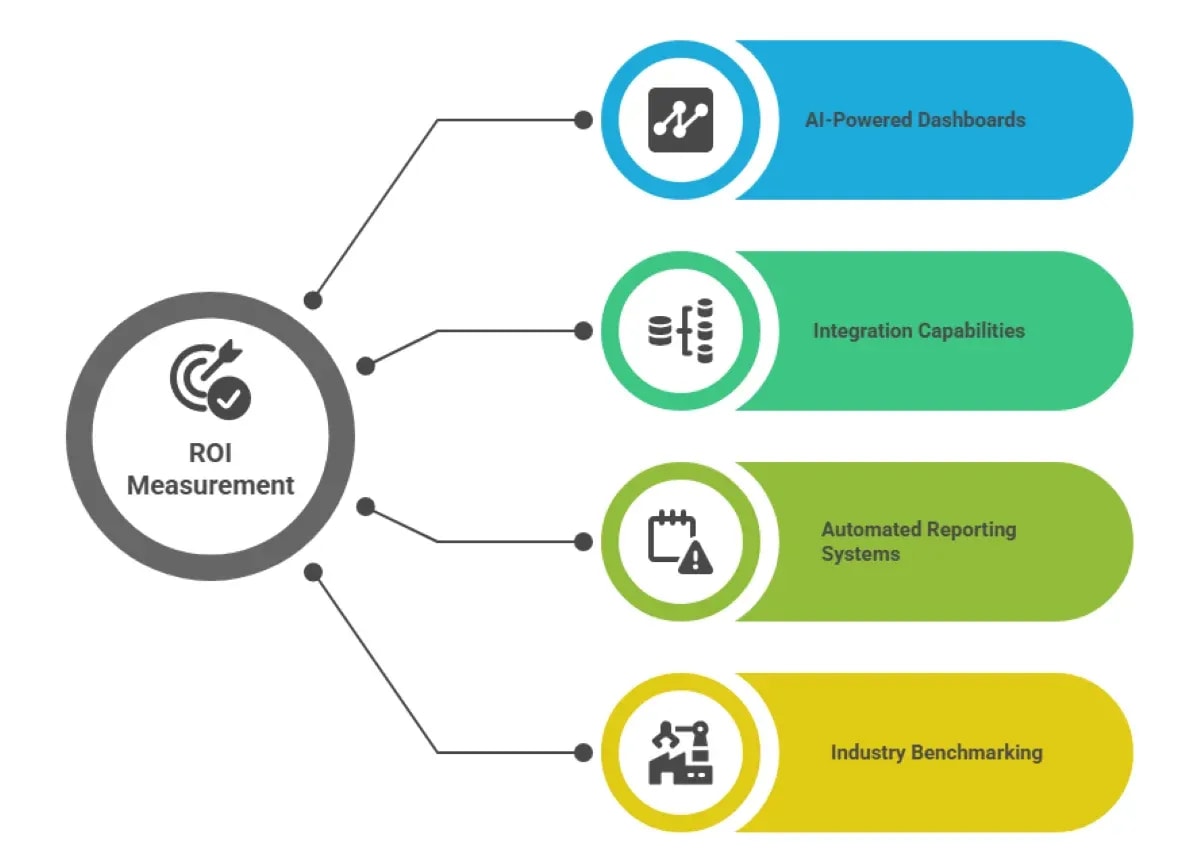
Successful ROI measurement requires the right combination of key performance indicators, tracking systems, and analytical tools.
AI-powered dashboards
Modern fleet management platforms provide real-time visibility into all cost categories and performance indicators. Automated reporting eliminates manual data collection while ensuring accuracy and consistency in ROI calculations.
Integration capabilities
Seamless data flow between systems enables comprehensive analysis without manual data entry. Integration ensures all relevant information contributes to ROI calculations, providing complete visibility into fleet performance and costs.
Automated reporting systems
Set up automatic alerts when performance metrics deviate from targets. Regular reporting schedules ensure stakeholders stay informed about ROI progress and can make adjustments when necessary.
Industry benchmarking
Compare your results to industry averages and best practices. Understanding where your fleet performs well and where improvement opportunities exist helps optimize ROI.
Common ROI calculation mistakes to avoid
Avoiding these frequent errors ensures accurate ROI calculations that provide reliable guidance for decision-making.
Ignoring long-term benefits
Many calculations focus only on immediate savings while overlooking the cumulative value of predictive capabilities. AI systems become more effective over time, generating increasing returns as they learn operational patterns.
Overlooking indirect savings
High driver turnover and regulatory violations create hidden costs that AI systems help eliminate. Include recruitment savings and penalty avoidance in comprehensive ROI calculations.
Using outdated cost benchmarks
Fleet operating costs change frequently due to fuel price fluctuations and regulatory updates. Ensure ROI calculations use current market rates and realistic assumptions about ongoing operational expenses.
Underestimating implementation costs
Factor in all costs associated with system deployment, including staff training, hardware installation, and potential downtime during transition. Accurate cost projections prevent budget overruns and ensure realistic ROI expectations.
Failing to account for technology evolution
AI systems require ongoing updates and potential hardware refreshes. Include these future costs in long-term ROI projections to maintain accurate financial planning.
The future of AI and fleet ROI in 2025 and beyond
The fleet management industry continues evolving rapidly, with emerging technologies creating new opportunities for enhanced ROI through AI-powered solutions.
Automation and autonomous vehicle integration
Self-driving technology will transform fleet operations over the next decade. Early adopters are already testing autonomous delivery vehicles and planning integration strategies that could dramatically improve ROI through reduced labor costs.
AI integration with electric vehicle management
Electric vehicle adoption accelerates fleet sustainability goals while creating new optimization challenges. AI systems help manage charging schedules, route planning around battery range, and energy cost optimization for maximum efficiency.
Enhanced predictive analytics
Advanced algorithms continue improving prediction accuracy and expanding into new operational areas. Future AI systems will anticipate market demand, optimize fleet sizing, and automate strategic planning decisions.
Expanded IoT connectivity
More detailed vehicle monitoring through additional sensors provides richer data for AI analysis. Enhanced connectivity enables real-time optimization and more precise performance tracking across all fleet operations.
Market growth projections
The AI-powered fleet management software market continues experiencing strong growth, indicating sustained industry momentum and continued innovation in available solutions.
Why choose Folio3.ai for fleet management?
Selecting the right AI fleet management partner determines the success of your ROI goals and long-term operational transformation.
Proven expertise in AI transportation solutions
Folio3 leverages cutting-edge AI tools, including machine learning, predictive analytics, and natural language processing, to ensure your fleet management software is future-ready, providing the technical foundation for superior ROI performance.
Flexible architecture adapts to changing operational requirements without requiring complete system replacement. Scalable solutions protect your investment while supporting business expansion and evolving fleet management needs.
Integration capabilities across existing systems
Seamless connectivity with current fleet management tools, ERP systems, and financial platforms ensures maximum data utilization. Integration capabilities eliminate silos and provide complete visibility for accurate ROI tracking.
Industry-specific solutions for diverse fleet types
Specialized expertise in logistics, construction, the public sector, and other industries ensures solutions address specific operational challenges. Industry knowledge translates to faster implementation and better ROI outcomes.
Ongoing support and continuous improvement programs
Dedicated support teams ensure optimal system performance and help identify new optimization opportunities. Continuous improvement programs keep your AI fleet management solution current with the latest technological advances and industry best practices.
Frequently asked questions
What is ROI in AI fleet management solutions?
ROI measures the financial return from investing in AI-powered fleet management technology compared to traditional systems. It calculates the percentage return based on cost savings versus implementation expenses.
How do you calculate ROI for AI-based fleet management?
Use the formula: ROI = (Cost Savings – Investment Cost) / Investment Cost × 100. Include fuel reduction, maintenance savings, safety improvements, and productivity gains in your calculations.
What is the average ROI timeline for AI fleet systems?
Most companies achieve positive ROI within 18-24 months. Returns accelerate over time as AI systems learn operational patterns and identify additional optimization opportunities.
Which cost factors impact fleet ROI the most?
Fuel costs (up to 60% of operating expenses), maintenance and repairs (up to 20%), driver wages, and insurance premiums represent the largest opportunities for AI-driven savings.
Can AI-powered fleet solutions reduce fuel expenses?
Yes, AI route optimization and driver coaching typically reduce fuel consumption by 15-25% through better routing, reduced idling, and improved driving behaviors.
How does predictive maintenance improve fleet ROI?
Predictive maintenance prevents costly emergency repairs and reduces vehicle downtime. Companies report a 10-20% reduction in maintenance costs through proactive scheduling and early problem detection.
Does fleet size affect ROI calculations?
Larger fleets often achieve higher absolute savings, but ROI percentages remain consistent across fleet sizes. Small fleets may see faster implementation and quicker returns.
Are AI fleet ROI calculators accurate for projections?
ROI calculators provide useful estimates based on industry averages, but actual results depend on specific operational factors. Use calculators as starting points for detailed analysis.
What hidden benefits contribute to AI fleet ROI?
Improved compliance, reduced insurance premiums, better customer service, driver retention, and competitive advantages create additional value beyond direct cost savings.
How can professional AI solutions help track and improve fleet ROI?
Professional providers offer custom AI solutions with advanced analytics, real-time monitoring, and continuous optimization features that maximize ROI through data-driven decision making and operational excellence.