Summary
To modernize player scouting and athletic evaluation, Folio3 developed a comprehensive, custom computer vision-based tracking solution for a premier football association. The software automates the recording and measurement of player and goalkeeper performance across a sequence of complex tactical drills. Operating seamlessly across broadcast-grade AV equipment and consumer smartphones, the system replaces manual evaluation with automated, frame-by-frame athletic and technical metrics.
About the Customer
The client is a renowned national football association dedicated to elite athlete development, standardizing performance benchmarks, and optimizing scouting pipelines. The organization manages high-profile national events and grassroots development initiatives across clubs and schools nationwide.
Understanding the Challenge
Traditional player tracking relies on expensive wearable GPS vests or high-end sensor-embedded balls, creating a barrier to mass scalability. The association needed a custom software solution to overcome several key challenges:
- Hardware & Setup Disparity: The system had to perform accurately across high-end, multi-camera setups (Client Events) and simple, user-operated tripod smartphones (Club & School Challenges).
- High-Speed Multi-Object Tracking: Tracking ultra-fast ball trajectories alongside shifting players and secondary training equipment without losing object identity.
- Quantifying Qualitative Traits: Moving beyond basic speed metrics to calculate highly complex parameters like object proximity control, behavioral response times, and touch quality.
- Environmental Variability: Maintaining diagnostic accuracy across unpredictable real-world lighting conditions, including bright sunlight, overcast skies, and artificial stadium floodlights.
Solution
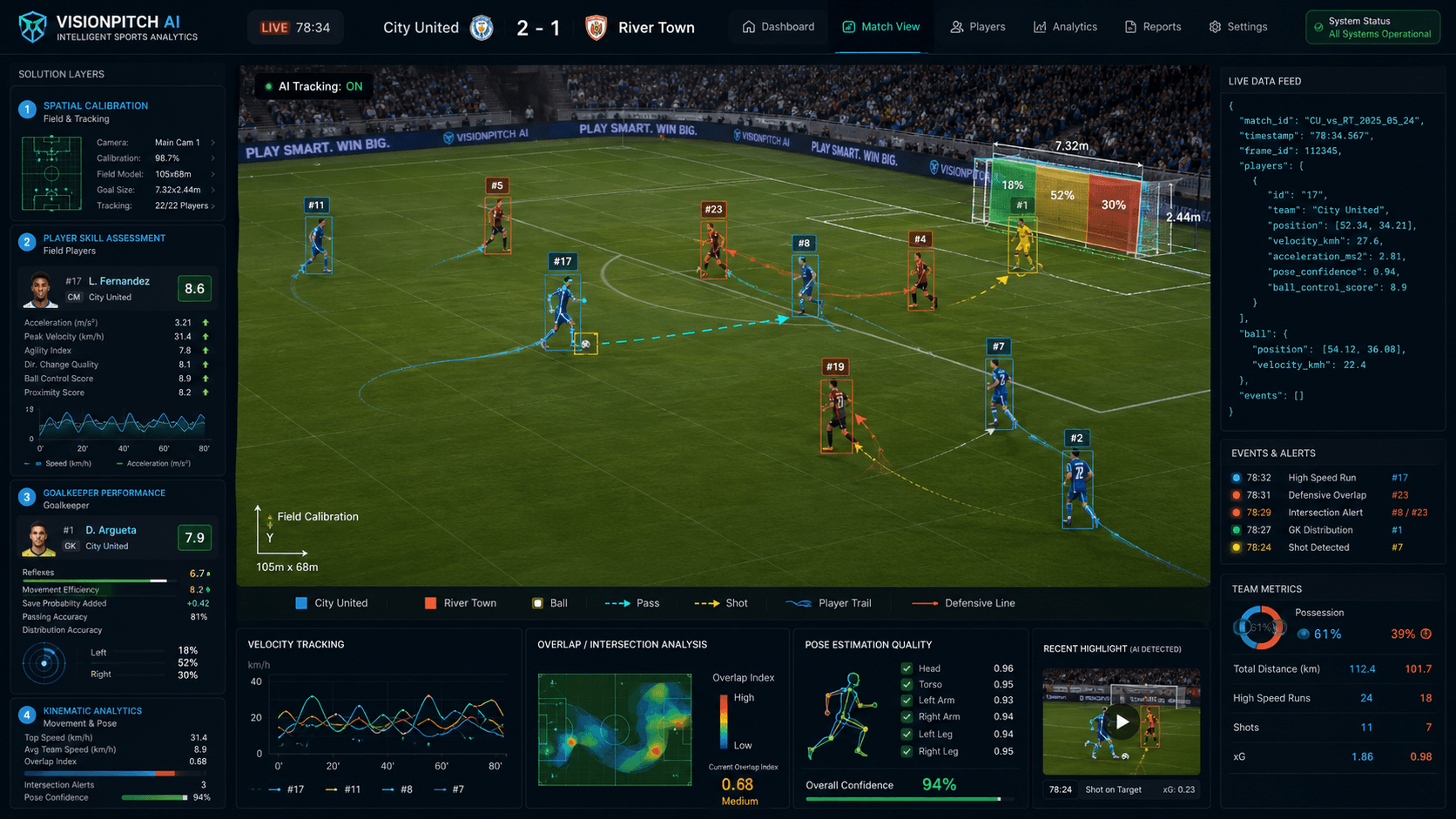
Folio3 built an end-to-end computer vision platform that converts raw video feeds into actionable data insights. The software utilizes deep learning architectures to isolate objects, recognize activities, and extract analytical data delivered via high-performance JSON APIs.
The system features four critical functional layers:
1. Spatial Calibration Engine
To accommodate different environments, the platform implements an optimized, single-frame calibration process. Users anchor foundational reference markers to adjust for lens distortion and map the 2D playing space relative to physical field boundaries and goal dimensions.
2. Field Player Skill Assessment
An activity-specific state machine automatically tracks performance sequentially through a structured training circuit. The module monitors player acceleration, peak velocity, directional change capabilities, and ball-to-player proximity to score control and agility metrics.
Tailored explicitly to defensive and distribution attributes, this layer monitors high-pressure match simulations. It evaluates specialized positional parameters, tracking reflexes, defensive movement direction, and the precise accuracy of throwing and passing distributions into distinct target zones.
4. Kinematic Analytics Pipeline
Instead of loose estimations, customized algorithms calculate structural measurements dynamically:
- Velocity Tracking: Frame-by-frame coordinate shifts measure physical and ball speed.
- Overlap Analysis: Continuous spatial intersection detection determines whether passes, shots, or movements successfully meet target boundaries.
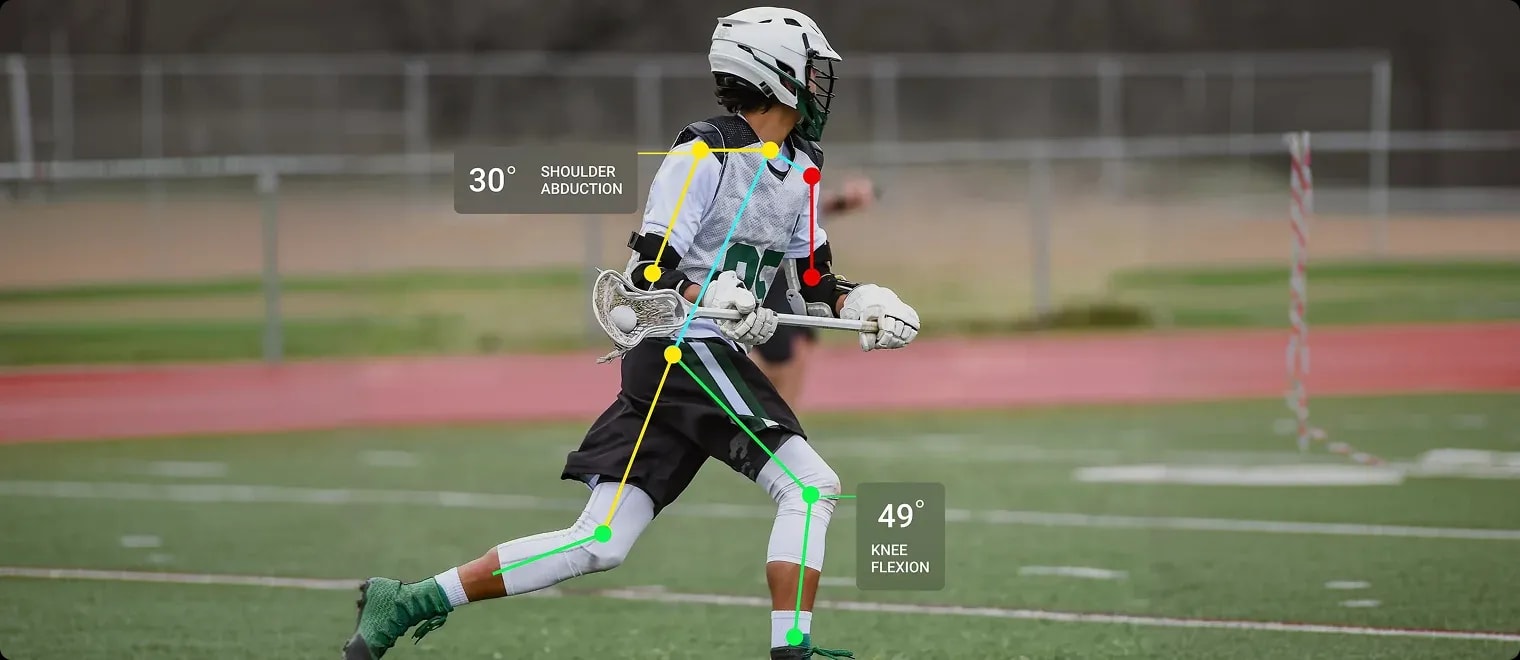
- Pose Estimation: Visual joint tracking tracks player orientation during high-intensity actions to issue quantitative technique ratings.
Result
- Hardware Agnostic Scouting: Successfully scaled talent analytics from elite stadiums directly to school grounds using basic smartphone tripods.
- 100% Objective Performance Data: Eliminated human bias from coaching evaluations by establishing standardized metrics for control, speed, and accuracy.
- Automated Data Ingestion: Integrated a frictionless pipeline that converts raw video files into structured JSON outputs via API for immediate central database evaluation.
- All-Weather Diagnostic Reliability: Achieved stable inferential accuracy across diverse conditions (sunny, overcast, floodlights) utilizing multi-environment dataset training pipelines.