


Enterprise AI Guardian for Safe LLM Scale.
Govern every prompt, document, agent, and model through one control plane for identity, policy, security, cost, and audit so enterprise AI can scale without shadow AI risk.
Microsoft Teams, Slack, Web App, Mobile, approved LLMs, internal agents, company knowledge, and business actions - governed together.
Stop Choosing Between Speed and Control.
Banning AI drives employee usage into the shadows. Ignoring it expands organizational risk. AI Guardian gives employees a useful way forward without giving IT, Security, Finance, or Risk less control.
Shadow AI Is Already Here.
Personal accounts, unapproved tools, sensitive uploads, fragmented subscriptions, and missing audit evidence leave organizations unable to see how AI is actually being used.



One governed path. Every AI interaction.
Before a request reaches a model, company knowledge base, agent, or business system, AI Guardian verifies identity, enforces policy, masks sensitive data, routes the request, and logs the outcome.
Five controls happen before the answer comes back.
A single employee request moves through identity, data protection, policy, model routing, agent execution, and audit logging - without forcing the employee to manage the complexity.
Start where employees already work.
The employee asks a question or uploads a file inside Microsoft Teams or the AI Guardian Web App. SSO matches the user to their role, department, and policy set.
Inspect data before it leaves.
The gateway scans prompts and documents for PII, secrets, prompt injections, and off-domain compliance violations before the request reaches an external model.
Choose the approved model automatically.
Policy verifies departmental quotas, user permissions, and model access before routing the request to the approved LLM for that role and task.
Let governed agents do the work.
When needed, specialized agents collaborate, retrieve company knowledge, and execute approved API actions while inheriting the same identity and security controls.
Return the answer with evidence.
The sanitized response is delivered to the employee while token usage, cost, policy decisions, model activity, and the identity-attributed conversation trace are logged.
Policy checks completed. Sensitive identifiers masked. Full identity and cost trace logged.
Stop Paying Frontier-Model Prices for Routine Work.
AI Guardian can govern model access by role and workload, so simple tasks use cost-efficient models while advanced reasoning is reserved for work that actually needs it.
One expensive model gets used for everything.
When organizations cannot see which models employees use for which tasks, low-complexity work can consume the same premium model capacity as high-value analysis and reasoning.
Match model capability to the work being done.
Role-based access, workload rules, approved model sets, and spend controls help route routine work toward lower-cost options while preserving premium models for complex reasoning, analysis, and high-impact workflows.
Blended AI spend
Example only - actual savings depend on workload mix and model pricing.Microsoft guidance recommends matching model capability to requirements, restricting access to approved models, and controlling usage patterns to avoid unnecessary AI spending.
The ≈30% savings figure and 100-to-25 task example above are AI Guardian scenarios, not Microsoft benchmarks or guaranteed savings. Actual results depend on workload complexity, model mix, token usage, pricing, routing rules, and user behavior.
Control the moments that create risk.
Instead of relying on after-the-fact monitoring, AI Guardian applies identity, content, data, model, and budget rules while the request is happening.
-dabebb8c-52bb-4158-9af9-c6f0a93248cd.png)
Shield sensitive data before LLM ingress.
Automatically detect and mask IBANs, Iqama or National ID numbers, phone numbers, financial details, and confidential content in prompts and multi-page attachments before data reaches the model.
Keep business AI on-domain and compliant.
Prevent misuse of organization-funded AI by declining off-domain requests and applying content controls that reflect corporate policy and ethics requirements.
-7adc68ba-ba12-4057-9cf9-703a656e9054.png)
Match model power to role and budget.
Set monthly spend caps, token quotas, and model permissions by department or user role so high-consumption models are reserved for the work that warrants them.
Move from basic chat to governed multi-agent work.
AI Guardian is not only a proxy for prompts. It can orchestrate specialized agents, company knowledge, and business actions under the same overarching governance layer.
-7b7fea75-2c69-4d9b-a4dd-f5a10fcaff25.png)
@ChatBuddy approve-invoice
Review the attached vendor invoice against procurement policy and the associated purchase order.
Control Plane
Reject the invoice. It includes an unlisted charge of
,200 that is not listed on the Purchase Order and lacks written procurement approval.Give every decision-maker the right level of control.
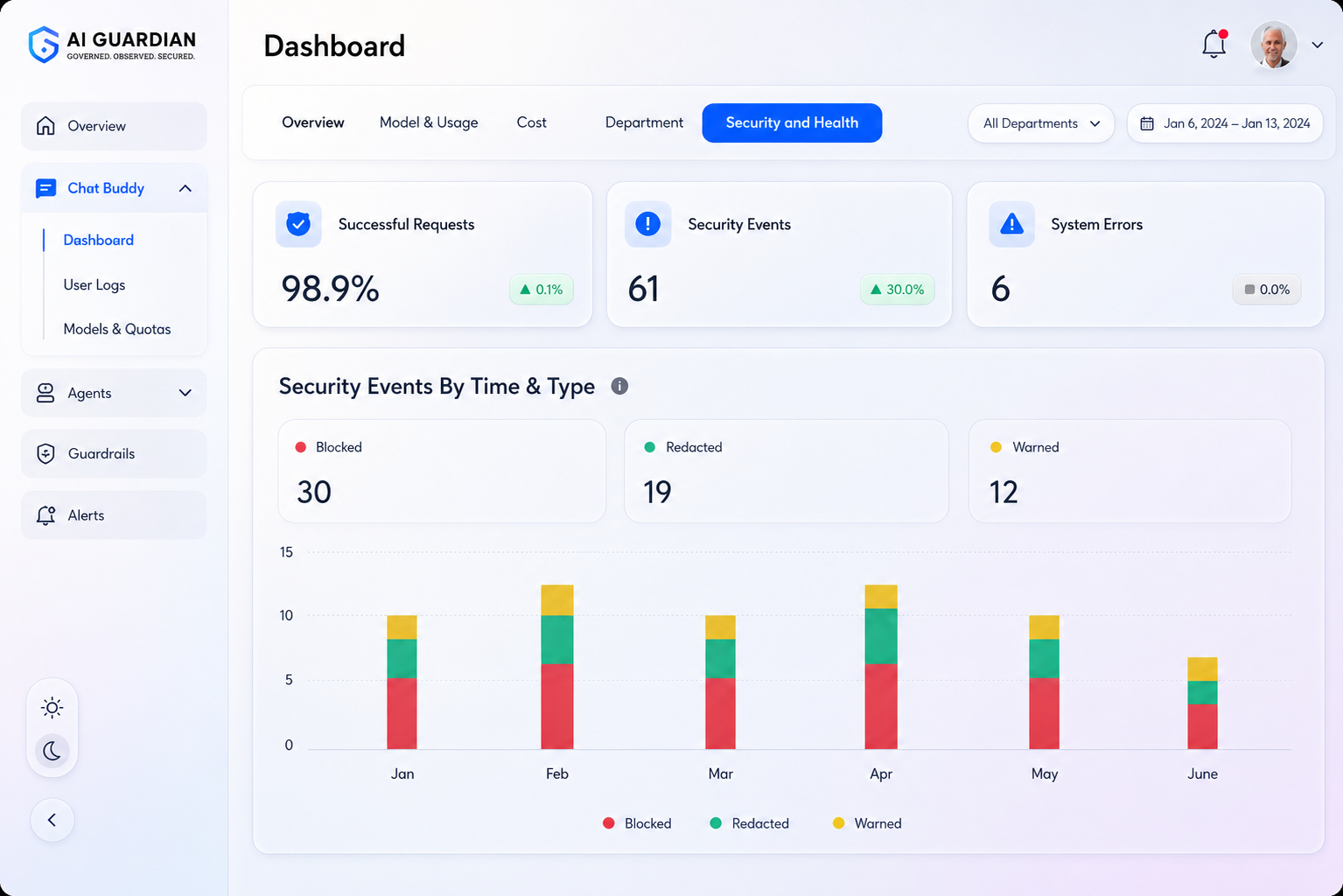
Department heads manage local quotas and model access. Risk and executive leadership see organization-wide usage, spend, blocked events, and identity-attributed audit history.
Set quotas, dollar caps, model availability, and monitor active departmental users.
See spend, security events, model distribution, user history, and complete audit traces.
-73058960-3f82-4342-ada8-2608adf5607c.png)
A Clear Investment to Launch and Scale.
Start with a one-time implementation investment, then continue with a predictable quarterly AI Guardian platform license.
Covers the implementation phase required to align, configure, deploy, validate, and prepare AI Guardian for go-live in your environment.
Ongoing quarterly licensing for continued use of the AI Guardian platform after the initial implementation and launch.
Final commercial terms may vary based on implementation scope, organizational complexity, integrations, deployment requirements, and licensing needs.
From Alignment to Deployment in Days.
A focused two-phase rollout aligns AI Guardian to your policies, users, controls, and cloud environment before go-live.
Understand your business, governance needs, and implementation scope.
- Review AI policies, governance, compliance, and regulatory requirements.
- Map LOBs, teams, organization hierarchy, and priority use cases.
- Define guardrails, model access, and policy requirements.
- Identify user roles, permissions, and approval boundaries.
- Align budgets, quotas, reporting needs, and governance ownership.
Configure AI Guardian to your requirements and deploy it in your environment.
- Configure the AI Guardian platform and organization hierarchy.
- Implement guardrails, policies, roles, and permissions.
- Set model access, budgets, quotas, and usage controls.
- Customize dashboards, reporting, and administrator views.
- Deploy inside your tenant and validate connectivity and configurations.
- Run smoke testing, go live, and hand over operational controls.
Where AI Guardian fits first.
Govern AI Around the Work People Actually Do.
AI Guardian can sit across industries and business functions to give employees approved access to models, agents, company knowledge, and business actions while applying the right identity, data, policy, model, cost, and audit controls.
Govern document analysis without exposing sensitive financial data.
Analysts can review policies, agreements, reports, and internal knowledge through approved AI while sensitive identifiers are masked, model access is controlled, spend is governed, and activity remains attributable to the user.
Give administrative teams governed access to AI for sensitive workflows.
Operations teams can use approved AI for internal documents, procedures, summaries, and knowledge access while identity, sensitive-data protections, model permissions, and usage controls remain consistently enforced.
Use AI for contract and policy work without losing governance.
Legal and compliance teams can analyze internal policies, contracts, and supporting documents through approved models while AI Guardian applies document protection, role-aware access, off-domain restrictions, and traceable activity.
Make employee AI useful without opening unrestricted model access.
HR teams can use AI for policy questions, internal knowledge, drafting, and routine employee-support tasks while access is limited by role, approved model, department, quota, and organizational policy.
Review vendor documents with governed agents and company policy context.
Procurement teams can compare agreements, invoices, and vendor information against internal policy using approved agents and knowledge while AI Guardian preserves the same identity, redaction, model, budget, and audit controls.
Replace scattered shadow AI with one governed employee access layer.
IT and Security can centralize approved model and agent access, define role and department policies, monitor usage and spend, block prohibited activity, and retain identity-attributed evidence across employee AI interactions.
AI Guardian is designed to apply controls by user, role, department, model, agent, and business context instead of forcing every team into the same AI access pattern.
More than an API gateway. More than a prompt filter.
AI Guardian combines the employee workplace, security enforcement, agent orchestration, spend governance, and executive visibility inside one control plane.
Explore AI Guardian
Explore AI Guardian’s Core Governance Capabilities
Go deeper into the controls enterprises use to discover unmanaged AI, manage risk, govern agent workflows, and route LLM traffic through one governed layer.
AI Risk Management Software
Build an AI risk inventory, apply controls by risk level, and keep operational evidence ready for governance and compliance review.
Explore risk managementShadow AI Detection Software
Find unmanaged AI usage, reduce blind spots from unapproved tools, and move employees toward a governed path for everyday AI access.
Explore shadow AI detectionAI Agent Governance
Control agent identity, permissions, model access, business actions, and audit trails across autonomous and multi-agent workflows.
Explore agent governanceEnterprise LLM Gateway
Put one governed layer between users and models for prompt inspection, model routing, budgets, permissions, and request-level logging.
Explore the LLM gatewayAI Guardrails Platform
Enforce AI usage policies in real time with configurable guardrails for sensitive data, prompt injection, content safety, access, and approved use.
Explore AI guardrailsQuestions teams ask before rollout.
AI Guardian is an enterprise AI control plane and governed workplace. It gives employees approved access to models, agents, company knowledge, and business actions while enforcing identity, security, PII protection, model routing, cost caps, and audit logging.
Standard AI gateways focus primarily on API routing and developer metrics. AI Guardian adds a complete employee workplace, multi-page PII redaction, multi-agent orchestration, and executive governance for department heads and risk leadership.
Yes. AI Guardian is designed for private deployment within enterprise cloud environments such as Azure, AWS, or GCP, aligned with network security, encryption, data residency, and tenant isolation requirements.
The platform intercepts prompts and uploaded documents in real time. Sensitive identifiers and confidential details can be redacted before the request is routed to a model provider.
Yes. Third-party and custom internal agents can plug into the agent registry so requests inherit the same identity controls, data redaction, spend tracking, and audit logging used for standard prompts.
By preventing organization-funded LLM capacity from being used for non-business tasks, teams can keep AI spend aligned to approved business use cases and make consumption more predictable.
Shadow AI is employee use of AI tools that IT and security have not approved. AI Guardian gives employees an approved path in Microsoft Teams or the Web App, so requests are tied to their identity, checked for sensitive data, routed to approved models and logged, instead of going to personal accounts.
Employees reach AI Guardian through Microsoft Teams, Slack, a Web App or Mobile. Requests are routed to the approved LLM for that user's role and task, based on policy, departmental quotas and model permissions. The approved model set is configured with your team during implementation.
AI Guardian is offered as a one-time implementation investment followed by a predictable quarterly platform license. Final terms depend on implementation scope, organizational complexity, integrations, deployment requirements and licensing needs, so Folio3 scopes pricing with you during an AI governance consultation.
Folio3 describes a focused two-phase rollout, from alignment to deployment in days. The first phase reviews your policies, teams, roles, budgets and priority use cases. The second configures guardrails, permissions, model access and dashboards, deploys inside your tenant, tests and hands over operational controls.

Your employees will use AI either way. Choose the environment you can govern.
Move AI out of the shadows and onto a platform your organization owns, governs, measures, and can defend with identity-attributed audit evidence.

