100 AI Job Replacement Statistics You Should Know in 2026
Since late 2022, workers aged 22 to 25 in the most AI-exposed US occupations have seen employment fall by as much as 16% relative to their peers, according to a Stanford Digital Economy Lab working paper revised in November 2025. That single number captures the split running through almost every AI employment debate: broad hiring hasn't collapsed, but a specific slice of the workforce is already absorbing the impact.
At the same time, the World Economic Forum's Future of Jobs Report 2025 projects a net gain of 78 million jobs worldwide by 2030, once 170 million new roles and 92 million losses are netted out. Both statements are true; they describe different time horizons, populations, and definitions of "replaced."
This article brings together the latest AI job replacement statistics, employment forecasts, workforce studies, industry estimates, and occupation-level data to explain how many jobs have already been affected, how many could be replaced by 2030, and which workers are most exposed to the next wave of AI-driven change.
The Most Important AI Job Replacement Statistics Right Now
Statistics | Source |
92 million jobs are projected to be displaced, while 170 million new jobs could be created by 2030. | World Economic Forum |
At least 173,568 US layoffs since 2023 have been attributed to artificial intelligence. | Challenger, Gray & Christmas |
Approximately 40% of jobs worldwide are exposed to artificial intelligence. | International Monetary Fund |
Generative AI could expose the equivalent of 300 million full-time jobs to automation. | Goldman Sachs |
Around 12.6% of US jobs are considered at high risk of AI-driven displacement. | SHRM |
AI and automation could eliminate approximately 6% of US jobs, equivalent to 10.4 million roles, by 2030. | Forrester |
Jobs requiring AI skills offer an average wage premium of approximately 62%. | PwC |
How Many Jobs Has AI Actually Replaced?
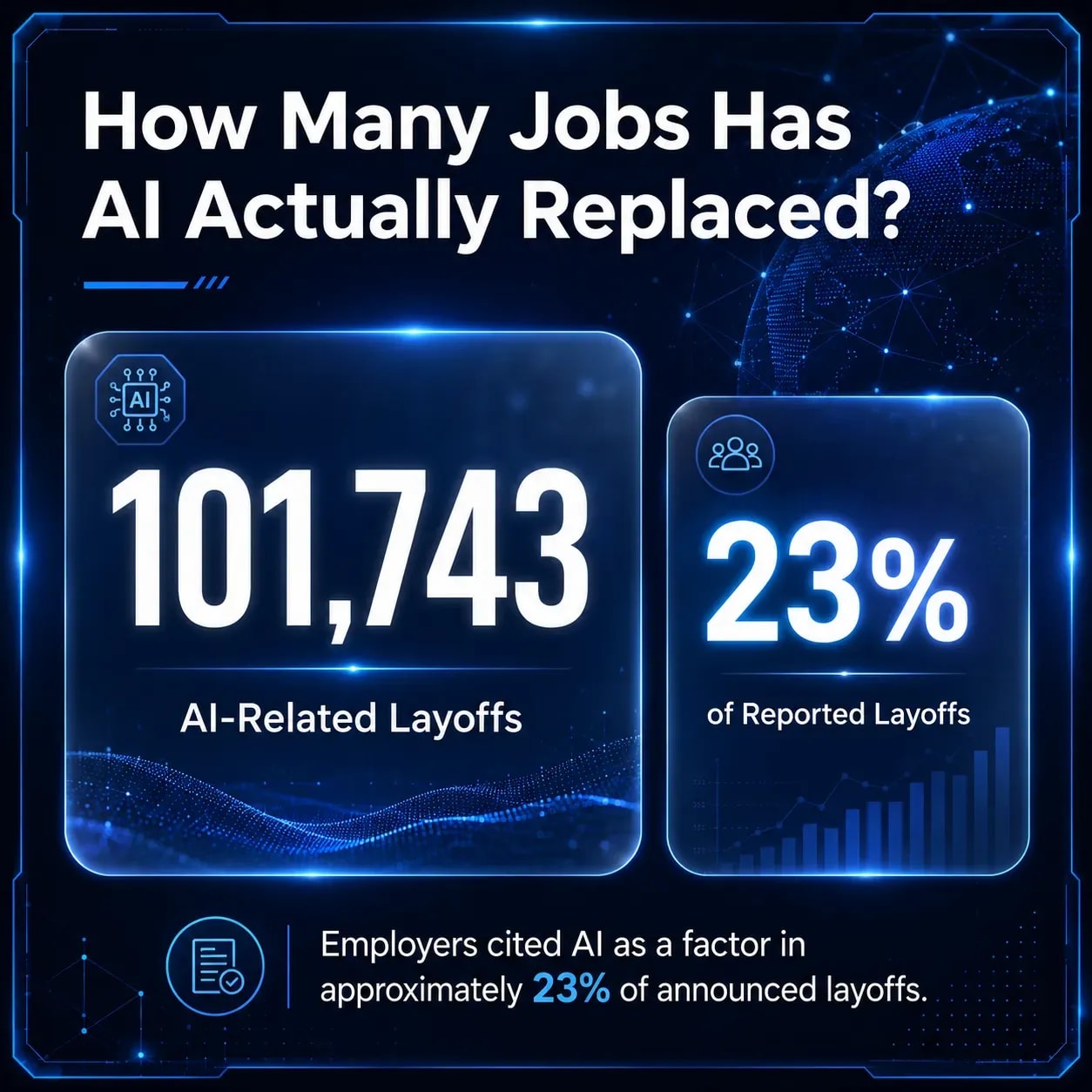
There is no single, agreed number. The closest running count of confirmed, employer-attributed AI layoffs comes from Challenger, Gray & Christmas, which has logged 173,568 US job cuts explicitly citing AI since 2023, including 54,836 in 2025 (5% of that year's cuts) and 101,743 through the first half of 2026 (23% of cuts so far). That is a real, if partial, count, not a total footprint, since many companies fold AI-related cuts into vaguer categories like "restructuring."
Year | What Happened | What the Data Shows | Important Context |
2022 | ChatGPT launched and research into AI-related job exposure accelerated. | This year serves mainly as the starting point for measuring the employment effects of generative AI. | Large-scale employment data was not yet available, so most findings focused on potential exposure rather than actual job losses. |
2023 | Challenger began recording AI as a separate reason for company layoffs. | Employers started explicitly identifying AI as a factor behind workforce reductions. | Because AI was a newly introduced reporting category, the figures may not capture every AI-related job cut. |
2024 | An estimated 54% of financial-services jobs were classified as having high automation potential. | Banking, insurance, and other financial roles appeared especially exposed to AI-driven task automation. | Automation potential does not mean that 54% of jobs were eliminated. It measures how much work could technically be automated. |
2025 | Employers attributed 54,836 layoffs to AI, representing about 5% of announced job cuts. Employment among workers aged 22–25 also fell by as much as 16% in highly AI-exposed occupations. | The evidence began showing both reported layoffs and measurable employment declines among younger workers. | Employers report layoff reasons, while the 16% figure represents a relative employment decline rather than a direct count of jobs replaced. |
2026, through June | Employers cited AI in 101,743 announced layoffs, accounting for approximately 23% of reported cuts during the period. | AI was being mentioned more frequently as a reason for workforce reductions than in the previous year. | This is a year-to-date figure and should not be treated as the final total for 2026. |
Sources: Challenger, Citi
AI Exposure vs. AI Displacement
Exposure means a job contains tasks AI can plausibly perform; displacement means a position has actually been removed, cut, or not refilled. Conflating the two is where most "AI has replaced X jobs" headlines go wrong.
Term | Meaning | What it does not mean | Example |
AI exposure | Tasks could be performed, supported, or accelerated by AI | The job has disappeared or will | A paralegal's document review is exposed even if the role continues |
Employment displacement | A position was removed, reduced, or not refilled, partly due to AI | Every exposed worker in that occupation lost their job | A bank cuts account-services headcount 10% over five years while keeping most roles |
Projected displacement | A model or survey estimates a future outcome | A confirmed, realized job loss | Goldman Sachs' 300 million exposed jobs is a projection input, not a body count |
Which Types of Tasks AI Is Automating First?
Occupations are bundles of tasks, not single automatable functions, which is why an "exposed" job so often survives with a changed task mix rather than disappearing outright.
Routine Cognitive Tasks
Data entry, basic bookkeeping, and standardized document processing are furthest along. The OECD's 2023 Employment Outlook found that among employers already using AI, roughly twice as many reported it automating repetitive tasks as reported it creating new ones.
Routine Manual Tasks
Warehouse picking, packing, and basic assembly are being reshaped by robotics paired with AI vision systems; DHL Trend Research has found that highly automated warehouses can run with about 25% fewer workers than manual ones, though staffing still needs to grow with volume.
Non-Routine Cognitive Tasks
Tasks such as drafting, research, analysis, document review, and code generation are increasingly supported by AI. These roles are more likely to be transformed through automation and productivity tools than eliminated entirely, as human judgment, expertise, and accountability remain important.
Non-Routine Manual Tasks
Skilled trades, healthcare, construction, maintenance, and other hands-on roles generally face lower automation exposure. These jobs often require physical dexterity, real-world decision-making, adaptability, and direct interaction with people or changing environments.
Task category | Estimated exposure | Example tasks | Near-term risk |
Routine cognitive | High | Data entry, invoice processing, scheduling | High |
Routine manual | Moderate-high | Picking, packing, basic assembly | Moderate |
Non-routine cognitive | Moderate | Drafting, first-pass review, code generation | Moderate |
Non-routine manual | Low | Skilled trades, direct patient care, site work | Low |
AI Job Replacement Statistics by Industry
See how AI is changing employment across major industries, where jobs face displacement, transformation, and new demand for specialized skills.
Customer Service
AI is increasingly used for chatbots, call routing, ticket classification, and first-response support. Most companies are using it to handle repetitive inquiries while human agents manage complex, sensitive, or high-value customer interactions.
Manufacturing
AI-powered robotics and computer vision are automating inspection, sorting, assembly, and equipment monitoring. In many factories, automation is helping address labor shortages and improve productivity rather than replacing entire workforces.
Banking and Finance
Banks are using AI across fraud detection, risk assessment, compliance, customer support, and back-office processing. Routine operational roles face higher exposure, while demand is growing for employees who can manage AI systems, interpret outputs, and oversee regulatory requirements.
Legal Services
AI can assist with document review, legal research, contract analysis, and first-draft preparation. However, legal judgment, negotiation, client advice, and accountability remain difficult to automate fully.
Healthcare
AI is supporting medical imaging, clinical documentation, diagnostics, scheduling, and administrative work. It is more likely to reduce repetitive workload and assist healthcare professionals than replace roles that require patient care, clinical judgment, and human interaction.
Retail
Self-checkout systems, demand forecasting, inventory automation, and personalized recommendations are changing how retail work is performed. Traditional cashier and stock-management roles may decline, while fulfillment, customer experience, and technology-supported positions continue to grow.
Transportation and Logistics
Warehouses are adopting AI for picking, sorting, route planning, inventory tracking, and demand forecasting. Automation is progressing faster in controlled warehouse environments than in road transport, where safety, infrastructure, and regulation remain significant barriers.
Administrative and Clerical Work
Administrative roles are among the most exposed because many tasks involve data entry, scheduling, document processing, and routine communication. AI may reduce demand for basic clerical work while increasing the need for employees who can manage exceptions, coordinate workflows, and verify outputs.
Technology and Software
AI tools are assisting developers with coding, testing, debugging, documentation, and system design. Entry-level and repetitive tasks may decline, but demand remains strong for experienced professionals who can design systems, review AI-generated work, and solve complex technical problems.
Generative AI is speeding up content drafting, design, research, campaign planning, and performance analysis. Rather than removing every creative role, it is changing production workflows and increasing expectations for faster output, stronger strategy, and human-led quality control.
Which Workers Face the Greatest AI Job Risk?
AI-related employment risks are unevenly distributed, with entry-level workers, younger employees, women, and routine-role professionals facing greater pressure as hiring practices continue to change rapidly.
Entry-Level Workers
Entry-level workers face greater risk because many junior tasks, such as research, data entry, basic analysis, and first-draft creation, can now be supported by AI. The impact often appears through fewer graduate roles and reduced junior hiring rather than immediate layoffs.
Mid-Level and Senior Workers
Indeed found senior-level US postings up 14.7% year-over-year as of May 2026 even as entry-level postings fell 6.2-7.5%, and PwC's 2026 Barometer found AI-exposed entry-level roles are now seven times more likely to require senior-level skills like judgment and leadership.
Younger vs. Older Workers
Stanford found no comparable decline for more experienced workers in the same AI-exposed occupations. France's INSEE recorded a similar pattern: IT and information-services employment fell 3% between 2023 and 2025, with workers aged 15-29 responsible for -3.8 points of that decline while workers 30-54 gained 1.4 points.
Gender Differences
Women face higher exposure mainly through occupational concentration, not any skill gap. As generative AI development accelerates across industries, the ILO found female-dominated occupations nearly twice as likely to be exposed to generative AI as male-dominated ones (29% versus 16%). Brookings found that of the 6.1 million US workers facing both high exposure and low adaptive capacity, 86% are women, concentrated in clerical and administrative roles.
Workforce segment | Observed or projected change | Most-affected roles | Measurement type |
Entry-level (ages 22-25), US | -16% relative employment in AI-exposed roles | Software engineering, customer service | Observed |
Senior-level, US | +14.7% postings YoY | Engineering, senior tech roles | Observed |
Youth (15-29), France | -3.8 points of IT employment decline | IT, publishing, consulting | Observed |
Female-dominated occupations | 29% GenAI exposure vs. 16% in male-dominated | Clerical, administrative, customer support | Exposure estimate |
Source: Stanford Digital Economy Lab, Indeed Hiring Lab, INSEE, ILO
Why Is AI Replacing Some Jobs?
AI is replacing some jobs because businesses use automation to reduce costs, improve efficiency, address shortages, and remain competitive globally.
Cost Reduction
Companies adopt AI to lower operating costs by automating repetitive work, reducing manual effort, and redirecting budgets toward technology, innovation, and higher-value business activities overall.
Productivity Gains
AI helps employees complete tasks faster, analyze information efficiently, and manage larger workloads, encouraging companies to restructure teams and reduce dependence on certain workplace roles.
Agentic Capabilities and Continuous Availability
AI agents can perform defined workflows independently, operate continuously, respond instantly, and handle routine decisions, reducing the need for constant human involvement and daily supervision.
Labor Shortages and Compliance Automation
Organizations use AI to address worker shortages, manage compliance tasks, monitor risks, and maintain operations where recruiting, retaining, or scaling human teams remains difficult today.
Competitive Pressure
Companies adopt AI to keep pace with faster-moving competitors, improve services, accelerate decision-making, and protect market position as technology rapidly reshapes customer and industry expectations.
AI-First Mandates
Leadership teams increasingly make AI central to business strategy, redesigning roles, workflows, and hiring priorities around automation, AI enablement, data-driven decisions, and new technology-focused capabilities for growth.
The Financial Impact of AI-Driven Job Replacement
AI-driven job replacement affects wages, productivity, employment structures, and long-term economic growth. While automation can reduce demand for certain roles, it also increases the value of employees with AI-related skills. Companies adopting AI often generate more output and revenue with fewer manual processes. At the same time, some workers may face displacement or need retraining as job requirements change. The overall financial impact therefore includes both cost savings for businesses and new earning opportunities for skilled workers.
Financial indicator | Key finding | What it means |
Pay advantage for AI skills | Workers with AI-related skills earned an average 62% wage premium, up from 56% in 2025. | Employees who can work with AI are becoming more valuable, even as automation reduces demand for some traditional roles. |
AI wage premium by industry | The wage premium ranged from 118% in consumer markets to 16% in government roles. | The financial value of AI skills differs by industry, depending on adoption levels, commercial demand, and the complexity of AI applications. |
Productivity growth in AI-exposed industries | Productivity growth increased from 7% during 2018–2022 to 27% during 2018–2024. | Industries adopting AI more extensively are producing greater output with the same or fewer resources. |
Revenue generated per employee | Revenue per employee grew three times faster in highly AI-exposed sectors than in less-exposed sectors. | AI helps companies generate more revenue from each employee by automating tasks and improving operational efficiency. |
Projected contribution to global GDP | Generative AI could increase global GDP by 7%, or approximately $7 trillion, over ten years. | AI-driven productivity, innovation, and new business activity could create significant economic value worldwide. |
Potential workforce displacement | An estimated 6%–7% of workers could be displaced during the AI adoption period. | Some workers may lose existing roles or require retraining as companies redesign jobs around AI-supported workflows. |
Employment growth at AI-exposed companies | Headcount grew 52% at the most AI-exposed firms, compared with 36% at the least-exposed firms since 2018. | AI adoption does not always reduce total employment, but it often shifts hiring toward technical and higher-skilled roles. |
Note: These statistics measure different financial outcomes, including wages, productivity, employment, and economic growth. They should be interpreted separately rather than combined into a single estimate.
Sources: PwC, Goldman Sachs, PwC
AI Job Replacement Statistics by Region
AI’s impact on employment varies by region based on economic structure, workforce skills, digital infrastructure, and adoption levels. Advanced economies face greater exposure because they have more knowledge-based and administrative roles. Emerging and low-income economies currently face lower automation risk but may also receive fewer productivity benefits. These figures represent potential AI exposure rather than confirmed job losses.
Region | Key statistic | Regional impact |
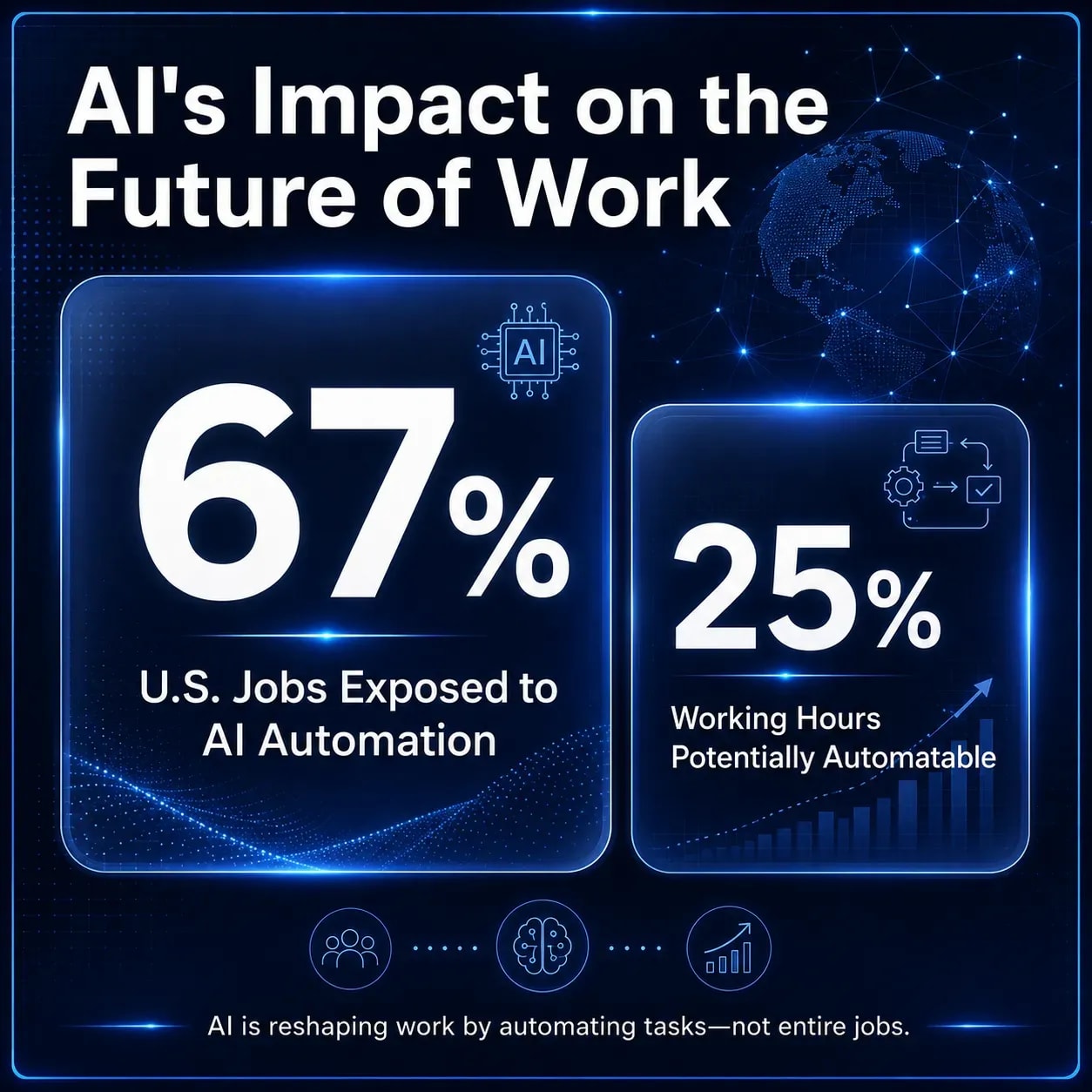
North America | Around 67% of US jobs are exposed to some automation, with approximately 25% of working hours potentially automatable. | AI-related layoffs and weaker entry-level employment are increasing, although exposure does not mean complete job elimination. |
Europe | Around 27% of working hours could be automated by 2030. | Businesses may gain productivity, but many workers could require retraining as employment-related AI regulations expand. |
Advanced economies | Approximately 60% of jobs are exposed to AI. | These economies face the greatest disruption but are also best positioned to benefit from AI-driven productivity. |
Emerging markets | Around 40% of jobs are exposed to AI. | Automation may progress more slowly because of limited infrastructure and a higher share of physical work. |
Low-income economies | Approximately 26% of jobs are exposed to AI. | Near-term disruption is lower, but limited digital investment may also restrict productivity and economic gains. |
Note: AI exposure measures how much work could be affected or transformed. It does not represent the percentage of workers expected to lose their jobs.
(Sources: Goldman Sachs, McKinsey, IMF)
Jobs Expected to Decline vs. Jobs Expected to Grow
The World Economic Forum provides some of the most detailed occupation-level forecasts on how AI and automation may reshape employment by 2030. Postal service clerks are expected to experience the fastest decline, with employment falling by 40%, followed by bank tellers and related clerks at 35% and data entry clerks at 34%.
In terms of total jobs lost, cashiers, administrative assistants, and executive secretaries are expected to face the largest reductions because these roles employ large numbers of workers and involve many repetitive tasks.
AI will also create new employment opportunities. AI and data-processing technologies are projected to generate 11 million jobs while displacing 9 million, resulting in a net gain of approximately 2 million roles. Expanded digital access could create 19 million jobs while displacing 9 million.
Robotics and automation are the main technology category expected to have a negative overall employment impact. The WEF estimates that they could eliminate around 5 million more jobs than they create.
How to Prepare for AI Job Disruption?
Preparing for AI-driven workforce change requires more than identifying jobs that could be automated. Organizations should evaluate individual tasks, strengthen workforce capabilities, establish responsible oversight, and create transition pathways before making employment decisions.
Assess Tasks First
Evaluate which activities within each role can realistically be automated instead of assuming the entire position is no longer required. Goldman Sachs estimates that around 44% of legal tasks are exposed to AI, while the realized displacement risk is closer to 17%, showing that automation is often absorbed into existing roles.
Build AI Skills
Help employees develop skills that allow them to work alongside AI, including prompt design, data interpretation, workflow automation, and AI quality assurance. PwC reports a 62% wage premium for AI-related skills, highlighting their growing value across industries.
Strengthen Human Expertise
Invest in capabilities that remain difficult for AI to replicate, including professional judgment, physical dexterity, creativity, relationship management, and direct human trust. Roles built around these capabilities generally face lower automation exposure.
Monitor Early Signals
Track changes in hiring activity, workload distribution, entry-level opportunities, and required skills rather than relying only on layoff announcements. Shifts in recruitment and task allocation often appear before changes become visible in overall headcount.
Support Internal Mobility
Create reskilling and internal transfer programs for employees in highly exposed roles. This is particularly important for clerical workers, who may have fewer comparable career pathways without structured training and transition support.
Maintain Human Oversight
Require human review for AI systems involved in hiring, performance evaluation, promotion, disciplinary action, or termination. The EU AI Act classifies employment-related AI systems as high-risk because of their potential impact on workers’ rights and opportunities.
Measure Workforce Impact
Analyze how AI adoption affects different employee groups, including younger workers, women, entry-level staff, and employees in administrative roles. Aggregate employment figures can hide significant differences in how disruption is distributed.
Prepare Before Restructuring
Folio3 AI helps organizations assess AI readiness, evaluate task-level automation opportunities, and redesign workflows responsibly. This enables businesses to separate genuine automation potential from roles that still require human judgment before making workforce decisions.
Conclusion
AI is reshaping employment rather than simply eliminating it. While routine, clerical, and entry-level tasks face the greatest disruption, new roles are emerging in AI, data, technology, and human-centered work. The impact varies across industries, regions, age groups, and skill levels, making broad job-loss claims misleading. Businesses should assess task-level exposure, invest in reskilling, support internal mobility, and maintain human oversight in workforce decisions.
For workers, developing AI-related skills, domain expertise, judgment, creativity, and relationship-building capabilities will be essential. The future of work will depend on how responsibly organizations balance automation, productivity, workforce transition, and inclusive economic opportunity for everyone.
Frequently Asked Questions
How many jobs has AI replaced so far?
There is no verified global total. The clearest available evidence comes from reported US layoffs linked directly to AI, but the actual number may be higher because companies do not always disclose AI as a factor.
How many jobs are being replaced by AI right now?
AI is currently affecting jobs mainly by automating parts of roles, reducing hiring, and changing workforce requirements. In many cases, tasks disappear before entire positions are removed.
How many jobs will AI replace by 2030?
The World Economic Forum expects millions of jobs to be displaced by 2030, but it also predicts that even more new roles will be created as industries adopt AI and digital technologies.
How many jobs could AI affect in the next decade?
Hundreds of millions of jobs may be exposed to some level of automation. However, exposure does not mean every role will disappear, as many jobs will instead be redesigned around AI-supported workflows.
Which industries are most affected by AI job replacement?
Administrative, clerical, banking, compliance, customer service, and legal roles face some of the highest exposure because they involve repetitive, structured, and information-heavy tasks.
Will AI create more jobs than it replaces?
Current projections suggest AI and related technologies could create more jobs than they eliminate. However, the workers losing roles may not automatically qualify for the new positions created.
Which jobs are safest from AI replacement?
Jobs requiring physical dexterity, human trust, complex judgment, creativity, and direct interaction are generally less exposed. These include skilled trades, healthcare, construction, maintenance, and relationship-based roles.