Every AI project begins the same way: a spreadsheet, a vendor demo, and a question nobody wants to answer out loud. The question is whether your team actually has what it takes to build what you need, or whether you should just buy something and move on. That tension is where most enterprise AI decisions either compound or collapse.
McKinsey's 2025 Global AI Survey found that while 88% of organizations now use AI in at least one function, only 5.5%, roughly 109 out of nearly 2,000 respondents, report that AI accounts for more than 5% of their enterprise EBIT. That gap does not trace back to bad technology. It traces back to poor sourcing decisions made before a single model was trained.
The AI build vs buy choice is not a procurement question. It is an architectural decision that determines what your organization can do with AI, how fast, and at what long-term cost. Getting it wrong means either overpaying for capability you could have bought off the shelf, or ceding strategic control to a vendor who will price accordingly in year three.
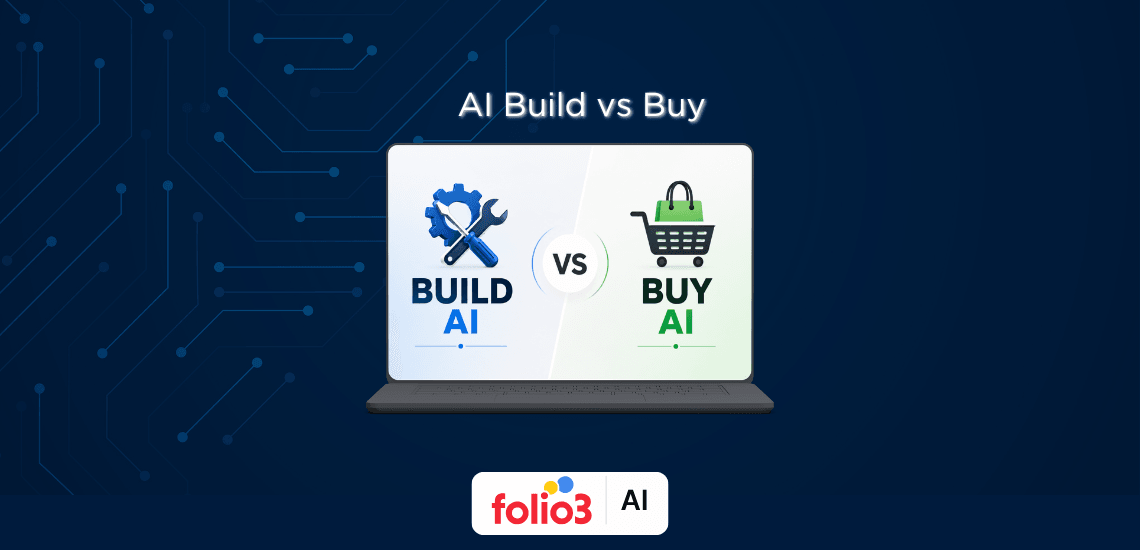
What "Build vs Buy" Actually Means in AI?
"Build" means your engineering team develops AI models, pipelines, and deployment infrastructure in-house. You own the training data, the model weights, the retraining cycles, and the production stack. Nothing moves without your team's involvement — which is both the strength and the cost.
"Buy" means licensing a pre-built AI platform or SaaS tool, configuring it to your workflows, and handing model maintenance and compliance coverage to the vendor. You trade control for speed.
The decision sits at the intersection of strategy, talent, data governance, and long-term cost, not just what the technology team prefers this quarter.
The Core Trade-Offs at a Glance
Dimension | Build | Buy |
Time to value | 6–18 months | 4–12 weeks |
Customization | Full control | Vendor-constrained |
Upfront cost | High (talent, infra, tooling) | Lower (licensing, integration) |
Long-term TCO | Lower at scale | Scales with usage/seats |
Data control | Complete | Shared or limited |
Vendor lock-in | None | High |
Talent requirements | ML engineers, MLOps, data scientists | Integration specialists, prompt engineers |
Compliance coverage | You own it | Vendor covers baseline; gaps remain |
When to Build AI In-House
Building makes sense when the capability you need is genuinely yours, when no vendor can replicate the competitive logic embedded in your data, your workflows, or your customer relationships. If a bought platform can do what you need, you probably should not be building.
Core IP or competitive differentiation
If your AI system encodes how you price, underwrite, route, or personalize, that logic is a business asset. Many high-value enterprise AI use cases depend on proprietary data and decision-making processes that competitors cannot easily replicate. Handing that capability to a vendor means your competitor can buy the same advantage next quarter.
Sensitive regulated data (PHI, PII)
Healthcare organizations and financial firms face data residency and access-logging requirements that most SaaS vendors cannot meet by default. In-house deployment gives you full control over where data goes and who touches it.
Deep proprietary system integration
When your AI needs to read from a legacy ERP, multiple internal data lakes, and systems that predate REST APIs, vendor connectors will not cover the last mile. Custom builds let you own the integration layer.
Long-term capability ownership goals
Organizations building AI maturity over a three-to-five-year horizon benefit from internal ownership. Each build cycle trains your team, generates institutional knowledge, and reduces dependency on vendors who will raise prices at scale.
High-volume, high-frequency inference workloads
When your AI runs millions of inferences daily, like fraud scoring, real-time recommendations, and dynamic pricing, vendor API costs compound fast. Owning the inference stack at scale almost always produces a lower per-call cost than paying per API request.
"The enterprises that come to us having already built internal AI foundations move ten times faster on custom development than those starting from scratch. The build decision is not just about the tool — it builds the team." — Abdul Sami, Sr. Software Architect & Head of AI Development, Folio3.
Buying is the right call for use cases where the problem is standardized, your team lacks AI depth, or speed to deployment is the overriding constraint. The mistake enterprises make is applying build logic to cases that don't need it.
Commoditized, standardized use cases
Document parsing, meeting transcription, basic sentiment analysis, and HR FAQ automation are solved problems. Dozens of production-grade tools handle these well. Rebuilding from scratch when a vendor does it at enterprise scale wastes 12 months you do not have.
Speed-to-value is the priority
When the board wants a working AI system next quarter, build timelines are not compatible. Bought platforms with pre-built connectors and vendor-managed compliance can go live in weeks, and that speed has real business value in competitive markets. For many companies adopting AI, the ability to deploy quickly and demonstrate measurable outcomes outweighs the benefits of building a custom solution from day one.
Limited internal AI/ML talent
A bought platform does not require ML engineers. It requires integration talent and domain experts who configure workflows. If your team lacks the data science bench, buying is not a compromise; it is the rational choice.
Vendor covers compliance coverage gaps
Enterprise AI vendors increasingly ship with SOC 2 Type II, HIPAA BAA, ISO 27001, and FedRAMP certification as standard. A vendor's certifications can close a compliance gap that would take your team 18 months to build independently.
Budget constraints favor predictable OpEx
Build projects carry unpredictable CapEx, talent, compute, and failed experiments. Bought platforms convert AI spend into predictable subscription costs that finance teams can model, approve, and audit without open-ended engineering budget exposure.
"There's a category of AI use case where buying is not only faster — it's permanently cheaper. The mistake is applying built logic to commodity problems. Save your engineering capital for the decisions that actually differentiate your business." — Muhammad Nasir, Senior Project Manager, Folio3
Operationalize AI Across Your Enterprise
We help enterprises embed AI into core operations — moving from strategy to scalable, production-ready systems with measurable business impact.
Explore AI Enablement Services
The Hybrid Path: Own vs. Orchestrate
Most mature enterprise AI architectures end up here: a foundation of bought infrastructure, with proprietary models or fine-tuned layers on top. The question shifts from build or buy to what you own and what you orchestrate.
Buy infrastructure, build differentiation
Use cloud-native AI platforms, like Azure OpenAI, AWS Bedrock, and Google Vertex, for foundational model access, vector storage, and inference infrastructure. Build on top of them: the fine-tuned layers, the retrieval pipelines, the domain-specific prompting architecture that encodes your business logic.
What to retain as enterprise IP
Retain ownership of your training data, your fine-tuned model weights, your evaluation harness, and your integration logic. These are the components that compound in value and create a foundation for long-term artificial intelligence enablement across the organization. The underlying model is a commodity. What you build on it is not.
Last-mile customization explained
Vendors get you 80% of the way to a working system. Last-mile customization covers the remaining 20%: connecting to your internal systems, handling edge cases your data generates, applying your terminology and business rules. That 20% is where build logic applies, even inside a primarily bought architecture.
The 80/20 buy-build rule of thumb
A practical starting point: buy 80%, like models, infrastructure, monitoring, and compliance tooling. Build 20%: the integration layer, the domain-specific fine-tuning, and the evaluation pipeline. For many organizations, this approach serves as an effective AI adoption roadmap, balancing speed, cost, and customization while allowing AI capabilities to mature over time. Adjust the ratio based on how proprietary your use case actually is.
Total Cost of Ownership: A 3-Year View
Year-one cost comparisons are almost always misleading. The build option looks expensive. The buy option looks affordable. By year three, the economics often reverse — but not always, and not automatically.
Year 1 snapshot vs. 3-year reality
Build costs front-load heavily: talent, infrastructure, and tooling hit immediately. Buy costs start low but compound with usage growth, seat expansion, and contract renewals. The crossover point depends on usage volume, vendor pricing structure, and how stable your use case remains over time.
Five hidden build costs enterprises miss
Year-one build budgets routinely undercount model retraining cycles, GPU infrastructure scaling, data labeling costs, MLOps tooling such as model registries, experiment tracking, and CI/CD for ML, along with the sunk cost of failed experiments that never reach production. These overlooked expenses are a significant factor behind the high AI implementation failure rate reported across enterprise initiatives, where projects often struggle to move from pilot to production.
Maintenance, drift, and model decay costs
AI models degrade as real-world data distributions shift away from training data. Keeping a custom model production-grade requires scheduled retraining, monitoring pipelines, and ongoing data engineering time, none of which appear in year-one budget projections.
Vendor pricing scale-up risk
SaaS AI vendors price per seat, per API call, or per data volume processed. Costs that look manageable at pilot scale become significant at enterprise volume. Contract terms that seemed reasonable at signing rarely account for how aggressively usage grows by year two.
Opportunity cost of internal engineering time
Every engineer hour spent maintaining a custom AI system is an hour not spent on product development, new use cases, or strategic initiatives. Organizations running an AI enablement program must weigh whether internal resources are better allocated to maintaining infrastructure or accelerating AI adoption across business units. Build decisions carry an ongoing opportunity cost that finance teams rarely model but engineering leaders feel directly.
Running a Real TCO Comparison
Abstract TCO arguments produce abstract decisions. A grounded comparison forces both options through the same set of inputs, not just what each costs in month one, but what each costs when usage doubles, and the contract comes up for renewal.
Start with total engineering hours, not headcount
Salary lines undercount build costs. The real input is total engineering hours across the project lifecycle, like initial development, integration, retraining cycles, monitoring, and incident response. An honest build estimate accounts for all of it, not just the team you hired to ship version one.
Project usage growth on both sides
Buy costs scale with usage. Build costs are largely fixed after initial deployment. A TCO comparison that holds usage flat across three years will always favor buying. Run the comparison at your realistic growth trajectory, then run it again at two times that volume.
Account for compliance and audit overhead
Compliance is not free on either path. Build teams carry the full cost of internal audits, documentation, and regulatory evidence production. Buy teams inherit vendor certifications but still absorb the cost of vendor security reviews, contract negotiation, and gap remediation where the vendor's coverage falls short of your requirements.
Factor in switching costs on the buy side
TCO models for bought platforms routinely omit the cost of leaving. Data migration, workflow reconstruction, retraining staff on a new system, and contract exit penalties are real costs that only appear if you model the full vendor relationship, not just the onboarding phase.
When build crosses over buy on a 3-year horizon
Build becomes the lower-cost option when usage volume is high and predictable, the use case is stable enough to limit retraining frequency, and internal talent is already in place. Buy remains cheaper when usage is unpredictable, the use case evolves faster than a custom model can be retrained, or the team lacks MLOps depth to maintain what was built.
How to Evaluate Your AI Use Case
Before committing to either path, run your use case through a structured evaluation. The goal is to separate what feels strategic from what actually is, because most enterprises overestimate how proprietary their AI needs really are.
Ask whether the output depends on your data
The clearest signal for build is when the AI system's value comes directly from data only you possess: your transaction history, your clinical records, and your customer behavior patterns. If a competitor could license the same platform and get a functionally equivalent output, the use case is commoditized. Buy it.
Assess data readiness before committing either way
Neither path works without clean, accessible, well-governed data. Before choosing build or buy, audit what you actually have: labeled training data, data pipeline maturity, and access controls. Many organizations use AI readiness assessment services to identify gaps in data quality, governance, infrastructure, and operational capabilities before committing to an AI strategy. A build decision made before data readiness is confirmed almost always runs over budget. A buy decision made without data readiness produces a platform that nobody can configure properly.
Map time pressure against strategic value
Use cases with high time pressure and moderate strategic value almost always belong in the buy column. Use cases with lower time pressure and genuinely proprietary requirements belong in the build column. The mistake is applying urgency logic to strategic decisions, buying something fast that you will need to replace in 18 months because it cannot do what you actually need.
Separate the pilot from the production decision
Many enterprises buy a platform for a pilot, then discover the vendor cannot support their production requirements, like volume, integration depth, compliance coverage, or customization. Evaluate use cases against production requirements from the start, not pilot requirements. The economics and feasibility of both paths look very different at scale.
Score feasibility across four dimensions
Before finalizing any build or buy decision, score the use case across: data readiness, internal talent availability, compliance exposure, and time-to-value pressure. Use those scores to rank your options honestly — not to justify a decision already made for political or budget reasons.
Build vs Buy AI: Common Failure Modes Enterprises Must Avoid
The AI build vs buy decision has predictable failure modes. Most of them come from compressing a strategic decision into a procurement process.
Comparing year-one costs only
Year-one numbers always favor buying. The problem is that vendor contracts are written for year one. By year three, usage has grown, seats have expanded, and the renewal conversation happens from a weak position. Enterprises that skip the three-year projection often underestimate the true cost of implementing AI and end up locked into pricing they never modeled.
Underestimating the talent requirement for building
Building AI requires data scientists, ML engineers, MLOps specialists, and data engineers working in coordination, not a software development team with good intentions. Organizations that greenlight build decisions before confirming talent availability either hire under pressure at inflated cost or ship models that are not production-grade and degrade quietly after launch.
Overbuilding for problems that are already solved
Custom development has a real engineering cost and a real opportunity cost. Spending 12 months building a document classifier or a meeting summarization tool that three enterprise vendors already do well at scale is not a strategic investment; it is a misallocation that delays the work that actually differentiates your business.
Treating vendor lock-in as a future problem
Lock-in in AI compounds faster than in traditional SaaS. Training data processed through a vendor's infrastructure, workflows encoded in proprietary formats, and teams skilled only in vendor-specific tooling all create switching costs that grow with every month of deployment. The time to negotiate data portability, exit clauses, and format standards is before signing, not when the renewal arrives.
Deploying without an evaluation harness
Without benchmark datasets, defined performance metrics, and regular model audits, there is no objective basis for knowing whether the system is working or when it stops working. This applies to both paths. A bought platform that quietly degrades and a custom model experiencing concept drift look identical without instrumentation in place to catch either one.
Transform Your Enterprise With Production-Grade AI
Our AI transformation programs help enterprises reimagine workflows, automate decisions, and build intelligent systems that deliver lasting competitive advantage.
See Our AI Transformation Approach
Industry-Specific Signals: Build or Buy?
The right answer also depends on your industry. Regulatory exposure, data structure, and the nature of competitive advantage vary significantly across sectors.
Healthcare
PHI handling requirements, clinical specificity of training data, and liability exposure from general-purpose models in care decisions push healthcare organizations toward building or heavily customizing. Shared vendor infrastructure rarely satisfies the data governance requirements that regulators and legal teams impose.
Financial services
Model decisions must be auditable and aligned with SR 11-7, the EU AI Act, and the NIST AI RMF. Effective enterprise AI governance is essential for ensuring accountability, transparency, and regulatory compliance across AI initiatives. Vendor compliance claims require independent verification; risk committees will ask for model governance documentation that most AI platform sales decks do not include.
Manufacturing
Predictive maintenance and quality inspection models can often be bought. The build decision in manufacturing is the integration layer, connecting AI outputs to PLCs, SCADA systems, and legacy ERP environments that vendor connectors rarely reach without custom development.
Retail and CX
Product recommendations, demand forecasting, and personalization use cases are well-served by mature vendor platforms. The underlying algorithms are commoditized. What separates retailers is data quality and configuration depth, not who built the model.
Legal and professional services
Law firms and consulting practices hold decades of proprietary work product that general-purpose models have never seen. Building retrieval and reasoning systems on that institutional knowledge creates a competitive moat that no vendor platform can replicate.
Conclusion
The AI build vs buy decision is not a technology question; it is a strategic one. Enterprises that treat it as procurement end up overpaying for bought tools they outgrow, or underdelivering on build projects they were never staffed to complete. The right answer starts with an honest read of your use case: how differentiated is it, how sensitive is your data, how much internal talent do you have, and what does the three-year cost picture actually look like?
Start Your AI Transformation Today
Talk to our team about where you are in your AI journey — we'll map a clear path from your current state to enterprise-wide transformation.
Talk to an AI Expert
Frequently Asked Questions
1. What is the main difference between building and buying AI?
Building AI means developing custom models and systems in-house, giving you full control over data, architecture, and capabilities. Buying means licensing a pre-built AI platform that you configure for your workflows, faster to deploy, but with less flexibility and higher vendor dependency over time.
2. Is it cheaper to build or buy an AI solution?
Neither is categorically cheaper. Buying typically costs less in year one; building often costs less by year three at high usage volumes. The crossover depends on vendor pricing structure, internal talent costs, and how aggressively your usage scales.
3. What is the total cost of ownership in AI decisions?
TCO in AI includes not just licensing or development costs but also model retraining, infrastructure scaling, compliance overhead, integration maintenance, MLOps tooling, and the internal engineering time required to keep the system performing accurately as data distributions shift.
4. When does building AI in-house make strategic sense?
Building makes sense when the AI system encodes proprietary business logic, when your data carries compliance obligations that limit third-party access, when vendor connectors cannot reach your internal systems, or when you are investing in long-term internal AI capability rather than just solving a short-term problem.
5. What is a hybrid AI approach?
A hybrid approach uses bought infrastructure, like cloud-based foundation models, vector databases, inference APIs, as the base layer, and builds proprietary components on top: fine-tuned model layers, custom integration logic, and domain-specific evaluation pipelines. Most mature enterprise AI architectures follow this pattern.
6. How long does it take to build a custom AI system?
A production-ready custom AI system typically takes 6 to 18 months, depending on data readiness, team size, and use case complexity. Systems that require significant data labeling, infrastructure buildout, or regulatory validation sit toward the longer end of that range.
The primary risks are vendor lock-in (proprietary formats, data dependency, switching costs), scale pricing that becomes expensive at enterprise usage volumes, insufficient customization for proprietary workflows, and compliance coverage gaps that the vendor's marketing obscures but your legal team will eventually surface.
8. How do enterprises handle AI vendor lock-in?
Enterprises mitigate lock-in by negotiating data portability clauses upfront, avoiding vendor-specific data formats for training datasets, building abstraction layers between their applications and vendor APIs, and maintaining internal evaluation benchmarks so they can objectively assess alternatives when contracts come up for renewal.
9. What is the NIST AI RMF, and why does it matter?
The NIST AI Risk Management Framework is a voluntary framework published by the National Institute of Standards and Technology that helps organizations identify, assess, and manage risks across the AI system lifecycle. It matters for enterprise build vs buy decisions because it sets the governance standard that regulators and enterprise procurement teams increasingly reference when evaluating AI deployments.
10. Can small enterprises afford to build AI in-house?
Small enterprises rarely have the ML engineering bench or budget to build from scratch. For most, a hybrid approach, buying infrastructure and making targeted customizations, provides the best combination of speed, cost, and capability without requiring a full internal AI team. The exception is when the use case is genuinely proprietary and the competitive stakes justify the investment.