AI Adoption is now mainstream
The year 2025 marked a decisive turning point for artificial intelligence adoption across global enterprises. What began as experimental pilots in 2023 has evolved into production-scale deployments that are fundamentally reshaping how businesses operate, compete, and deliver value.
Business owners, technology leaders, and innovators worldwide increasingly recognize the transformative potential of AI in driving operational excellence, enhancing customer experiences, and creating competitive advantages in today's fast-paced digital economy.
This wrap-up examines AI adoption trends across major industries, explores the factors driving successful implementations, highlights Folio3 AI's key achievements and client deliveries in 2025, and identifies emerging trends that will shape business strategy in 2026 and beyond.
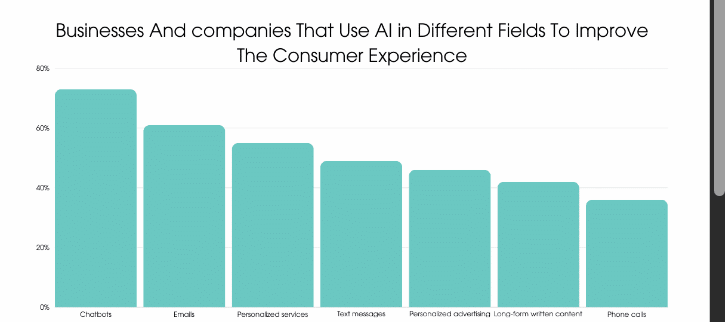
77% of companies use AI or are planning to use it in their business operations.
This surge in adoption reflects several key factors:
Production-scale AI deployment: 72% to 88% of organizations have already deployed AI in production environments, with another7% having fully scaled it, demonstrating the technology's evolution from experimental to essential infrastructure.
Generative AI surged quickly: Use of generative AI jumped dramatically in 2024, with many firms reporting regular use in at least one business function, and adoption continues to grow through 2025.
Maturity gap remains: While a sizable share of firms spend heavily on GenAI, many still struggle to prove ROI or keep projects operational long-term. High-maturity organizations show far better trust and staying power in their AI initiatives.
See What AI Innovation Can Do for Your Business
Partner with Folio3 AI to turn emerging technologies into practical, scalable business impact.
Book a Consultation
What is the current state of artificial intelligence (AI)?
This year demonstrated the strong maturity of AI technology. More than ever before, businesses are successfully leveraging intelligent algorithms to support both internal operations and customer-facing applications. The overall percentage of AI-ready companies has surged significantly.
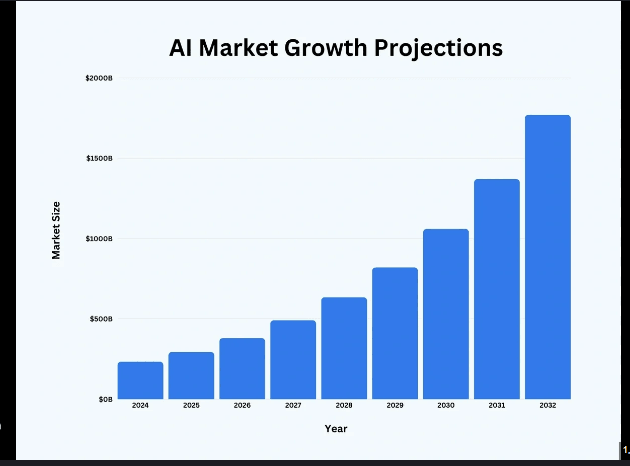
AI market growth projections
Year | Market Size | Change Over the Previous Year |
2024 | $233.46 billion | - |
2025 | $294.16 billion | ↑ $60.7 billion |
2026 | $380.05 billion | ↑ $85.89 billion |
2027 | $491.03 billion | ↑ $110.98 billion |
2028 | $634.41 billion | ↑ $143.97 billion |
2029 | $819.66 billion | ↑ $185.25 billion |
2030 | $1.06 trillion | ↑ $240.34 billion |
2031 | $1.37 trillion | ↑ $310 billion |
2032 | $1.77 trillion | ↑ $400 billion |
Source: Exploding Topics
AI adoption by technology
AI technology has matured from experimental deployments to production-scale implementations across industries. Organizations are leveraging AI to automate complex processes, extract actionable insights from data, and improve operational efficiency in ways that were not possible just a few years ago.
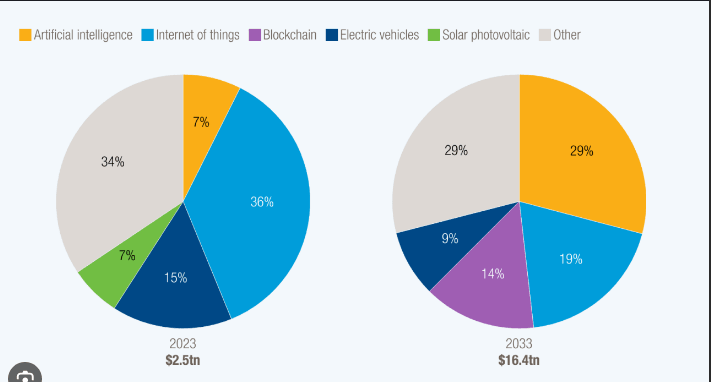
Technology adoption patterns (2023-2033)
The distribution of AI investment across technology categories shows clear trends:
- Artificial Intelligence (7% → 29%): The core AI category shows explosive growth as enterprises move from experimentation to production deployment across multiple use cases.
- Internet of Things (36% → 19%): While IoT remains significant, its relative share decreases as AI-specific applications mature and differentiate from broader IoT implementations.
- Blockchain (15% → 14%): Steady adoption continues in specific use cases, particularly in supply chain, finance, and identity verification applications.
- Electric Vehicles (7% → 9%): Growing adoption of AI-powered autonomous and semi-autonomous vehicle systems drives steady market expansion.
- Solar Photovoltaic (34% → 29%): While percentage share declines, absolute market value continues growing as renewable energy adoption accelerates globally.
Source: UN Trade and Development
AI adoption by industry
The past decade has seen a surge in the adoption of intelligent systems across all industries. From retail to healthcare to manufacturing, businesses of all sizes are turning to AI to improve their operations and better serve their customers.
Industry | Adoption Level | Notes |
Software / IT | Leader | Broad production use; strong genAI uptake; highest maturity/value realization |
Telecommunications | Leader | Network ops automation; customer-care copilots in production |
Financial Services | High | Mature risk/fraud ML; rapid genAI pilots in CX/ops |
Healthcare | Medium | Growing use (coding, triage, imaging assist) but uneven productionization |
Manufacturing | Medium–Low | Vision/QC and predictive maintenance pockets; US adoption ~16% vs services ~25% |
Energy & Utilities | High (exploration) | ≈74% report implemented or exploring AI; grid forecasting, maintenance |
Retail / CPG | Medium | Demand forecasting, pricing optimization, genAI for content scaling |
Public Sector | Medium–Low | Pilots expanding; governance & procurement slow rollouts |
Real Estate & Construction | Low | Early pilots (estimating, safety vision); limited production use |
Chemicals & Materials | Low | R&D use rising; enterprise deployment lagging |
Fashion / Apparel | Low | Limited production AI; some genAI content and demand pilots |
Source: McKinsey and others
AI technology adoption by type
Different AI technologies are maturing at varying speeds across industries. Organizations are strategically selecting specific AI capabilities based on business objectives, technical readiness, and competitive pressures rather than adopting technology indiscriminately.
Large language models (LLMs)
Enterprise LLM adoption has become standard practice across major industries. Organizations increasingly favor domain-specific models over general-purpose systems for improved accuracy and relevance in specialized business applications requiring contextual understanding.
Generative AI
Generative AI adoption reached 71% of organizations in 2025, up from 65% in early 2024. The technology has moved from experimental to operational status, with organizations deploying it for content creation, code generation, and business process automation.
AI agents
AI agent adoption has accelerated rapidly, with 79% of organizations now deploying agents at some level. The AI agent market reached $7.38 billion in 2025, nearly doubling from $3.7 billion in 2023, and is projected to reach $103.6 billion by 2032.
Machine learning models
Traditional machine learning remains foundational for predictive analytics and operational optimization. Organizations continue deploying ML models for demand forecasting, predictive maintenance, and data analysis across business functions.
Computer vision
Computer vision market growth accelerated across industries in 2025, driven by automation demand and improved AI capabilities. Manufacturing leads adoption at 35%, followed by healthcare at 27% and security applications at 26%, primarily deployed for quality inspection, facial recognition, and autonomous systems.
Major AI technology releases in 2025
Model | Company | Release Date | Key Capabilities |
Llama 4 | Meta | April 2025 | Scout and Maverick variants advancing open-source AI. Text-image processing and agent-like workflows. |
GPT-5 | OpenAI | August 2025 | Unified advanced reasoning with multimodal processing. Significant improvements in math and coding benchmarks. |
Sora 2 | OpenAI | September 2025 | Physics-accurate video generation with synchronized audio. Realistic videos with proper object permanence. |
DeepSeek R1 | DeepSeek | September 2025 | Demonstrated significant efficiency gains with substantially lower training costs than comparable Western models. |
Gemini 3 | Google | November 2025 | First model to surpass 1500 Elo on LMArena benchmarks. 1-million-token context window. |
Grok 4.1 | xAI | November 2025 | Real-time reasoning and live data integration with top leaderboard positions with reduced hallucination rates. |
Claude Opus 4.5 | Anthropic | November 2025 | Extended thinking capabilities and reasoning transparency. Particular strength in coding tasks, document analysis, and enterprise applications. |
Veo 3 | Google | December 2025 | Advanced video generation producing 4K videos up to two minutes long. Outperformed competitors in human evaluations with superior motion consistency. |
What to expect from AI technology in 2026?
Foundational AI developments
Agentic AI and multi-agent systems
AI evolves from answering questions to executing multi-step workflows independently. It has been predicted that 40% of enterprise applications will embed task-specific agents by late 2026, though 40% of projects risk cancellation due to complexity and unclear ROI.
World models and digital twins
Industry is now moving toward world models. Digital replicas predict physical movement and run real-time simulations. Unlike text-based LLMs, these understand spatial relationships and dynamics, critical for robotics, autonomous systems, and gaming applications.
Physical AI integration
Intelligence moves to edge devices like smart glasses, AI wearables, and factory robots. Physical AI enables machines to perceive and act in real-world environments in real-time, with robotics integration accelerating across logistics, manufacturing, and warehousing.
Domain-specific language models
Smaller, specialized models fine-tuned for healthcare, law, and finance replace general-purpose LLMs. Domain-specific language models deliver higher accuracy, lower costs, and better regulatory compliance. Edge AI deployment expands for privacy and speed optimization.
Massive infrastructure investment
Hyperscalers will spend over $500 billion on AI infrastructure in 2026. First gigawatt-scale GPU clusters start operation early in the year, representing unprecedented computing power dedicated to AI training and inference capabilities.
1- Next-gen assistants
More powerful multi-modal tools for reasoning and real-time collaboration emerge. Google ecosystem tools will dominate workspace automation and content generation, enabling seamless integration across documents, spreadsheets, presentations, and communication platforms for enhanced productivity.
2- Intelligent search
Advanced search tools remain top research partners, delivering cited, noise-free information in real-time. AI-powered search engines will prioritize source verification and context accuracy, reducing information overload while providing comprehensive answers with transparent attribution.
3- Project management
Project management platforms evolve to autonomously summarize statuses, predict resource bottlenecks, and manage complex schedules. AI agents handle routine coordination tasks, allowing teams to focus on strategic decisions while maintaining visibility across workflows and dependencies.
4- Video and image creation
Text-to-video generation reaches high-fidelity output with improved consistency and control. Image generation tools achieve new realism levels and precise text rendering capabilities, enabling designers to create production-ready assets with minimal manual refinement required.
5- Advanced coding
Coding assistants evolve beyond autocomplete to offer "repository intelligence," understanding entire codebase context and history. AI suggests complex refactorings, identifies technical debt patterns, and maintains architectural consistency across large-scale projects with minimal developer intervention.
Ready to Accelerate Your AI Journey?
Discover how Folio3 AI is helping businesses transform operations, unlock growth, and lead innovation across industries.
Talk to an Expert
How will businesses become AI-ready in 2026?
Establish executive leadership and strategy
Ensure your CEO directly oversees AI governance. Organizations with CEO-level ownership report significantly stronger financial outcomes. Implement top-down AI programs with centralized platforms rather than crowdsourcing initiatives. Treat AI as a strategic transformation requiring organizational rewiring, not an IT project to delegate.
Build a data infrastructure foundation
Audit your data infrastructure for AI readiness; data must be trustworthy, governed, contextualized, and aligned to specific use cases. Modernize pipelines, consolidate fragmented silos, and implement metadata standards with lineage tracking. Establish real-time data availability and treat data governance as AI's strategic enabler.
Invest in talent and training
Plan to reskill significant portions of your workforce within three years. Extend AI training beyond technical roles, embed AI fluency across all business functions. Organizations with comprehensive training programs are 65% more likely to deploy AI successfully at scale.
Select focused use cases
Avoid pilot purgatory by selecting 3-5 high-impact workflows with measurable business outcomes. Prioritize use cases offering clear ROI, standardized processes, and clean data. Scale proven implementations rather than running 20 disconnected experiments simultaneously.
Implement governance and security frameworks
Establish comprehensive AI governance policies with automated enforcement and continuous scanning. Prepare for EU AI Act compliance (August 2026) if serving EU markets. Build evidence-quality audit trails; organizations with strong audit capabilities show 20-32 point advantages on AI readiness metrics.
Redesign workflows for human-AI collaboration
Fundamentally redesign workflows rather than layering AI onto existing processes. Define clear boundaries where agents work autonomously versus requiring human oversight. Remember: technology delivers 20% of value; workflow redesign delivers 80%.
Deploy a scalable technology stack
Build centralized orchestration platforms with unified command centers for deployment and monitoring. Verify vendors offer genuine agentic capabilities; only approximately 130 thousand vendors provide legitimate agent technology. Avoid "agent washing" and vendor lock-in.
Measure business outcomes continuously
Track business outcomes, not adoption percentages. Measure AI value through P&L impact, EBIT contribution, and market differentiation. High-performing organizations commit 20%+ of digital budgets to AI and review AI performance dashboards daily alongside financial metrics.
Folio3 AI’s focus areas and achievements in 2025
During the year, Folio3 AI successfully acquired and delivered more than 6 AI-driven projects in collaboration with companies across multiple industries. These projects demonstrated our breadth of expertise, ranging from AI solutions in sports technology to AI-powered transportation and vehicle detection systems.
In parallel with our client work, we conducted a series of webinars on Vibe Coding for the finance industry, aimed at helping financial institutions modernize their development practices.
We also proudly launched Pronto, our AI-powered review management platform designed to help businesses transform customer feedback into actionable insights.
Generative AI services
Throughout 2025, Folio3 AI expanded its generative AI practice to address growing enterprise demand for production-ready AI systems. Our service offerings encompass the complete implementation lifecycle:
- AI-powered chatbot development: Design and deployment of conversational systems engineered for customer engagement, support automation, and internal knowledge management
- Large Language Model (LLM) solutions: Custom model development, architecture selection, and enterprise deployment infrastructure.
- LLM fine-tuning services: Domain adaptation of pre-trained models using client-specific datasets to achieve specialized performance.
- AI agent development: Creation of autonomous systems capable of multi-step reasoning, tool utilization, and goal-oriented task execution.
- ChatGPT and commercial API integration: Production-grade implementation of third-party LLM services with appropriate safeguards and monitoring.
- Healthcare-specific AI solutions: Development of HIPAA-compliant chatbots and AI agents designed for clinical documentation and patient interaction.
- Retrieval-Augmented Generation (RAG): Implementation of systems that combine language model capabilities with enterprise knowledge retrieval.
- Prompt engineering: Systematic optimization of AI interaction patterns to ensure output quality, consistency, and alignment with business requirements.
- Enterprise AI integration: End-to-end incorporation of generative capabilities into existing business systems and workflows.
AI in sports
Folio3 AI worked with sports organizations to deploy performance analysis systems in 2025 that reduced manual video review time while increasing the depth and objectivity of performance assessment. Our technology enables coaching staff to focus on strategic decision-making rather than data collection and basic analysis.
- Performance analysis: Automated tracking and assessment of player movements, technique evaluation, and skill development progression monitoring.
- Video analysis capabilities: Frame-by-frame breakdown of athletic performance across multiple sports disciplines.
- Injury prevention systems: Gait analysis, movement pattern recognition, and fatigue detection to identify injury risk factors.
- Tactical intelligence: Game strategy analysis, opponent scouting capabilities, and play pattern recognition.
- Fan engagement technology: Enhanced viewing experiences through real-time statistics, player tracking visualization, and augmented analytics.
- Talent identification: Objective assessment frameworks for evaluating athletic potential and optimizing recruitment decisions.
Automatic license plate recognition (ALPR) solutions
In 2025, Folio3 AI deployed ALPR systems for transportation and security applications, demonstrating the technology's maturity and reliability in production environments. Our implementation approach emphasizes accuracy, processing speed, and system reliability to ensure consistent performance under operational conditions.
- ALPR for law enforcement: Automated vehicle identification, stolen vehicle detection, and real-time alert systems integrated with law enforcement databases.
- AI smart parking solution: Frictionless entry/exit automation, real-time occupancy monitoring, and integrated payment processing for parking facilities.
- Smart city ALPR software: Traffic flow analysis, parking enforcement automation, and data collection infrastructure for urban planning initiatives.
- ALPR camera integrations: Hardware integration supporting multiple camera manufacturers and deployment configurations across various environmental conditions.
- ALPR integration solutions: End-to-end system integration with existing security platforms, fleet management software, and enterprise business systems.
- ALPR for commercial fleets: Vehicle tracking, route optimization, and unauthorized usage detection for logistics and delivery operations.
- ALPR for waste fleet operations: Route verification, service documentation, and compliance monitoring for municipal and commercial waste collection.
- ALPR for food and beverage distribution: Fleet tracking with delivery verification supporting cold chain compliance in temperature-controlled logistics.
Cattle counting solutions
Folio3 AI deployed cattle counting solutions across livestock auction facilities and commercial feedlot operations in 2025, demonstrating the technology's reliability in production agricultural environments.
- Cattle counting for livestock transport and auction houses: Automated counting during loading/unloading operations, reducing transaction time and ensuring accurate record-keeping at auction facilities.
- Cattle counting solution for feedlots and livestock farms: Real-time headcount verification, movement tracking, and inventory management for commercial feeding operations.
New Product launch: Pronto AI review management
In 2025, Folio3 AI launched Pronto, an intelligent AI-powered online review management platform that transforms how businesses handle Google reviews and online reputation.
What Pronto does: Pronto enables businesses to collect, track, and auto-respond to Google reviews directly through WhatsApp, making review management fast, stress-free, and radically simple. The platform eliminates the complexity of traditional review management systems by bringing everything into a familiar messaging interface.
Key features of Pronto:
WhatsApp-based review management: Manage Google reviews effortlessly right from WhatsApp. Get instant alerts, review summaries, and AI-suggested replies all in one chat. Approve, edit, or post with a tap, with no app switching required.
AI-powered smart replies: Pronto's AI generates on-brand responses matched to customer sentiment. When a new Google review arrives, the AI drafts an appropriate reply that you can approve, edit, or send with a single tap. You maintain full control while the AI handles the heavy lifting.
Instant Google review sync: Every new review is delivered to your WhatsApp in real time, with no manual checking needed. The platform automatically monitors your Google Business Profile and notifies you immediately when reviews come in.
Sentiment analysis and rating tracking: Built-in sentiment analysis helps you understand customer feedback patterns. Track ratings, monitor customer sentiment trends, and protect your reputation with automated insights.
Automated workflow with full control: Set auto-reply for 4 and 5-star reviews to ensure consistent engagement, while maintaining approval control for other responses. The system learns from your edits and approvals, making replies more personalized over time.
Secure cloud storage: Every review and response is safely stored, searchable, and accessible anytime. Keep a complete record of your customer interactions and reputation management activities.
It can be connected in three simple steps:
- Connect your accounts - Link your business WhatsApp and Google Business Profile.
- Reply with AI - Review AI-drafted responses and approve or edit before posting.
- Track and improve - Monitor trends, refine AI replies, and watch your reputation grow.
Industry education: Vibe coding webinars for finance
In 2025, Folio3 AI conducted specialized webinars focused on Vibe Coding for the finance industry, addressing the unique challenges and opportunities of applying modern AI development methodologies in financial services.
What is Vibe Coding?
Vibe Coding represents a modern approach to AI development that emphasizes rapid prototyping, iterative refinement, and close collaboration between business stakeholders and technical teams. Unlike traditional waterfall development, Vibe Coding enables faster time-to-value and ensures AI solutions align with actual business needs.
Webinar focus areas:
AI development for financial services: The webinars demonstrated how financial institutions can adopt Vibe Coding principles to accelerate AI implementation while maintaining the rigor and compliance requirements essential in the finance sector.
Rapid prototyping in regulated environments: We explored practical approaches to building and testing AI prototypes for financial use cases, including fraud detection, risk assessment, customer service automation, and trading analytics, while maintaining necessary compliance and governance frameworks.
Balancing speed with compliance: A key focus was addressing how to move quickly in AI development while meeting stringent regulatory requirements, including model explainability, audit trails, bias detection, and compliance documentation.
Why these webinars mattered: Financial institutions often face unique challenges in AI adoption due to regulatory complexity and risk management requirements. Our Vibe Coding webinars provided frameworks for accelerating AI development while maintaining the governance that financial services demand.
Key topics included:
- Building minimum viable AI products in regulated environments
- Iterative model development with stakeholder feedback
- Risk management in agile AI development
- Creating effective cross-functional AI teams
- Tools and platforms for rapid AI prototyping in finance
- Change management for AI adoption in traditional financial organizations
The webinar series engaged participants from banks, fintech companies, insurance providers, and asset management firms, reflecting the broad interest in modernizing AI development approaches across the financial services industry.
Let’s Build the Future With AI
Explore how our 2025 innovations can help your organization create smarter products, better decisions, and stronger outcomes.
Book a Consultation
How Folio3 AI helps businesses become AI-enabled?
Strategic AI consultation and roadmapping
We begin every engagement by understanding your business objectives and identifying where AI creates measurable impact. Through comprehensive consultation, we assess your current infrastructure, data readiness, and organizational capabilities to develop tailored AI strategies that optimize ROI rather than deploying technology for technology's sake.
Custom AI solution development
Rather than forcing you into rigid platforms, we build custom end-to-end solutions aligned to your specific business processes and industry requirements. Our 15+ years of experience across Fortune 500 enterprises and startups enable us to architect AI systems that integrate seamlessly with your existing workflows and scale as your organization matures.
Industry-specific expertise and contextualization
As AWS partners with ML Services Competency, we bring deep domain knowledge across healthcare, financial services, manufacturing, retail, logistics, and 10+ other industries. We understand industry-specific regulations, compliance requirements, and operational challenges, enabling us to build AI solutions that work within your real-world constraints rather than laboratory conditions.
Flexible talent augmentation for AI capability building
We provide you with on-demand access to specialized AI talent including data engineers, ML specialists, and computer vision experts. This flexible staffing model allows you to scale AI capabilities without long-term hiring commitments, addressing the critical talent shortage while building internal AI competency over time.
End-to-end integration and operational support
We handle complete implementation from data pipeline architecture to model deployment and monitoring, ensuring your AI systems operate reliably in production environments. Our approach transforms you from an AI experimenter to an AI operator by establishing the infrastructure, governance, and processes required for sustained AI success.
About Folio3 AI
Since 2014, Folio3 AI has been helping global companies leverage the power of AI and data analytics to achieve business outcomes. As a leading AI technology partner, we handle the full-cycle process of digital transformation, including consulting, design, implementation, and maintenance.
With proficiency in artificial intelligence, computer vision, generative AI, and machine learning, Folio3 AI has helped over 150 clients from the USA, UK, EU, and other countries bring their projects across the goal line and make sense of trending technologies.
As a recognized leader, Folio3 AI is listed among the top AI service providers and maintains AWS Partner status with ML Services Competency.
Our expertise includes:
- AI Consulting: Strategy, architecture, implementation planning, and AI readiness assessment
- AI Agent Development: Autonomous agents, multi-agent systems, and vibe coding for low-code AI solutions
- Computer Vision Development: Object detection, image recognition, video analysis
- Generative AI Services: LLM development, chatbot creation, RAG implementations
- Large Language Models: Custom LLM fine-tuning, domain-specific model development, prompt engineering
- Machine Learning Solutions: Predictive analytics, custom model development, MLOps
North America Phone: +1 (408) 412-3813 Email: contact@folio3.ai
Visit us online Website: www.folio3.ai LinkedIn: linkedin.com/company/folio3ai Facebook: facebook.com/Folio3AI