
Artificial Intelligence
LangChain vs LangGraph: Which AI Agent Framework Is Better in 2026?
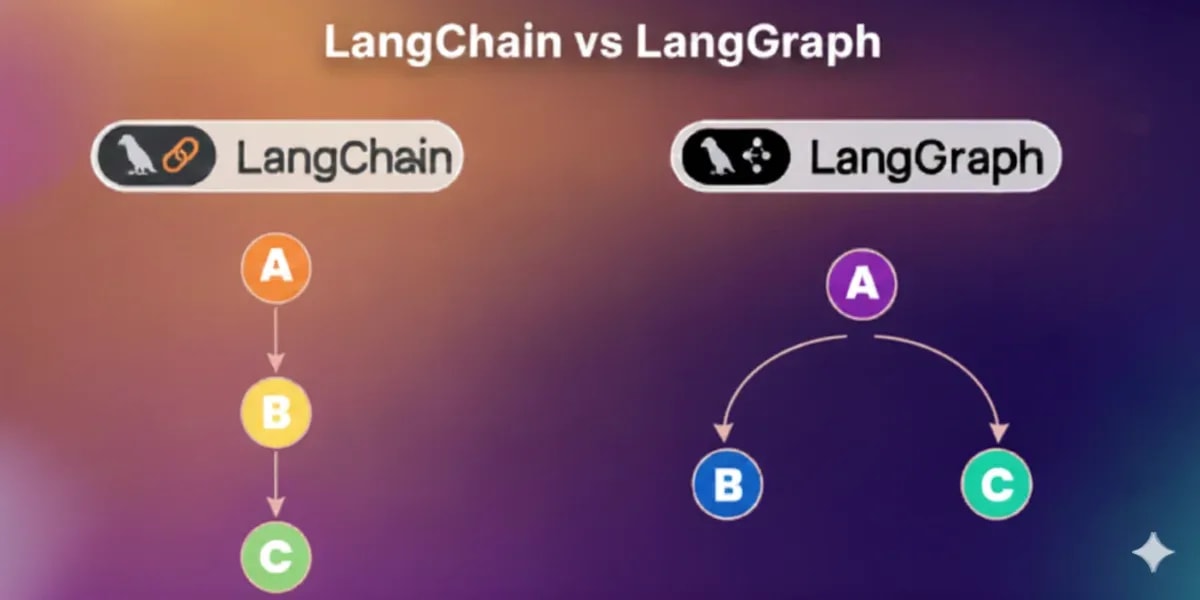
LangChain speeds up simple LLM apps; LangGraph powers stateful, multi-agent workflows built for production scale.

In the fascinating realm of Generative AI, one of the most influential and versatile tools at our disposal is the Large Language Model (LLM). These models, like the well-known GPT-3.5, have ushered in a new era of AI text generation, allowing us to create coherent and contextually relevant text with remarkable ease.
In this blog, we'll delve into the mechanics of text generation using LLMs, exploring techniques that give us control over the output, such as conditioning prompts, temperature scaling, and nucleus sampling. So, let's take a closer look at how AI text generation works in the realm of Generative AI.
At the heart of AI text generation lies the concept of LLMs. These models are built on the foundation of transformer architectures, enabling them to understand the context and relationships between words in a given piece of text. This understanding forms the basis for their remarkable ability to generate coherent and contextually relevant text.

from transformers import GPT3Tokenizer, GPT3LMHeadModel
tokenizer = GPT3Tokenizer.from_pretrained("gpt3.5-turbo")
model = GPT3LMHeadModel.from_pretrained("gpt3.5-turbo")
prompt = "The Benefits of Renewable Energy:"
input_text = prompt + " "
output = model.generate(input_text, max_length=200, num_return_sequences=1)
generated_text = tokenizer.decode(output[0], skip_special_tokens=True)
print(generated_text)
AI text generation is not just about relevance; it's also about creativity. Temperature scaling is a technique that allows us to control the level of randomness in the generated output. A higher temperature value (e.g., 1.0) introduces more randomness, resulting in diverse and imaginative text. Conversely, a lower temperature value (e.g., 0.2) produces more deterministic and focused text.
temperature = 0.8
output = model.generate(input_text, max_length=150, num_return_sequences=1, temperature=temperature)
The nucleus sampling technique adds another layer of control to AI text generation. It involves considering only the top-n most likely next words at each step of text generation. This approach ensures that the generated text remains coherent while allowing for more focused output.
from transformers import pipeline
nucleus_sampling_generator = pipeline("text-generation", model="gpt3.5-turbo", device=0)
nucleus_sampling_output = nucleus_sampling_generator(prompt, max_length=150, num_return_sequences=1, top_k=50)
LangChain speeds up simple LLM apps; LangGraph powers stateful, multi-agent workflows built for production scale.