Baseball is no longer just a game of instinct and tradition; it’s a game of numbers. Every pitch, swing, and stolen base is now tracked, measured, and analyzed with scientific precision. Today’s baseball teams don’t rely solely on gut feelings from scouts; they leverage advanced statistics, AI-driven insights, and data analytics to uncover hidden talent, optimize game strategies, and gain a competitive edge. Behind every winning season is a powerful blend of scouting experience and data science, transforming how franchises recruit players, manage lineups, and make million-dollar decisions.
Major League Baseball organizations now collect up to seven terabytes of data during each game, transforming how baseball franchises use statistics and data analysis into a core competitive advantage. At Folio3, we've helped sports organizations harness similar analytical power through our AI and machine learning solutions, enabling organizations to make data-driven decisions that drive real results.
How do baseball teams leverage AI and data analysis?
Modern baseball franchises harness comprehensive statistical frameworks and AI-powered data analysis methodologies to gain strategic advantages across player evaluation, performance optimization, and tactical decision-making processes.
Organizations utilize AI-driven statistical models to assess player contributions beyond traditional statistics, incorporating machine learning algorithms that provide comprehensive evaluations of individual performance across multiple situational variables.
Strategic game planning and tactical optimization
Real-time AI analysis enables coaching staff to make informed strategic decisions during games, utilizing predictive algorithms and historical performance patterns to optimize lineup construction, pitching rotations, and defensive positioning strategies.
Player development and injury prevention systems
Advanced AI-powered biomechanical analysis and wearable technology monitoring allow organizations to track player development systematically while identifying potential injury risks through machine learning data collection and predictive modeling applications.
Financial optimization and contract valuation
AI-driven approaches help franchises maximize financial efficiency by identifying undervalued talent, reducing recruitment risks, and making objective contract decisions based on machine learning performance analytics rather than subjective evaluations.
Future technology integration and innovation
Emerging artificial intelligence applications and advanced machine learning systems continue expanding analytical capabilities, providing automated performance assessment, AI-powered predictive insights, and real-time optimization tools for enhanced competitive advantages.
The evolution of baseball analytics
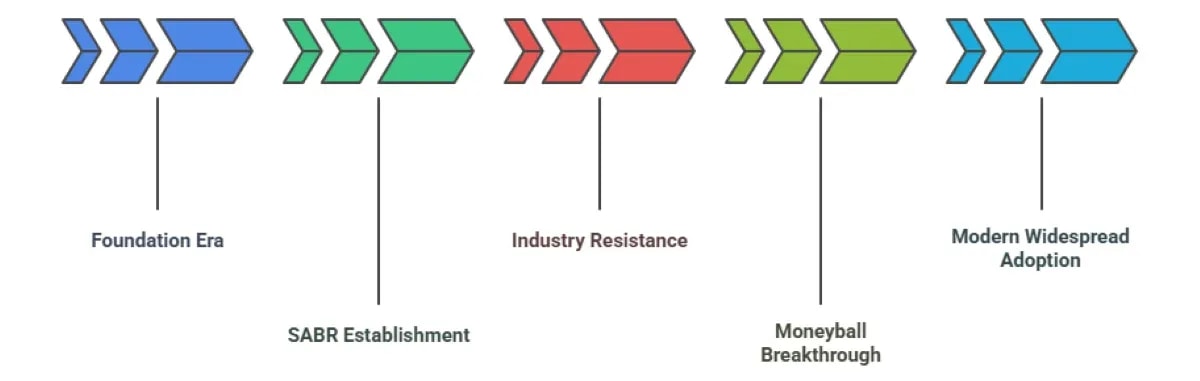
The journey from traditional scouting to data-driven decision making represents one of sports' most significant transformations over the past five decades.
The foundation era (1970s-1980s)
Bill James began releasing Baseball Abstracts in 1977, establishing the foundation for modern sabermetrics despite initial resistance from baseball's traditional establishment. His work challenged conventional wisdom about player evaluation and strategy development.
SABR organization establishment
The Society for American Baseball Research, founded in 1971, provided a platform for statistical analysts to share findings and develop sabermetric principles. Additionally, this organization became the intellectual hub for baseball's analytical revolution.
Industry resistance period
Organizations initially dismissed analytical approaches as meaningless, with franchises like the Chicago Cubs refusing to provide statistical data to researchers in the early 1980s. Nevertheless, traditional baseball culture strongly opposed these new methods.
The Moneyball Breakthrough
The Oakland Athletics embraced sabermetrics in the early 2000s under Billy Beane, using data-driven decisions to compete with wealthier organizations on limited budgets. Furthermore, this success proved that analytics could deliver tangible results.
Modern widespread adoption
Today's baseball organizations employ sophisticated statistical analysis departments, with franchises like the Yankees and Mets becoming adept at using analytical tools for competitive advantage. Subsequently, every major league organization now has a dedicated analytics staff.
Types of baseball data analysis
Modern baseball analytics encompasses multiple data categories, each providing unique insights into player performance and game strategy optimization.
Traditional sabermetrics
On-base plus slugging (OPS) combines on-base percentage and slugging percentage, measuring both a player's ability to reach base and hit for power. Additionally, these foundational metrics replaced simple batting averages as evaluation standards.
Statcast biomechanics
Advanced sensor data now controls for variables outside traditional statistics, including opponent defender skill, ballpark dimensions, weather conditions, pitch velocity, and spin rate. Moreover, this technology provides unprecedented detail about player mechanics.
Pitch tracking systems
PITCHf/x technology offers start-by-start analysis of any pitcher from any game, providing comprehensive data about pitching mechanics and performance patterns. Furthermore, organizations use this information for strategic planning and player development.
Video and movement analysis
High-speed cameras now capture player movements at 300 frames per second, generating detailed biomechanical data for performance analysis and injury prevention. Additionally, this technology reveals subtle movement patterns invisible to human observation.
Wearable technologies allow for the prospective collection of kinematic data to improve mechanics and prevent injuries through real-time monitoring of player stress and fatigue levels. Moreover, franchises now track workload to optimize player health.
The infrastructure supporting modern baseball analytics relies on sophisticated hardware and software systems that capture and process massive amounts of performance data.
Statcast camera systems
The Hawk-Eye Statcast system features twelve strategically placed cameras in each stadium, with five dedicated to pitching and hitting at 300 frames per second. Furthermore, this network captures every movement during games with extraordinary precision.
Data volume and processing
Camera systems collectively generate 24 terabytes of data for each of the 2,430 regular-season MLB games, creating unprecedented information processing challenges for organizations. Additionally, managing this data requires specialized infrastructure and expertise.
Online data platforms serve as the best source for precalculated historical statistics, essentially rendering printed encyclopedias obsolete through comprehensive digital access. Moreover, researchers and analysts rely on these platforms for research and analysis.
Historical data repositories
Retrosheet provides play-by-play data for games after 1952 and large numbers of earlier games, representing tens of thousands of volunteer hours and serving as the greatest sabermetric resource available. Furthermore, this database enables historical comparison and trend analysis.
Organizational proprietary systems
Organizations employ patchwork software systems, leading to data integration challenges, with many franchises seeking centralized data management solutions to streamline their analytical processes. Additionally, each organization develops customized approaches to data analysis.
How do baseball organizations use data in player recruitment?
Data analysis has transformed talent acquisition from subjective evaluation to objective measurement, helping franchises identify undervalued players and reduce recruitment risks through predictive modeling.
Advanced scouting metrics
Organizations analyze the pay-performance advantages of "Moneyball" executives and franchises, tracking whether data analytics provides sustainable competitive advantages in player acquisition and evaluation. Furthermore, scouting now incorporates sophisticated statistical models alongside traditional observation.
Risk reduction strategies
Analytics helps organizations ensure their money is well spent, with average MLB salaries reaching $4.98 million per year and franchises managing substantial total payroll investments. Additionally, data-driven evaluation reduces the likelihood of expensive recruitment mistakes.
International player evaluation
Organizations use analytics-informed player development strategies to identify undervalued talent in international markets where traditional scouting data may be limited or inconsistent. Moreover, this approach helps franchises discover hidden talent in global markets.
Minor league development tracking
Organizations use technology to track prospects' progress throughout their development, helping franchises tailor training programs and make informed promotion decisions based on performance data. Furthermore, development becomes more systematic and measurable.
Draft strategy optimization
Analytical tasks include roster strategy, forecasting, advanced scouting, player development, draft analysis, international arbitration, financial modeling, and budgeting across all organizational levels. Additionally, every aspect of talent acquisition now incorporates data analysis.
How do baseball organizations use data in game strategy?
Real-time analytics now influence every strategic decision during games, from pitcher selection to defensive positioning, fundamentally changing how managers approach in-game tactics.
Real-time decision making
Coaches and managers access tablets displaying up-to-the-minute statistics, player strengths and weaknesses, and insights on opposing strategies during games for immediate strategic adjustments. Furthermore, technology enables instant access to relevant performance data.
Pitching strategy optimization
Managers rely on data for lineup construction, pitching rotations, and defensive positioning decisions, with defensive shifts becoming a common strategy based on individual hitter tendencies. Additionally, every pitching decision can be informed by historical performance patterns.
Offensive strategy enhancement
Organizations focus on undervalued skills like drawing walks and getting on base, signing players who excel in these areas but were overlooked by traditional evaluation methods. Moreover, the offensive approach becomes more scientific and targeted.
Defensive positioning systems
Defensive shifts position fielders based on hitter tendencies and have become a common strategy, with organizations using data to optimize defensive alignment for each batter. Furthermore, traditional defensive positioning gives way to data-driven arrangements.
Situational analysis applications
Advanced statistics help organizations evaluate player performance in specific situations, providing evidence-based insights for critical game moments and strategic decision-making processes. Additionally, context-specific data guides tactical choices throughout games.
Role of AI and advanced technology
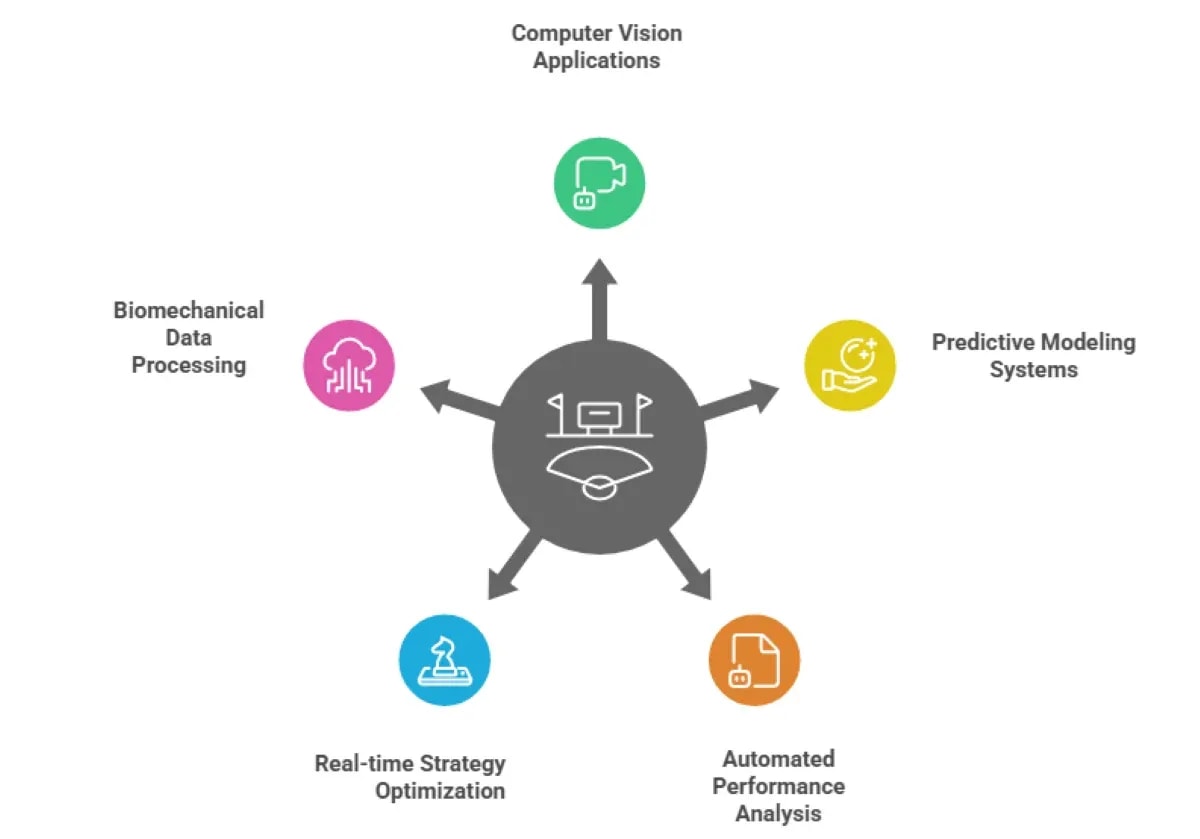
Artificial intelligence and machine learning technologies are pushing baseball analytics beyond traditional statistics into predictive modeling and automated analysis systems that provide deeper insights.
Computer vision applications
Machine learning and artificial intelligence techniques show promise in predicting player performance and preventing injuries through automated analysis of movement patterns and biomechanical data. Furthermore, visual recognition systems can identify subtle performance indicators.
Predictive modeling systems
Artificial intelligence and machine learning could further enhance sabermetrics in the future, helping organizations predict player tendencies, assess injury risks, and refine strategic approaches. Additionally, predictive capabilities continue expanding as technology advances.
AI systems automatically analyze video footage to assess player mechanics, swing patterns, and defensive positioning without human intervention. These automated systems provide consistent evaluation standards and can process vast amounts of game footage to identify performance trends and improvement opportunities.
Real-time strategy optimization
Advanced technologies like augmented reality allow fans to access real-time player statistics, live heat maps, and predictive game scenarios, demonstrating the potential for similar coaching applications. Furthermore, real-time optimization becomes increasingly sophisticated.
Biomechanical data processing
Traditional analytical tools face limitations when dealing with biomechanical data, requiring modern platforms capable of handling complex data processing and machine learning applications for effective analysis. Additionally, advanced processing capabilities enable deeper biomechanical insights.
Benefits of data-driven decision making
Organizations that successfully implement analytics-driven approaches consistently outperform traditional methods across multiple performance metrics, from player development to financial efficiency and competitive success.
Data-driven decision making enables franchises to identify optimal strategies and tactical approaches that maximize win probability. Furthermore, analytics provide objective performance insights that help organizations build more competitive rosters and make strategic adjustments based on statistical evidence rather than intuition alone.
Financial optimization results
Advanced analytics allow franchises to identify undervalued talent and maximize budget efficiency by focusing resources on players with the highest statistical impact per dollar spent. Additionally, data-driven contract negotiations help organizations avoid overpaying for declining performance while investing in players with projected statistical improvement.
Player development improvements
Statistical analysis enables systematic player development by identifying specific skill areas for improvement and tracking measurable progress over time. Moreover, biomechanical data and performance metrics help coaches develop personalized training programs that optimize each player's natural abilities and address individual weaknesses.
Strategic decision accuracy
Analytics provide objective insights into optimal lineup construction, pitching matchups, and defensive positioning based on historical performance data and situational statistics. Furthermore, data-driven strategic decisions eliminate guesswork and emotional bias while maximizing the probability of positive game outcomes.
Long-term organizational success
Systematic analytical approaches create sustainable competitive advantages by establishing consistent evaluation criteria and decision-making frameworks that persist beyond individual personnel changes. Additionally, organizations with comprehensive analytics departments demonstrate superior resource allocation and strategic planning capabilities that translate into sustained performance improvements.
Challenges and limitations
Despite significant advantages, data-driven approaches face meaningful obstacles, including cultural resistance, information management challenges, and the ongoing need to balance analytical insights with traditional baseball wisdom.
Many organizations currently employ patchwork software systems, leading to data integration challenges, with franchises seeking centralized management solutions to streamline their analytical processes effectively. Furthermore, technical infrastructure remains a significant challenge.
Cultural resistance factors
The divide between front office analytics and players can often be toxic and unhealthy, requiring careful management and communication to ensure the successful implementation of data-driven insights. Additionally, organizational culture must evolve alongside analytical capabilities.
Data quality and accuracy
Traditional data warehouses face limitations when dealing with biomechanical data analysis, requiring specialized platforms and expertise to ensure accurate processing and meaningful insights from complex datasets. Moreover, data quality directly impacts decision-making effectiveness.
Human element considerations
Critics argue that over-reliance on data diminishes the human element of baseball, believing that intangible factors like leadership, grit, and teamwork cannot be captured through numerical analysis. Nevertheless, the balance between data and intuition remains essential.
Competitive balance concerns
The rise of defensive shifts and data-driven decisions has led to complaints about the slower pace of play, with frequent adjustments disrupting game flow and sparking debate. Furthermore, fan experience must be considered alongside competitive advantages.
Future of baseball analytics
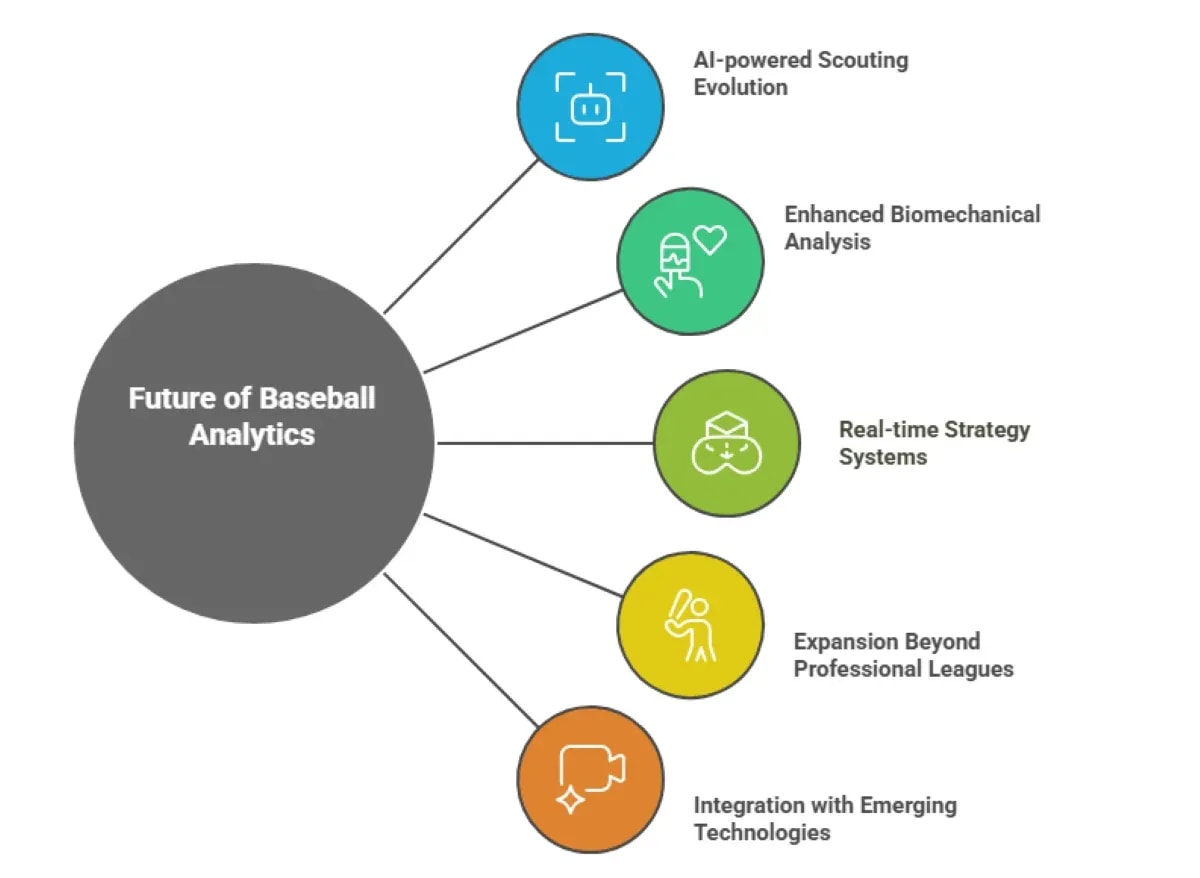
The next generation of baseball analytics will integrate artificial intelligence, advanced biomechanics, and real-time optimization to create even more sophisticated approaches to player development and strategic decision making.
AI-powered scouting evolution
Technology continues opening doors for infinite analytical advancement, with analytics representing one of the fastest-growing job types as more organizations expand their in-house analytical capabilities. Additionally, automated scouting systems will supplement human evaluation.
Enhanced biomechanical analysis
Wearable technologies and motion analysis techniques will provide more comprehensive data for improving performance and preventing injuries through real-time monitoring of player biomechanics and stress levels. Moreover, player health monitoring will become increasingly sophisticated.
Real-time strategy systems
Future applications may include more advanced augmented and virtual reality systems that provide coaches with immersive analytical environments for strategic planning and real-time decision making. Furthermore, strategic tools will become more intuitive and powerful.
Expansion beyond professional leagues
Research shows most collegiate organizations will employ at least one analyst in the near future, with only about ten of 302 NCAA Division One baseball programs currently having a dedicated analytical staff. Additionally, analytics adoption will spread throughout all levels of baseball.
Integration with emerging technologies
Companies like Folio3 are developing AI solutions that can analyze video footage with over 90% accuracy, providing automated performance assessment and personalized training recommendations. Moreover, these technologies will become standard tools for player development across all levels of baseball.
Folio3 AI’s live projects
At Folio3, we have worked with Locked In Lacrosse, which demonstrates the potential for AI applications in baseball analytics. The project developed an AI-powered web application using activity detection models to analyze player performance through video analysis.
Furthermore, using advanced pose estimation techniques, the system assessed specific movements, generated output videos with pose markings, and calculated performance metrics based on biomechanical markers.
The solution achieved over 90% accuracy in performance analysis while providing real-time injury prevention insights.
Additionally, similar applications in baseball could automate swing analysis, pitching mechanics evaluation, and defensive positioning optimization.
Moreover, this technology represents the future direction of sports analytics, where AI supplements human expertise with precise, objective measurement and analysis.
Baseball's transformation from tradition to technology continues accelerating. Organizations that successfully integrate analytical insights with baseball wisdom will maintain competitive advantages, while franchises that resist change risk falling behind. Furthermore, the future belongs to those who can balance data-driven decision-making with the human elements that make baseball America's pastime.
Basketball shooting analytics solution
We partnered with a U.S.-based sports technology startup focused on revolutionizing basketball training through wearable devices and AI. Their mission centered on helping players, coaches, and teams enhance shooting performance through real-time feedback and data-driven insights. Our team of five specialists worked over six months to develop a comprehensive training solution that combines biomechanical sensors with advanced AI models.
Technical challenges we addressed
The project presented several complex requirements that our team successfully resolved.
Precision data capture requires accurately tracking shooting motions with minimal latency using biomechanical sensors.
Real-time analysis demanded delivering immediate feedback to users based on joint movements and form.
Device integration involved seamlessly pairing with MetaMotionS sensors and capturing high-fidelity motion data.
We also prioritized building an intuitive mobile app interface for coaches and players to access insights easily.
Our solution approach
We designed and developed a comprehensive iOS-based mobile solution fully integrated with the MetaMotionS device. Our platform captures real-time biomechanical data and leverages advanced machine learning models, including LSTM networks, to analyze player shooting mechanics and detect patterns. The app provides instant feedback and analytics that help users fine-tune their technique during practice sessions.
Key features we implemented
Our sensor integration established a real-time connection to MetaMotionS biomechanical sensors, enabling joint angle measurement and precise motion tracking throughout shooting motions.
We implemented LSTM neural networks for motion pattern detection and algorithmic comparison between ideal and actual shooting forms.
The iOS native application built in Swift features interactive dashboards explicitly designed for coaches and players.
Our performance feedback system provides visual insights with correction suggestions, along with historical performance tracking and progress monitoring capabilities.
Results and impact achieved
Our solution enabled the client to deliver high-precision shooting analytics with real-time feedback during training sessions. Players and coaches gained actionable insights into biomechanical performance, which improved shooting accuracy and consistency across practice and game situations.
How Folio3 AI revolutionizes baseball analytics?
Folio3's comprehensive AI-powered baseball analysis platform transforms raw video footage into actionable insights, enabling organizations to optimize player performance, strategic decision-making, and competitive advantages through cutting-edge computer vision technology.
Pitch trajectory tracking
Advanced AI algorithms precisely monitor pitch speed, trajectory, and spin rate metrics in real-time, providing coaches with detailed performance data to optimize pitching strategies and identify mechanical improvements.
Player positioning analysis
Machine learning systems analyze defensive player positioning patterns and movements, delivering strategic insights that enhance defensive formations, anticipate opponent tactics, and improve overall field coordination and coverage effectiveness.
Batting stance evaluation
Computer vision technology examines batting stances, swing mechanics, and contact points with high precision, enabling coaches to refine hitting techniques, increase power generation, and optimize individual player performance capabilities.
Fielding dynamics analysis
AI-powered systems track and assess fielding efficiency, reaction times, and coordination patterns across all defensive positions, providing comprehensive performance metrics to enhance defensive skills and team coordination strategies.
Base-running strategy analysis
Advanced analytics evaluate base-running techniques, timing patterns, and speed metrics to optimize scoring opportunities, improve strategic decision-making, and enhance overall offensive efficiency and game situation awareness.
Frequently asked questions
What is the role of statistics in baseball recruitment?
Statistics help organizations identify undervalued players and reduce recruitment risks through objective evaluation methods. Furthermore, modern recruitment combines traditional scouting with advanced metrics to make informed decisions about player potential and contract value.
How do baseball organizations use sabermetrics to evaluate players?
Organizations use advanced metrics like WAR, OPS, and FIP to assess player value beyond traditional statistics. Additionally, sabermetrics provides context-adjusted performance measures that account for factors like ballpark dimensions and opponent quality.
What data is most important for making game strategy decisions?
Real-time performance data, situational statistics, and opponent tendencies drive strategic decisions. Moreover, managers use information about pitcher effectiveness, batter matchups, and defensive positioning to optimize in-game tactics.
How do baseball scouts use data analysis to find hidden talent?
Scouts combine traditional observation with statistical analysis to identify players whose performance metrics suggest greater potential than their reputation indicates. Furthermore, data helps scouts focus on players who excel in valuable but underappreciated skills.
What role does AI play in baseball analytics today?
AI automated video analysis, predicts injury risks, and processes complex biomechanical data. Additionally, machine learning systems can identify performance patterns and provide predictive insights that human analysis might miss.
What are examples of advanced baseball metrics (WAR, OBP, SLG)?
WAR measures total player value, OBP tracks reaching base ability, and SLG measures power hitting. Moreover, these metrics provide more comprehensive player evaluation than traditional statistics like batting average.
How do baseball managers use data during live games?
Managers access real-time statistics on tablets to make informed decisions about pitching changes, defensive positioning, and batting matchups. Furthermore, data helps optimize strategic choices throughout the game.
What technology is used to collect baseball statistics?
Statcast camera systems, radar technology, and wearable sensors capture comprehensive performance data. Additionally, these systems generate terabytes of information about every aspect of player performance and game action.
What are the benefits of using data in baseball decision-making?
Data-driven decisions reduce financial risks, improve player development, and provide competitive advantages. Moreover, organizations that effectively use analytics consistently outperform those relying solely on traditional methods.
What is the future of data analytics in Major League Baseball?
AI-powered systems, enhanced biomechanical analysis, and real-time optimization will continue advancing baseball analytics. Furthermore, future applications will integrate multiple data sources to provide even more sophisticated insights for organizations and players.