Executive Summary:
Starting a multi-output dataset in an atom is similar to starting any other task, with one exception. called "multi-output classification" can predict many outcomes simultaneously. After making any predictions, the model will provide two or more outputs in multi-output classification. However, the mLearn how multi-output datasets improve machine learning models by predicting multiple outcomes simultaneously.:
Classification (binary and multiclass) and regression are the two common machine-learning problems everyone knows about. In these situations, we are attempting to forecast one target column. However, there are multiple target columns in the multi-output scenario, and we want to train a model that can predict all of them simultaneously. Therefore, we recognize three categories of multi-output tasks:
- Multilabel: Multilabel is a classification task that predicts properties of a sample, such as topics relevant to a text document.
- Multiclass-multioutput: Multiclass-multioutput is a classification task
that labels each sample with a set of non-binary properties, with a maximum number of properties and classes of 2.
- MultiOutput regression: Multi Output regression predicts multiple numerical properties for each sample, such as wind speed and direction.
Ready to Scale Your Machine Learning Projects?
From model development to deployment, Folio3 AI helps businesses build high-performance AI solutions faster.
Explore Free Consultation
Data preparation
Starting a multi-output dataset in an atom is similar to starting any other task, with one exception. It would be best if you defined the target columns using the keyword argument y. atom = ATOMClassifier(X, y=y, verbose=2, random_state=1) If y= is omitted, the atom will interpret the second input as the test set, as if the initialization had been done with the syntax atom = ATOMClassifier(train, test) and throw a column mismatch error. You can also supply a list of column names or locations to specify the target columns in X.
Use this as an example to designate the final three columns as the target: atom = ATOMClassifier(X, y=(-3, -2, -1), verbose=2, random_state=1) Whenever possible, print oneself. Instead of the target of type Series, x now returns the target of type DataFrame. The target column for jobs with several labels can resemble this.
0 [politics]
1 [religion, finance]
2 [politics, finance, education]
3 []
4 [finance]
5 [finance, religion]
6 [finance]
7 [religion, finance]
8 [education]
9 [finance, religion, politics]
Name: target, dtype: object
A model cannot directly ingest a variable number of target classes. Instead, use the clean technique to assign a binary output to each class for each sample. Positive classes are denoted by 1, whereas negative classes are denoted by 0. Doing n-classes binary classification tasks can be compared to this.
atom.clean()
The target (atom.y) in our case is transformed into:
education finance politics religion
0 0 0 1 0
1 0 1 0 1
2 1 1 1 0
3 0 0 0 0
4 0 1 0 0
5 0 1 0 1
6 0 1 0 0
7 0 1 0 1
8 1 0 0 0
9 0 1 1 1
Training and validation of models
Some models natively support multi output jobs. In other words, all target columns are directly predicted using the original estimate. However, most models need more comprehensive support for multi output jobs. By encasing the estimators in a meta-estimator that can handle numerous target columns, ATOM still makes using them possible. Furthermore, this is carried out automatically without additional programming or user input.
ClassifierChain
The default meta-estimators for multiclass-multioutput and multi output regression tasks are, respectively:
MultioutputRegressor
The meta-estimator object is contained in the multi output attribute. Use a custom object by altering the value of the attribute. The underlying estimator can be the initial parameter in either classes or situations. For regression models, for instance, use the following to modify the meta-estimator:
from sklearn.multioutput import RegressorChain
atom.multioutput = RegressorChain
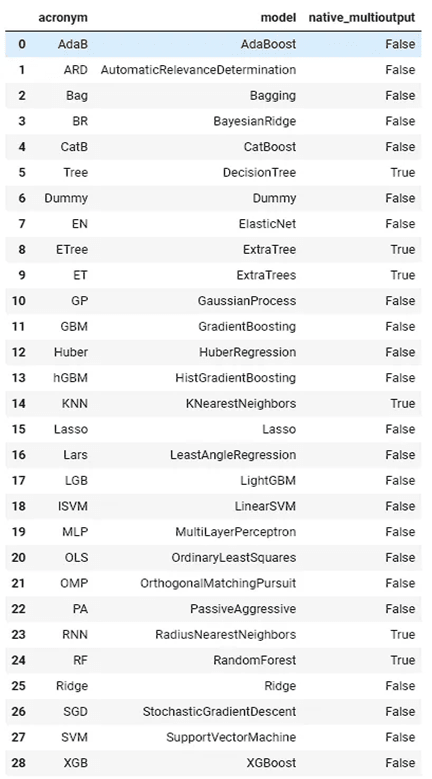
Use the following to determine which models natively handle multioutput datasets and which do not:
atom.available_model()[["acronym", "model", "native_multioutput"]]
atom.run(models=["LDA", "RF"], metric="f1")
atom.multioutput = None
# MLP won't use a meta-estimator wrapper now
atom.run(models=["MLP"])
Build Smarter ML Models with Folio3 AI
Unlock the power of multi-output machine learning with scalable AI solutions tailored to your business needs.
Explore Free Consultation
Conclusion:
In conclusion, multi-output datasets are a powerful tool in machine learning, allowing us to predict multiple outcomes simultaneously. With the techniques and strategies we've discussed, you can effectively utilize these datasets in your own projects and achieve more accurate predictions. If you're looking for high-quality image classification datasets using machine learning, check out our blog post on the topic. By incorporating multi-output datasets and other advanced techniques into your machine learning solutions, you can stay ahead of the curve and unlock new insights and opportunities for your business.
FAQs:
What is a multi-output classifier?
A multi-output classifier is a machine learning model that predicts multiple target variables at the same time. For example, it can identify both the type of fruit (orange, mango, pineapple) and its color (red, green, yellow, orange) in a single prediction.
How does multi-output regression work?
Multi-output regression predicts two or more numerical outcomes simultaneously. Unlike traditional regression models that generate a single prediction, multi-output regression models can forecast multiple related values for each input sample.
How can different machine learning models be integrated?
Different machine learning models can be integrated using ensemble or hybrid approaches. Ensemble models combine multiple algorithms to improve prediction accuracy, while hybrid models leverage the strengths of different techniques to solve complex problems more effectively.
What is multimodal learning in machine learning?
Multimodal learning is a machine learning approach where models are trained to process and understand multiple types of data, such as text, images, audio, and video. This helps AI systems gain richer context and deliver more accurate insights.
Why are multi-output datasets important in machine learning?
Multi-output datasets allow machine learning models to predict several outcomes at once, improving efficiency and reducing the need for separate models. They are especially useful in complex AI applications where multiple variables are interconnected.
What are the common applications of multi-output machine learning models?
Multi-output machine learning models are commonly used in healthcare diagnostics, recommendation systems, financial forecasting, image recognition, and predictive analytics where multiple outputs need to be generated simultaneously.