Healthcare providers face several challenges when managing administrative tasks and providing quality patient care.
It's too hectic to manage complex records and cater to each patient. A virtual medical scribe has proved to be invaluable in these situations.
Medical scribes are trained healthcare professionals who assist physicians by capturing patient interactions.
They help manage medical documentation and streamline administrative workflows, meaning there is no need for healthcare staff.
Virtual Medical Scribes will handle patient care. This blog will discuss how virtual scribes will let physicians focus more on core activities, their benefits, and why it's important in healthcare.
What is a Virtual Medical Scribe?
Virtual medical scribes are simply a virtual technology that provides physicians with real-time medical documentation during patient interactions.
They work just exactly like doctors; the same level of accuracy and support is provided without the need to meet the scribe in person.
They work through secure online platforms to deliver the same level of accuracy and support.
The services of virtual medical scribes include updating Electronic Health Records (EHRs), transcribing physician notes, and ensuring documentation is completed promptly.
As a result, doctors can focus more on medical decision-making than paperwork, improving patient care efficiency.
Improve Clinical Efficiency Without Compromising Care
Virtual medical scribes support real-time documentation, reduce physician burnout, and help healthcare teams maintain accurate records across in-person and telehealth workflows.
Book a Demo
How Virtual Medical Scribes Work
Medical scribes work as part of secure platforms to listen to live patient-doctor interactions, capture vital details accurately, and integrate into live patient-doctor interactions.
Throughout assessing a patient, they document their history, diagnoses, and treatment plans in real-time, ensuring records are current and complete.
In addition to utilizing advanced documentation tools, EHR systems, and transcription software, they adhere to strict data security and privacy protocols, including HIPAA compliance, to protect patient information.
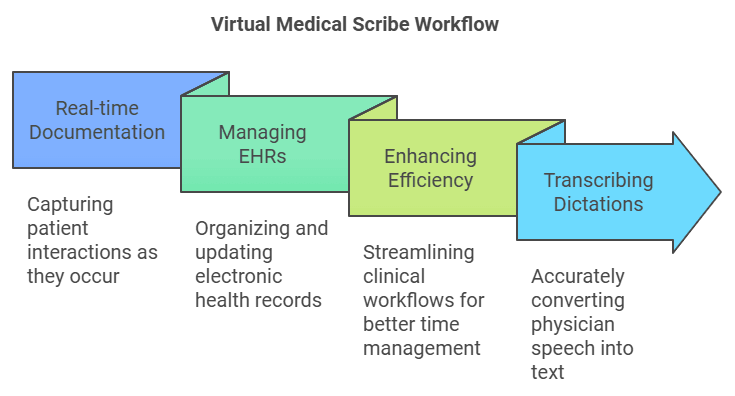
Core Responsibilities of a Virtual Medical Scribe
- Real-time documentation of patient interactions and visits.
- Managing electronic health records (EHRs).
- Making clinical workflows more efficient allows doctors to spend more time with patients on a one-on-one basis.
- Accurately transcribing physician dictations.
Benefits of Hiring a Virtual Medical Scribe
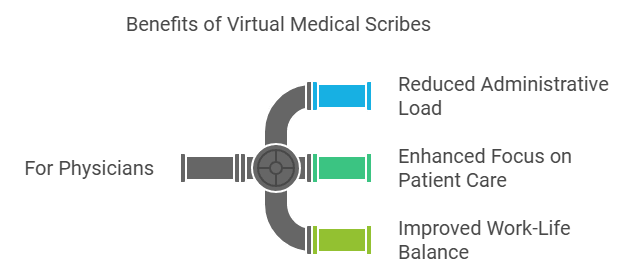
For Physicians:
- Reduced Administrative Load: It allows physicians to focus on critical medical tasks instead of time-consuming documentation.
Enhanced Focus on Patient Care: Doctors who are not distracted by taking notes can better connect with patients.
- Improved Work-Life Balance: Physicians can focus more on your professional and personal well-being with less paperwork.
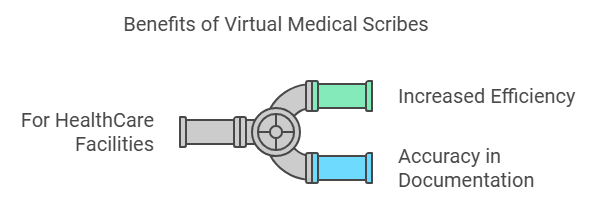
For Healthcare Facilities:
- Increased Efficiency: With virtual scribes, workflows are streamlined, delays are reduced, and productivity is enhanced.
- Accuracy in Documentation: Using scribes ensures accurate and detailed medical records, preventing errors and helping maintain compliance with the healthcare industry.
Skills and Qualities of a Virtual Medical Scribe
1. Proficiency in Medical Terminology
As part of maintaining quality records, it is critical to have a solid understanding of medical language. This can ensure that diagnoses, treatments, and procedures are accurately recorded.
2. Expertise in EHR Systems and Documentation Software
Using electronic health records (EHRs) and documenting tools, virtual medical scribes enable seamless integration into healthcare workflows.
3. Attention to Detail and Confidentiality
Documentation that maintains patient privacy and conforms to HIPAA regulations requires an eye for detail as well as a strong sense of confidentiality.
4. Effective Communication Skills
The ability to communicate with physicians and healthcare teams effectively helps virtual scribes ensure the accuracy and clarity of documentation.
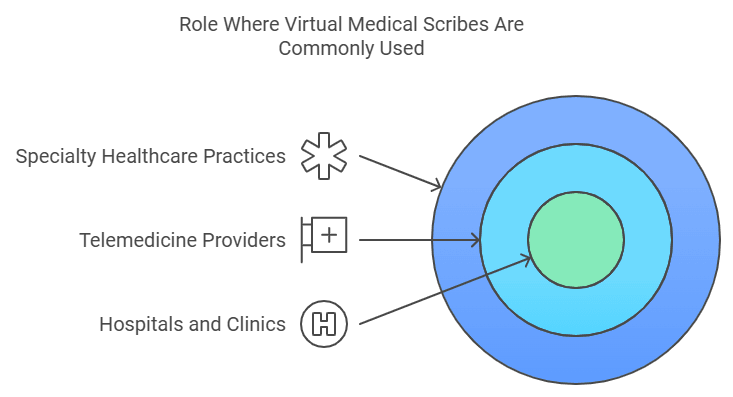
Industries and Roles Where Virtual Medical Scribes Are Commonly Used
1. Hospitals and Clinics:
Virtual medical scribes play a crucial role in healthcare. They work alongside physicians to simplify documentation and help them focus more on providing the best care for their patients.
2. Telemedicine Providers:
As virtual consultations become more common, scribes are essential in capturing detailed records of remote patient interactions, enabling doctors to stay fully engaged with their patients.
3. Specialty Healthcare Practices:
Virtual scribes offer tailored documentation support, adapting to each field's specific terminology and workflows. These fields include cardiology, orthopedics, dermatology, and others.
Common Misconceptions About Virtual Medical Scribes
Myth 1: Virtual medical scribes eliminate the need for doctors' direct input.
Reality: One common myth associated with virtual medical scribes is that they are a replacement for doctors, which is not the case.
As discussed earlier in this article, virtual medical scribes assist doctors with time-consuming tasks, allowing them to focus more on meaningful work and patient care.
Doctors continue to make all medical judgments, diagnoses, and treatment decisions.
Myth 2: Basic documentation is the only task virtual medical scribes can manage.
Reality: Another myth is that virtual scribes are only responsible for managing documentation histories. In reality, this is just a small part of their role.
They are also capable of supporting specialized documentation in various fields, including cardiology, orthopedics, and telemedicine.
Myth 3: Virtual medical scribes are not compliant with regulations like HIPAA and lack necessary security.
Reality: Virtual medical scribes work on secure platforms and adhere to strict security measures to protect patient privacy and comply with HIPAA standards.
They are thoroughly trained in handling sensitive medical information and always prioritize data protection.
The Future of Virtual Medical Scribes in Healthcare
The future for virtual medical scribes in healthcare is looking bright. With telemedicine and remote healthcare becoming more common, there's a growing need for virtual scribes to handle real-time documentation during these virtual visits.
The blend of advanced AI tools and virtual scribes will streamline the process, making documentation more innovative and efficient by automating routine tasks while keeping that human touch.
This partnership between human skills and AI healthcare solutions will boost accuracy, ease physicians' workloads, and improve overall efficiency in healthcare.
As these technologies continue to develop, we're likely to see them adopted more widely, especially in areas where telehealth services are expanding.
Conclusion
Virtual medical scribes are essential in today's healthcare world. They lighten the load for physicians by taking care of the paperwork, ensuring accurate documentation, and letting doctors concentrate on what they do best, caring for patients.
As telemedicine and technology advance, the importance of virtual scribes will only increase.
Healthcare providers should consider adopting these services to boost efficiency, simplify workflows, and guarantee top-notch patient care.
Embracing these tools will enhance productivity and help healthcare professionals achieve a better work-life balance.
Free Your Providers From Time-Consuming Documentation
Discover how virtual medical scribes can improve charting accuracy, streamline EHR workflows, reduce administrative overload, and help clinicians stay focused on patient care.
Book a Demo
FAQS
1. What Qualifications Does a Virtual Medical Scribe Need?
Virtual medical scribes need knowledge of medical terminology, proficiency in EHR systems, and strong communication skills, often with healthcare training or scribe certification.
2. Are virtual medical scribes HIPAA-compliant?
Yes, they follow HIPAA regulations to ensure patient privacy and data security.
3. How do virtual scribes improve patient care?
They allow physicians to focus more on patient interactions by handling documentation, improving efficiency, and reducing burnout.
4. What does a virtual medical scribe do?
They document patient visits in real time, update EHRs, and ensure accurate medical records.
5. What qualifies you as an Equity Solutions virtual medical scribe?
Equity Solutions scribes have strong medical knowledge, EHR expertise, and adaptability to different clinical settings
6. What is the difference between a virtual medical scribe and an AI medical scribe?
A virtual medical scribe is a human working remotely via secure platforms. An AI medical scribe uses machine learning and NLP to automate documentation without a human operator.
7. How much does a virtual medical scribe cost?
Costs vary by provider and volume, but virtual scribes typically cost significantly less than in-person scribes, with no overhead for physical presence or equipment.
Yes. Virtual scribes integrate with telemedicine tools to capture and document remote patient interactions in real time, supporting HIPAA-compliant records.