Key Takeaways
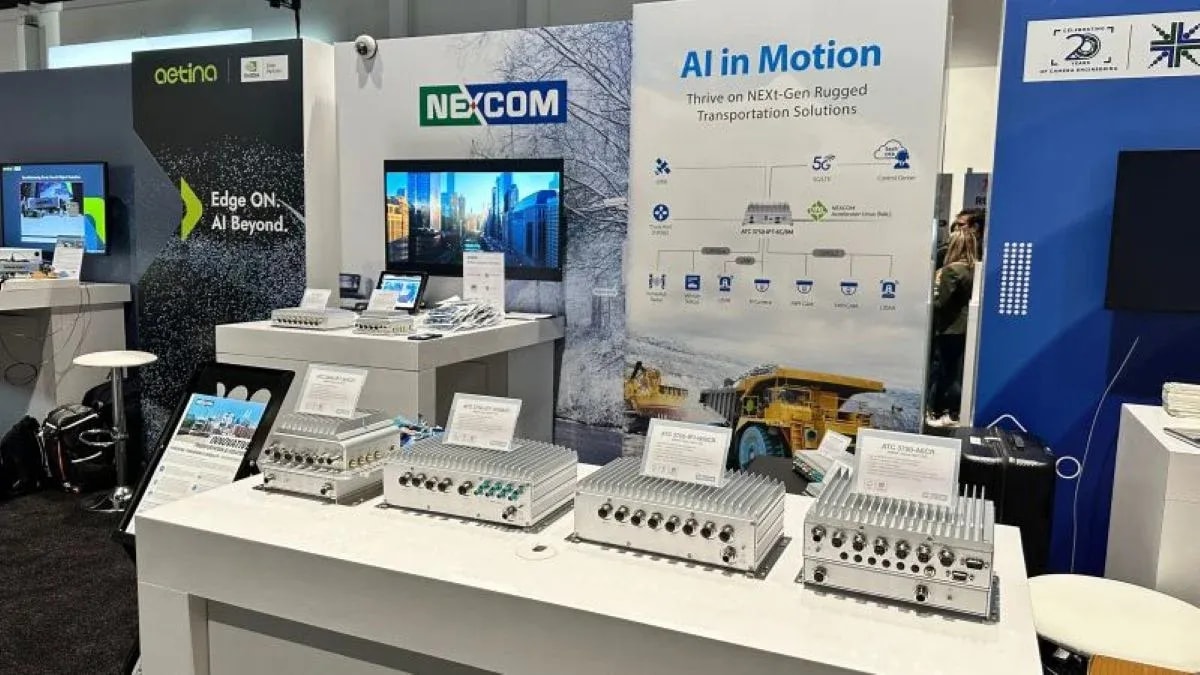
NEXCOM International has unveiled advanced IP67-rated edge AI platforms designed to withstand the punishing conditions of mining operations, construction sites, railway systems, and autonomous vehicles.
The systems combine NVIDIA Jetson Orin Nano, NX, and AGX Orin system-on-modules with proprietary thermal engineering to create fully sealed, fanless computers capable of operating in extreme environments.
The platforms address critical needs in industries where real-time artificial intelligence has become essential for safety and efficiency.
From object detection and equipment monitoring to worker safety and hazard avoidance, these systems enable AI-powered operations in locations where conventional computing hardware would fail.
According to NEXCOM, the IP67-rated platforms deliver full AI workload performance from Jetson Orin modules without thermal throttling, operate fanlessly in vibration-heavy environments such as railcars and mining vehicles, and resist dust, water, shock, and temperature extremes while maintaining uninterrupted inference at the edge.
The company's ATC 3750-IP7-8M edge computer, powered by the NVIDIA Jetson AGX Orin system-on-module, delivers up to 275 TOPS of AI processing power.
This device, along with the VTK-SCAP supercapacitor-based uninterruptible power supply, received the 2025 Taiwan Excellence Award in December 2024.
Leo Chang, Assistant Vice President at NEXCOM's Mobile Computing Solutions division, stated in materials related to the company's participation at NVIDIA GTC 2025 that by leveraging NVIDIA Jetson technology, NEXCOM's solutions deliver real-time AI computing, precision motion control, and autonomous capabilities.
The ATC 3750-IP7-8M has obtained automotive E-mark and railway EN50155 certifications alongside its IP67 protection rating, positioning it among the first high-end edge AI computers for in-vehicle and railway applications that integrate intelligent image recognition and AI video analytics technology.
The system supports advanced driver assistance systems, automatic number plate recognition, autonomous mobile robots, machine learning, intelligent transportation systems, and railway safety applications.
Engineered for industrial certification standards
NEXCOM's engineering extends beyond basic waterproofing to meet stringent industrial requirements.
The platforms are fully sealed against particulate ingress and water immersion, compliant with MIL-STD-810H for shock and vibration resistance, and certified for transportation standards including CE/FCC, UKCA, E-mark, EN 50155, and EN 45545-2.
The systems operate across a wide temperature range from -25°C to 60°C, feature wide-range DC input with ignition control for vehicle integration, and support extensive connectivity options.
These include PoE+, GMSL2, USB 3.2, CAN bus, RS-232, digital input/output, and HDMI interfaces, enabling integration with IP cameras, LiDAR, radar, and industrial sensors.
The VTK-SCAP backup battery unit provides sophisticated power management through supercapacitor technology rather than traditional lithium batteries, operating in temperatures from -35°C to 80°C.
The system can be expanded to support up to 200W computer systems and provides uninterrupted power during outages, which is critical for transportation and safety systems.
Real-world deployment in critical infrastructure
NEXCOM has deployed its edge AI platforms in collaboration with international railway operators across Europe and Asia.
One notable implementation is the Intelligent Railway Infrastructure System in Hong Kong, developed in partnership with spatial intelligence company Kodifly.
The system connects high-resolution cameras and LiDAR sensors to NEXCOM's ATC 3750-A6CR railway computer, which analyzes railway circuits to identify potential hazards such as intrusions, obstacles, or vegetation growth that could disrupt service.
The platform pinpoints the exact location of potentially hazardous instances on 3D maps in real time, allowing control center staff to immediately address risks.
The platforms enable real-time AI model retraining through cyber-physical systems integration with optional 5G NR, Wi-Fi 5/6, and GNSS connectivity.
This capability allows systems deployed in remote or mobile environments to continuously improve their performance based on field conditions.
Read more: