Key takeaways
OpenAI introduced AgentKit on Monday, a comprehensive toolkit designed to streamline the creation and deployment of AI agents, as the company pushes to consolidate fragmented development tools and expand its enterprise footprint.
The announcement came during OpenAI's DevDay conference in San Francisco, where CEO Sam Altman unveiled the platform alongside other major product launches. ChatGPT, the company's flagship product, has now reached 800 million weekly active users.
"AgentKit is a complete set of building blocks available in the open AI platform designed to help you take agents from prototype to production. It is everything you need to build, deploy, and optimize agent workflows with way less friction," Altman said during his keynote address.
The launch represents OpenAI's ambitious move into full-stack AI development infrastructure, directly challenging established workflow automation platforms and signaling the company's intention to own the entire agent development ecosystem.
Four core components target enterprise pain points
Image Source: OpenAI[/caption]
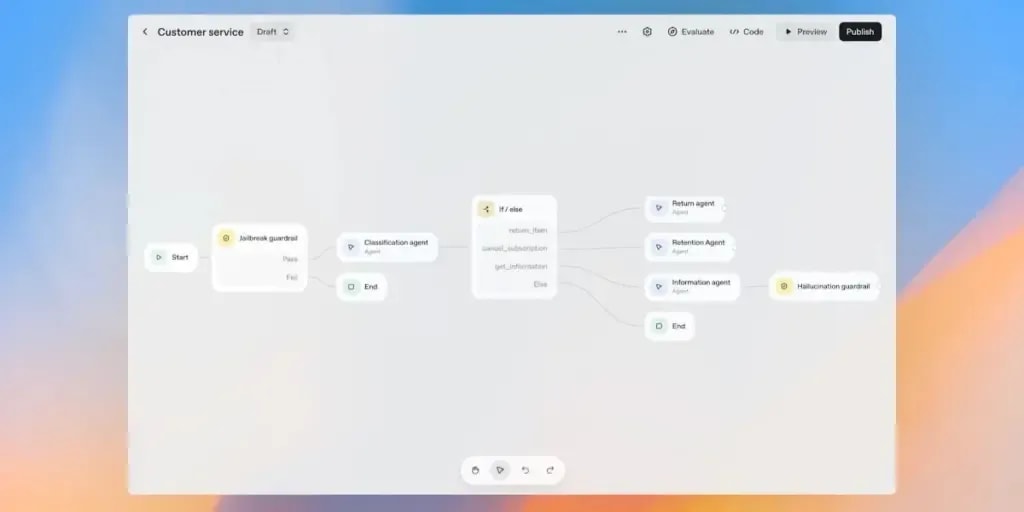
AgentKit comprises four integrated tools addressing key challenges in agent development. Agent Builder provides a visual, drag-and-drop canvas for designing multi-agent workflows with versioning capabilities and built-in safety guardrails.
The platform supports both blank canvas creation and prebuilt templates for common use cases like customer service bots and data enrichment routines.
ChatKit offers developers embeddable chat interfaces that can be customized with their own branding and workflows. "You can bring your own brand, your own workflows, whatever makes your own product unique," Altman explained.
The enhanced Evals platform introduces new capabilities, including datasets for building evaluations from scratch, trace grading for end-to-end workflow assessment, automated prompt optimization, and support for evaluating third-party models directly within OpenAI's platform.
Connector Registry provides enterprise administrators with a centralized control panel for managing data sources and tool integrations across multiple workspaces, including prebuilt connectors for Dropbox, Google Drive, SharePoint, and Microsoft Teams.
To demonstrate the platform's ease of use, OpenAI engineer Christina Huang built a complete AI workflow and two agents live on stage in under eight minutes.
"So in just a few minutes, we've designed an agent workflow, visually," Huang said. "We added in some tools and widgets. We previewed it, we deployed it, we tested it, and now you all can use it."
Early adopters report dramatic time savings
Several companies have already deployed agents using AgentKit with notable results.
Financial technology company Ramp reported building a procurement agent in just a few hours using Agent Builder, compared to what previously required months of complex orchestration and custom coding.
"Agent Builder transformed what once took months of complex orchestration, custom code, and manual optimizations into just a couple of hours.
The visual canvas keeps product, legal, and engineering on the same page, slashing iteration cycles by 70% and getting an agent live in two sprints rather than two quarters," Ramp stated.
Payment service provider Klarna has deployed a support agent that now handles two-thirds of all customer service tickets, while sales platform Clay reported achieving 10x growth with an AI sales agent built on OpenAI's platform.
Financial firm Carlyle reported that OpenAI's evaluation platform reduced development time on its multi-agent due diligence framework by over 50% while increasing agent accuracy by 30%.
Altman mentioned that HubSpot utilized AgentKit to enhance its Breeze AI tool, generating more compelling responses to customer inquiries.
Strategic competition in agent development space
The AgentKit launch positions OpenAI in direct competition with established workflow automation platforms, including Zapier, n8n, and Make.
Other major AI providers have also moved to offer integrated agent development tools, with Google releasing its Agent Development Kit in April and Microsoft announcing its Agent Framework to consolidate agent creation.
"Until now, building agents meant juggling fragmented tools—complex orchestration with no versioning, custom connectors, manual eval pipelines, prompt tuning, and weeks of frontend work before launch," OpenAI stated in its announcement.
"This is all the stuff that we wished we had when we were trying to build our first agents," Altman noted, adding that OpenAI has secured several launch partners who have already scaled agents using the platform.
The platform's Guardrails feature provides an open-source safety layer designed to protect agents against unintended behavior, including personally identifiable information leaks and jailbreak attempts.
ChatKit and the new evaluation capabilities are now generally available to all developers. Agent Builder launched in beta on October 6, with Connector Registry beginning its beta rollout to select API, ChatGPT Enterprise, and ChatGPT Edu users. All AgentKit tools are included with standard API model pricing.
OpenAI also announced plans to introduce a standalone Workflows API and additional deployment options for ChatGPT, further expanding the AgentKit ecosystem in coming months.
When asked about profitability during a post-keynote press conference, Altman told reporters that generating revenue is currently not among his top 10 concerns.
Read more: