Key takeaways
The new feature allows people to securely connect medical records, fitness trackers, and wellness applications to receive personalized health guidance.
The artificial intelligence company said more than 230 million people worldwide already ask ChatGPT health-related questions every week, making it one of the platform's most common use cases.
ChatGPT Health aims to expand on this demand by providing users with tools to understand lab results, prepare for doctor appointments, and navigate nutrition and exercise recommendations.
Privacy protections and data handling
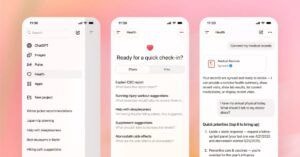
ChatGPT Health operates as a separate space within the chatbot, with conversations, connected apps, and files stored apart from regular chats.
[caption id="attachment_33684" align="aligncenter" width="800"]
Image Source: OpenAI[/caption]
The system includes its own isolated memories, ensuring health information remains compartmentalized.
"ChatGPT Health is another step toward turning ChatGPT into a personal super-assistant that can support you with information and tools to achieve your goals across any part of your life," Fidji Simo, CEO of applications at OpenAI, wrote in a Substack post.
OpenAI emphasized that conversations within ChatGPT Health will not be used to train its foundation models.
The company partnered with b.well, a health data network, to enable secure medical record integration for U.S. users.
Additional app connections include Apple Health, Function, MyFitnessPal, Weight Watchers, AllTrails, Instacart, and Peloton.
Development with medical professionals
The company spent two years building ChatGPT Health with feedback from more than 260 doctors who practiced across 60 countries and dozens of specialties.
These physicians provided input on model outputs in 30 focus areas more than 600,000 times, according to OpenAI.
During a call with reporters Wednesday, Simo explained the tool's intended role in healthcare.
"AI doesn't replace medical care, but can play an important role in helping people navigate a complicated health care system," she said, according to Axios.
"It's great at synthesizing large amounts of information. It has infinite time to research and explain things. It can put every question in the context of your entire medical history."
OpenAI stressed that ChatGPT Health is designed to support medical care, not replace it, and is not intended for diagnosis or treatment.
Limited availability and regulatory considerations
ChatGPT Health is initially rolling out to a small group of early users and will expand access on web and iOS in the coming weeks.
Only ChatGPT Free, Go, Plus, and Pro subscribers outside the European Economic Area, Switzerland, and the United Kingdom can access the feature. Medical record integration remains available only in the United States.
Europe's stricter data protection rules and the EU AI Act likely influenced the delayed rollout.
Health data receives extra protections under European law, and consumer health chat applications could potentially be classified as medical device software under the AI Act, subjecting them to additional regulatory requirements.
OpenAI has deepened its push into healthcare in recent months. After the company launched its GPT-5 model in August, CEO Sam Altman told CNBC that healthcare was "maybe the area where there's the strongest improvement of any category."
The company's entrance into consumer health technology comes as multiple tech giants compete to become the primary digital interface for healthcare information.
Read more:
Infosys And AWS Collaborate To Accelerate Enterprise Adoption Of Generative AI
Fake Images And Recycled Photos Spread Misinformation After Maduro Capture
Snowflake And Anthropic Sign $200 Million AI Agents Deal