Vehicle detection is becoming business-critical for traffic operators, parking providers, tolling networks, logistics facilities, and urban mobility programs. The traffic sensor market was valued at USD 805.8 million in 2025 and is projected to reach USD 1.54 billion by 2034.
This guide compares 10 vehicle detection technologies by capabilities, operating limitations, installation requirements, and lifecycle cost. You will learn which sensors suit specific business applications, how accuracy should be evaluated, when sensor fusion helps, and what to validate before deployment.
Which Vehicle Detection Sensor Fits Your Use Case?
A suitable sensor must match the required output, installation environment, vehicle state, coverage area, privacy constraints, and lifecycle cost. Start with the operational decision the data must support, then select hardware and software around that requirement.
Application | Recommended Starting Point | Why It Fits |
Individual parking spaces | Ultrasonic sensor or overhead AI camera | Supports localized occupancy monitoring |
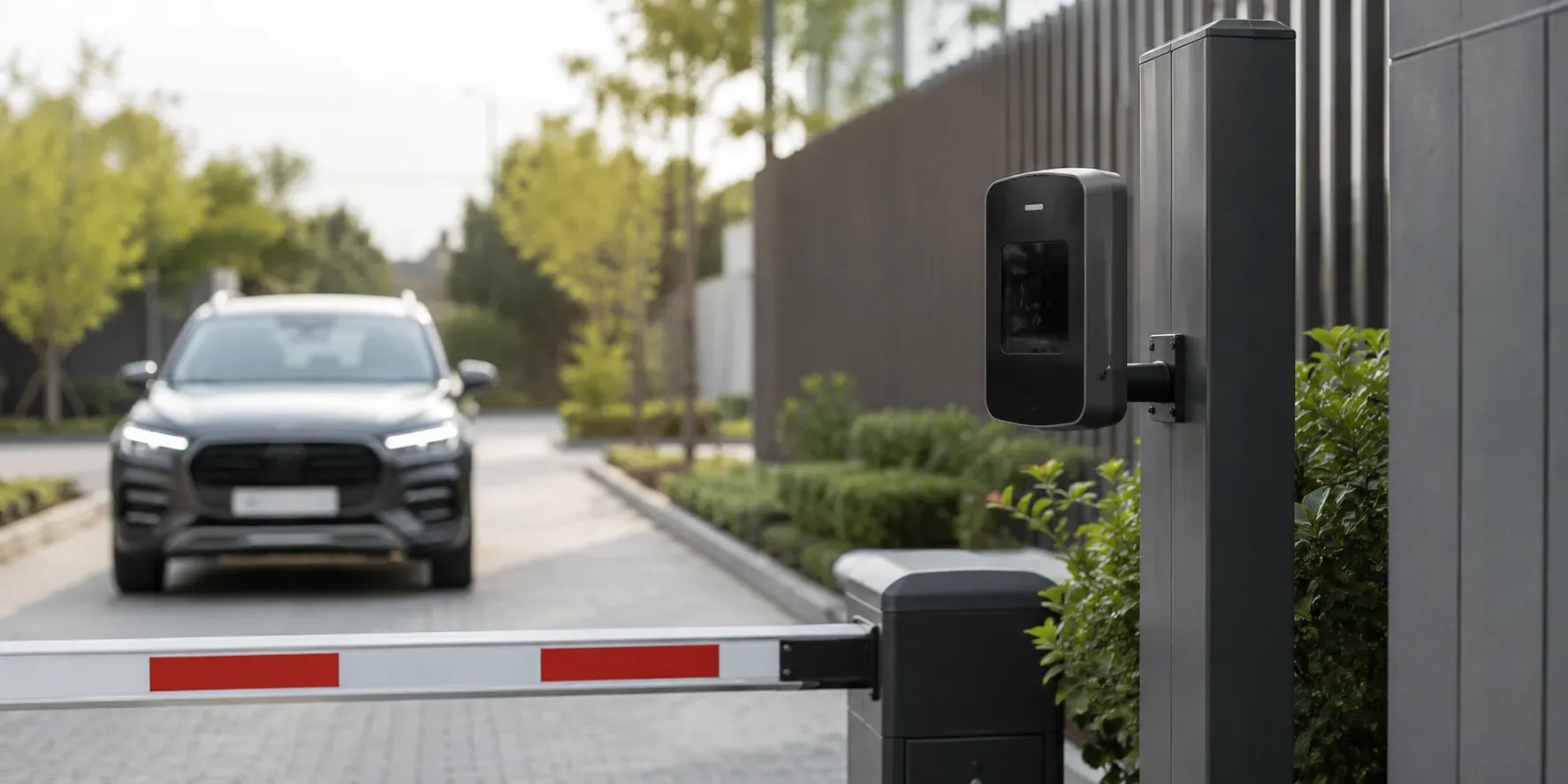
Automatic gates | Magnetometer, inductive loop, or FMCW radar | Provides vehicle presence or arrival signals |
Signalized intersections | Loop, FMCW radar, AI camera, or LiDAR | Supports presence, queues, movements, and actuation |
Multi-lane monitoring | AI camera, radar, or LiDAR | Can monitor several lanes from one suitable position |
Vehicle counting | Camera, radar, loop, or LiDAR | Produces lane-level passage and volume data |
Vehicle classification | AI camera, LiDAR, or light grid | Uses visual, dimensional, or profile information |
Speed monitoring | Radar, paired loops, LiDAR, or video analytics | Measures or calculates vehicle speed |
License plate recognition | High-resolution AI camera | Captures imagery for plate localization and OCR |
Low-light environments | Radar, thermal imaging, or LiDAR | Does not depend entirely on visible illumination |
Stopped vehicle detection | Presence loop, FMCW radar, camera, or LiDAR | Maintains detection after a vehicle stops |
Build Smarter Traffic Systems With the Right Detection Sensors
Explore how AI-powered vehicle detection can improve traffic flow, increase safety, and support real-time transportation decisions.
Talk to an Expert
10 Vehicle Detection Technologies Compared
These technologies represent common in-roadway and over-roadway approaches. Their capabilities vary by product, waveform, placement, software, and environment, making qualitative comparisons more defensible than assigning universal range, cost, or accuracy percentages.
Technology | Best Applications | Stationary Vehicles | Multi-Lane Potential | Classification Potential | Primary Limitation |
Inductive loop | Stop lines, gates, signals | Yes | Limited | Limited to moderate | Pavement cutting |
Magnetometer | Gates, parking, localized presence | Model-dependent | Limited | Low | Small detection zone |
FMCW radar | Intersections, queues, highways | Yes | High | Moderate | Configuration and reflections |
AI camera | Counting, tracking, ALPR | Yes | High | High | Visibility and occlusion |
LiDAR | 3D tracking, intersections, tolling | Yes | High | High | Cost and integration |
Ultrasonic | Parking bays, height sensing | Yes | Limited | Low | Temperature and turbulence |
Thermal sensor | Darkness, tunnels, intersections | Yes | High | Moderate | Lower visual detail |
Photoelectric | Gates, car washes, entrances | Yes | Limited | Low | Alignment and contamination |
Light grid | Tolling, profiling, separation | Yes | Limited | High | Two-sided installation |
Acoustic array | Passage and traffic flow | Model-dependent | Moderate | Limited | Noise and slow traffic |
1. Inductive Loops
Inductive loops use insulated wire embedded in pavement to detect electrical changes caused by vehicles. They support presence, passage, volume, occupancy, and specialized classification, but installation and repair usually require pavement cutting, traffic control, and lane closures.
Best for: Traffic signals, stop lines, gate control, lane counting, parking entrances, and occupancy measurement.
Key limitation: Installation, road resurfacing, cable damage, or maintenance may interrupt traffic and increase lifecycle costs.
2. Magnetometers
Magnetometers detect disturbances in the Earth’s magnetic field created by ferrous vehicle components. They suit gates, parking, and localized presence detection, although small detection zones often require multiple units, and some magnetic designs cannot reliably detect stopped vehicles.
Best for: Gate activation, drive-thrus, parking occupancy, arrival alerts, and localized lane detection.
Key limitation: Coverage is normally localized, making one magnetometer unsuitable for wide, multi-lane monitoring without additional sensors.
3. Radar Sensors
Radar transmits radio-frequency energy and analyzes reflections to measure presence, range, speed, or direction. CW Doppler radar detects moving vehicles, while correctly configured FMCW radar can also support stationary presence, queues, and multi-zone traffic monitoring.
Best for: Intersections, queues, gates, highways, speed monitoring, wrong-way detection, and multi-lane traffic data.
Key limitation: Performance depends on waveform, mounting angle, lane geometry, nearby reflective structures, and detection-zone configuration.
4. AI Cameras
AI cameras combine video feeds with computer vision to count, classify, track, and identify vehicles. They provide rich evidence and configurable zones, but performance depends on camera placement, lighting, weather, resolution, occlusion, model training, and privacy controls.
Best for: Vehicle counting, classification, trajectory tracking, queue monitoring, wrong-way alerts, incidents, ALPR, and visual verification.
Key limitation: Poor angles, large vehicles, shadows, glare, weather, camera movement, and contaminated lenses can reduce performance.
Expert Insight
“Reliable vehicle detection is not achieved by applying one model to every feed. Camera placement, representative training data, tracking continuity, environmental coverage, acceptance metrics, and post-deployment monitoring must reflect the conditions where the system will operate.”
— Abdul Sami, Head of AI Development, Folio3 AI
5. LiDAR Sensors
LiDAR measures reflected laser pulses to create three-dimensional point clouds. It supports precise positioning, shape analysis, classification, and trajectories, although cost, occlusion, lens maintenance, dense fog, blowing snow, and integration complexity can affect deployment decisions.
Best for: Complex intersections, tolling, three-dimensional tracking, vehicle dimensions, road-user analytics, and digital traffic twins.
Key limitation: LiDAR normally requires perception software, edge processing, calibration, suitable placement, and a higher deployment budget.
6. Ultrasonic Sensors
Ultrasonic sensors calculate distance using high-frequency sound echoes. They work well for individual parking bays, vehicle height, and controlled short-range zones, but temperature, turbulence, mounting angle, target shape, and cross-interference can influence performance.
Best for: Covered parking, indoor parking spaces, loading docks, height detection, and controlled short-range applications.
Key limitation: Temperature changes and strong air movement can affect sound propagation, requiring compensation and careful positioning.
7. Thermal Sensors
Thermal sensors detect infrared energy rather than visible light. They support nighttime and low-light detection, tunnels, intersections, and road-user monitoring, but provide less fine visual detail for tasks such as plate recognition or vehicle color identification.
Best for: Nighttime intersections, tunnels, vulnerable road-user detection, signal control, and low-light incident monitoring.
Key limitation: Thermal imagery does not provide the same plate, color, or fine-detail information available from high-resolution RGB cameras.
8. Photoelectric Sensors
Photoelectric sensors detect vehicles when an emitted light beam is interrupted or reflected. They provide fast, deterministic outputs for gates, car washes, and controlled entrances, but alignment, dirt, glare, steam, spray, snow, and target reflectivity require attention.
Best for: Car washes, controlled gates, loading zones, entrance monitoring, and confirming vehicle clearance.
Key limitation: The emitter and receiver must remain correctly positioned, clean, and unobstructed for dependable beam detection.
9. Measuring Light Grids
Measuring light grids use multiple parallel beams to capture a vehicle’s cross-sectional profile. They support tolling, vehicle separation, profiling, and controlled classification, but require precise alignment and equipment positioned across both sides of the monitored lane.
Best for: Tollbooths, vehicle separation, controlled classification lanes, transaction control, and industrial vehicle processing.
Key limitation: Light grids provide profile information rather than complete visual identification and may require integration with cameras or additional sensors.
10. Acoustic Arrays
Acoustic arrays use microphones and signal processing to detect vehicle-generated sound. They can support passage, traffic volume, and average-speed estimation, but wind, background noise, cold temperatures, quiet vehicles, and stop-and-go traffic may reduce reliability.
Best for: Passive roadside traffic monitoring, vehicle passage, traffic volume, and selected speed-estimation applications.
Key limitation: Certain acoustic systems are unsuitable for slow-moving or stop-and-go traffic and may become less reliable in cold conditions.
What Vehicle Detection Sensors Actually Measure
Vehicle detection may mean recognizing presence, passage, count, occupancy, speed, direction, classification, trajectory, or identity. Defining the required output prevents teams from comparing technologies using vague accuracy claims that measure fundamentally different tasks.
Presence
Presence detection determines whether a vehicle occupies a defined zone, even after stopping. It is essential at signal stop lines, gates, parking bays, queues, loading docks, and drive-thrus where motion-only detection may create unsafe or inaccurate decisions.
Passage
Passage detection records when a vehicle crosses a point or enters a zone. It supports counting, arrival alerts, wrong-way detection, transaction control, and sequence logic, but does not necessarily confirm that a stationary vehicle remains present.
Counting
Counting measures how many vehicles pass through a lane, entrance, road segment, or monitored area. Reliable systems must prevent duplicate counts across frames, adjacent lanes, overlapping zones, camera transitions, or closely spaced vehicles moving together.
Classification
Classification separates vehicles into categories such as motorcycles, cars, vans, buses, and trucks. Depending on the sensor, classification may use visual appearance, dimensions, magnetic signatures, axle patterns, object length, or fused measurements from multiple technologies.
Speed
Speed can be measured directly through suitable radar or calculated from the time a vehicle takes to cross known points. Acceptance testing should compare results with a calibrated reference device across different lanes, speeds, and vehicle classes.
Trajectory
Trajectory tracking follows a vehicle’s position and identity over time. It supports turning-movement analysis, queue behavior, near-miss studies, multi-camera tracking, off-track alerts, and operational workflows requiring continuity beyond a single detection event.
Identification
Identification goes beyond detecting a generic vehicle. It may include license plate recognition, vehicle make, model, color, fleet association, or a persistent tracking ID, increasing requirements for imagery, processing, privacy, security, and validation.
How to Choose the Right Sensor
The best architecture begins with the required decision, not a preferred device. Evaluate coverage, vehicle state, environment, output detail, latency, integration, privacy, installation disruption, maintenance access, and total ownership cost before selecting hardware.
Detection Task
Determine whether the system needs presence, passage, counting, speed, classification, direction, trajectories, license plates, or alerts. A basic gate trigger requires less data and processing than multi-lane classification or continuous multi-camera tracking.
Vehicle State
Stationary detection matters at gates, queues, loading docks, parking bays, and stop lines. Confirm whether the selected product provides true presence detection, because basic motion sensors may stop reporting once the vehicle becomes motionless.
Coverage Area
A sensor monitoring one parking bay has different requirements from one covering six lanes or an intersection. Assess mounting height, field of view, lane geometry, occlusion, target size, detection-zone overlap, and future expansion requirements.
Installation Method
In-road sensors may offer stable point detection but require pavement work. Over-road sensors reduce trenching yet need poles, structures, power, connectivity, line of sight, safe maintenance access, and protection from vibration or accidental movement.
Environmental Conditions
Rain, fog, snow, dust, glare, shadows, darkness, steam, road spray, temperature changes, and lens contamination affect technologies differently. Validate the chosen system under representative site conditions instead of relying only on laboratory or vendor specifications.
Data Requirements
A binary presence signal requires little bandwidth or storage. Video, point clouds, trajectories, and plate data create higher processing, networking, retention, cybersecurity, privacy, and governance requirements that must be included in the architecture.
Ownership Cost
Lifecycle cost includes hardware, installation, civil work, traffic control, power, networking, edge compute, software, cloud services, calibration, integration, storage, maintenance, repairs, model updates, support, and replacement—not merely the sensor’s purchase price.
Which Sensor Works Best by Application?
No technology leads every category. Cameras deliver rich visual intelligence, radar provides robust range and speed measurements, loops offer mature point detection, and LiDAR captures precise 3D geometry. Operational requirements should determine the final selection.
Use Case | Primary Option | Alternative | Additional Consideration |
Traffic signal actuation | Inductive loop or FMCW radar | AI camera or LiDAR | Confirm stopped-vehicle detection |
Multi-lane counting | AI camera | Radar or LiDAR | Evaluate occlusion and placement |
Parking occupancy | Ultrasonic sensor | Camera or magnetometer | Compare units per space |
Toll classification | Light grid or LiDAR | AI camera | Consider profile and transaction data |
Gate automation | Magnetometer or loop | Presence radar | Add clearance confirmation |
Vehicle speed | Radar | Paired loops or video | Validate against reference equipment |
ALPR | AI camera | Camera with radar trigger | Ensure plate pixel density |
Low-light monitoring | Thermal sensor | Radar or LiDAR | Determine whether visual evidence is needed |
Racecourse tracking | AI camera | Camera and radar fusion | Maintain cross-camera identity |
Wrong-way detection | AI camera or radar | Thermal or LiDAR | Define alert latency |
How Vehicle Detection Accuracy Should Be Measured
Vehicle detection accuracy cannot be represented by one universal percentage. Performance depends on the task, vehicle mix, sensor model, mounting geometry, environment, software version, confidence thresholds, maintenance condition, dataset, and definition of a correct result.
Detection Task | Recommended Metrics |
Vehicle presence | Detection rate, missed-call rate, false-call rate |
Vehicle counting | Counting error by lane and time period |
Object detection | Precision, recall, F1 score |
Classification | Per-class precision, recall, confusion matrix |
Multi-object tracking | ID switches, track fragmentation, missed tracks |
Speed measurement | Mean absolute error against a reference |
ALPR | Plate detection and full-plate recognition rates |
Operational alerts | Event precision, event recall, alert latency |
Reliability | Uptime, recovery time, device failure rate |
Folio3 AI Car Detection Case Study
Folio3 AI developed a customized car detection and tracking solution for a European technology company needing continuous racecourse monitoring. The system processed live feeds, assigned vehicle IDs, switched cameras automatically, issued alerts, and generated car-specific output videos.
Client Challenge
Manual monitoring made it difficult to follow every race car across multiple cameras, maintain uninterrupted data, and identify missing or off-track vehicles. The client needed real-time tracking that preserved each car’s identity throughout the monitored course.
Folio3 Solution
Folio3 AI customized and fine-tuned its vehicle detection technology for the client’s environment. The system recognized cars entering camera focus, maintained assigned IDs across feeds, switched viewing focus, and produced processed videos for individual vehicles.
Project Results
The published car detection case study reports above 90% detection and tracking accuracy, real-time missing-car alerts, individual processed outputs, and an architecture designed to support additional tracks and vehicles.
Core Capabilities
The deployment included live camera processing, automatic camera switching, persistent vehicle ID assignment, continuous tracking across different feeds, real-time off-track alerts, car-specific processed video output, zooming, panning, and support for future expansion.
Result Context
The reported result applies to the defined racecourse environment, camera network, vehicle population, and validation method. It should not be presented as a universal performance guarantee for every roadway, weather condition, camera configuration, or vehicle class.
“A detection model creates value only when connected to the operational workflow. Identity continuity, camera transitions, alert rules, processed outputs, integrations, measurable acceptance criteria, and scaling requirements transform a prototype into a dependable production system.”
— Muhammad Nasir, Senior Project Manager, Folio3 AI
Ready to Upgrade Your Traffic Monitoring Infrastructure?
Discover sensor solutions designed for all-weather detection, better classification accuracy, and smarter transportation operations.
Talk to an Expert
Frequently Asked Questions
What is a vehicle detection sensor?
Vehicle detection sensors indicate vehicle presence, passage, movement, position, speed, or classification within a defined area. They support traffic control, parking, tolling, security, access, logistics, analytics, and intelligent transportation applications.
Which vehicle detection sensor is best?
There is no universal best sensor. Cameras provide rich information, radar supports presence and speed sensing, loops offer mature point detection, and LiDAR provides precise 3D data. The correct option depends on the application.
Which sensors detect stopped vehicles?
Presence-mode loops, suitable magnetometers, FMCW radar, AI cameras, LiDAR, ultrasonic sensors, thermal sensors, and beam sensors can detect stationary vehicles. Confirm product specifications because motion-only sensors may stop reporting after movement ends.
Can radar detect stationary vehicles?
FMCW and other purpose-built presence radars can detect stationary vehicles. Basic CW Doppler radar depends on movement and cannot maintain stopped-vehicle detection independently, making the waveform and product configuration important selection criteria.
Can cameras monitor multiple lanes?
Cameras can monitor multiple lanes when resolution, placement, angle, field of view, and processing are suitable. Occlusion, large vehicles, weather, lighting, and lane geometry can still reduce coverage or create inaccurate counts.
Which sensor works for gates?
Magnetometers, inductive loops, or presence radar commonly activate gates. Photoelectric sensors can confirm vehicle clearance, while cameras add security evidence, classification, or plate recognition. Tailgating risks and pavement access should influence the final design.
Which sensor works for parking?
Ultrasonic sensors suit individual indoor spaces, magnetometers provide localized in-ground detection, and overhead AI cameras can monitor multiple spaces. The correct choice depends on coverage, installation constraints, analytics requirements, lighting, and privacy policies.
Which sensor works without visible light?
Radar, LiDAR, inductive loops, magnetometers, ultrasonic sensors, and thermal sensors do not rely entirely on visible illumination. Each technology still has environmental, placement, maintenance, and configuration limitations that must be evaluated.
Are AI cameras accurate?
AI camera accuracy depends on the detection task, training data, resolution, placement, lighting, weather, traffic density, occlusion, confidence thresholds, and validation method. Buyers should request task-specific field results rather than one universal percentage.
How much does a vehicle detection system cost?
A vehicle detection system’s cost depends on sensors, lanes, installation, mounting, civil work, processing, storage, software, integration, calibration, validation, and maintenance. Comparing lifecycle cost produces better decisions than comparing hardware prices alone.
Can existing CCTV cameras be used?
Existing CCTV cameras may support vehicle detection when resolution, frame rate, stability, viewing angle, lighting, and stream access are suitable. A feasibility assessment should confirm whether they meet counting, tracking, classification, or ALPR requirements.
What is sensor fusion?
Sensor fusion combines outputs from multiple technologies, such as cameras with radar or LiDAR. It can improve coverage and data richness but increases synchronization, calibration, integration, computing, maintenance, and failure-handling requirements.

-293091c9-d9e6-4676-b3fb-1a2eb21db5d5.webp&w=1920&q=90)