SUMMARY
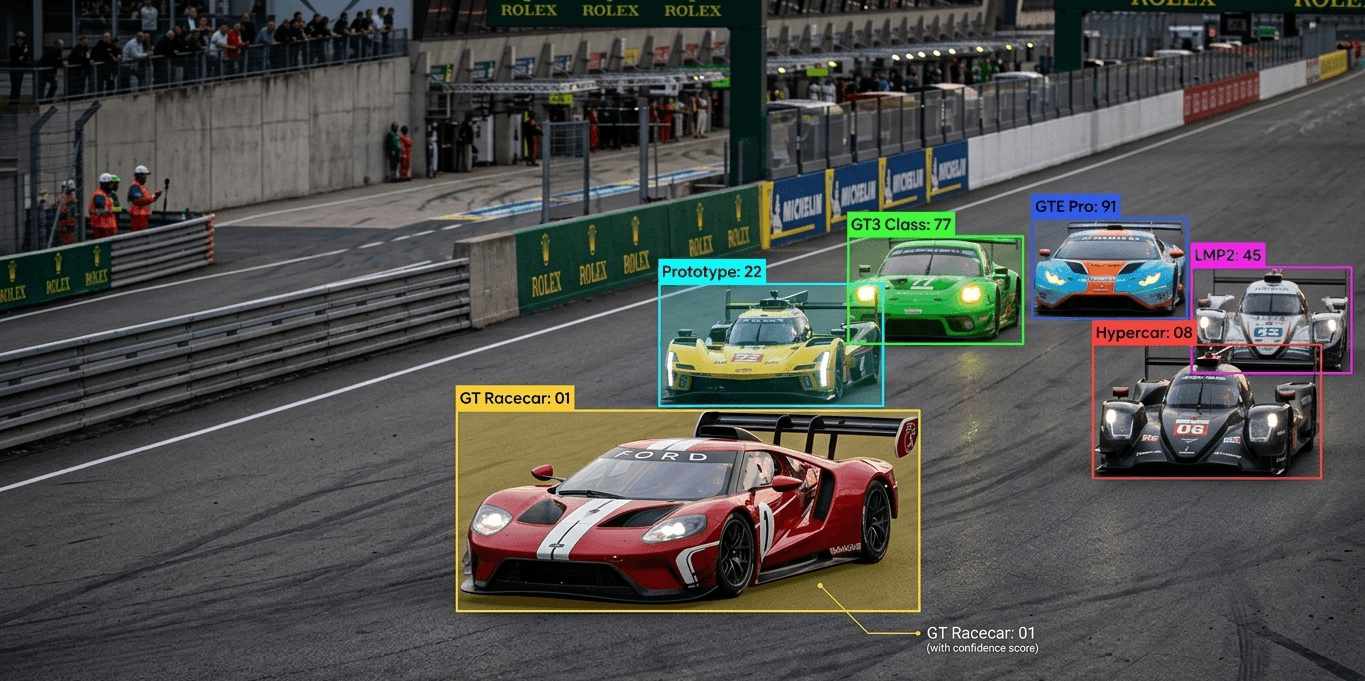
A European technology company partnered with Folio3 AI to build an AI-powered race car detection and multi-camera tracking solution.
The goal: detect, identify, and continuously track race cars across multiple live camera feeds while maintaining vehicle identities, identifying missing or off-track cars, and generating real-time alerts. Folio3 AI built a computer vision pipeline to process live race footage, assign persistent vehicle IDs, track cars across camera transitions, and generate vehicle-specific video outputs for scalable race monitoring.
90%+
Detection & Tracking Accuracy
10 Months
Project Duration
6 Members
AI Engineering Team
Real-Time
Vehicle Tracking & Alerts
ABOUT THE CUSTOMER
Client Name
Technology Company
(Name cannot be disclosed due to NDA)
Industry
IT Services & Technology
Primary Use Case
Race Car Detection & Multi-Camera Tracking
The client is a technology company providing software development, cloud infrastructure, data center, hardware support, and other technology services.
For its motorsports initiative, the company wanted to strengthen how race cars were monitored across a track using multiple cameras positioned throughout the racing environment.
The objective was to move beyond isolated camera feeds and create a connected tracking system capable of identifying individual vehicles, understanding where they were located, and maintaining visibility as they moved through different sections of the course.
THE CHALLENGE
Tracking race cars across an entire course becomes difficult when monitoring depends on several independent camera feeds.
Operators had to follow vehicles manually as they moved from one camera's field of view to another. This created the risk of tracking gaps, incorrect vehicle identification, missed cars, and delayed detection when a vehicle went off track.
The client needed a computer vision system capable of maintaining vehicle identities across camera feeds while providing continuous visibility throughout the race.
Three primary challenges defined the project.
- Multi-Camera Vehicle Tracking: Cars repeatedly entered and exited different camera views. The system needed to preserve each vehicle's identity throughout those transitions.
- Continuous Vehicle Identification: Every detected car needed a persistent ID so the platform could distinguish individual vehicles and maintain tracking continuity.
- Missing & Off-Track Detection: The system needed to identify when expected vehicles disappeared from monitored areas or deviated from the race course and immediately alert operators.
OUR DELIVERY APPROACH
Live Camera
Video Processing
Persistent IDs
Vehicle Tracking
Real-Time
Detection & Alerts
Multi-Camera
Tracking Coverage
Folio3 AI approached the project as a complete computer vision and video tracking workflow rather than a standalone object detection implementation.
The team first analyzed how vehicles appeared across the available camera network and how those cameras covered different sections of the racing environment. Training data was then collected and prepared to represent the vehicles, camera perspectives, viewing conditions, and race-course scenarios the system would encounter.
Computer vision models and custom tracking algorithms were developed to identify cars within each feed, associate detections with assigned vehicle identities, and maintain continuity as vehicles moved through different camera zones. The solution was then integrated into the wider application so tracking results, processed video outputs, and alerts could be consumed by users during race monitoring.
THE SOLUTION
The team designed and built an AI-powered race car detection and multi-camera tracking platform that acts as the intelligence layer between live race-course camera feeds and the client’s monitoring environment. The solution ingests live video streams, detects race cars as they enter each camera view, assigns persistent vehicle identities, tracks movement across multiple cameras, and generates real-time alerts when vehicles become missing or move off track.
At its core, the platform processes high-speed motorsports footage through a computer vision and vehicle tracking pipeline customized for the client’s race-course environment, camera coverage, and monitoring requirements.
THE FOUR-STAGE PIPELINE
Folio3 built a four-stage pipeline that takes live race-course camera feeds and converts them into continuous vehicle tracking intelligence, real-time alerts, and processed outputs for operational monitoring.
1. Video ingestion and frame extraction — The client’s race-course camera network provides multiple live video feeds as the primary input. The system ingests these streams, standardizes incoming video, extracts analyzable frames, and organizes them for real-time processing while preserving timing and camera-level context across the racing environment.
2. Video preprocessing and vehicle preparation — Incoming race footage is prepared before model inference to improve detection and tracking performance. This includes frame resizing, visual normalization, motion blur handling, noise reduction, and preparation of relevant track regions where race cars are most likely to appear and transition between camera views.
3. Vehicle detection, identification, and multi-camera tracking — The processed video sequences are passed through trained computer vision and tracking models designed to detect race cars, assign persistent vehicle IDs, and follow individual vehicles across frames and camera transitions. The system analyzes high-speed movement, changing camera angles, similar-looking vehicles, partial occlusions, and temporary visibility loss to maintain tracking continuity throughout the race.
4. Alert generation and tracking output delivery — The resulting tracking data is evaluated to identify missing vehicles, off-track events, and camera transitions requiring operator attention. The system generates real-time alerts and delivers vehicle tracking outputs, processed video footage, and monitoring data to the client’s application for continuous race visibility and review.
SOLUTION ARCHITECTURE
RESULTS ACROSS RACE CAR TRACKING WORKFLOWS
70%+
Less Manual Camera Switching
Automated cross-camera tracking reduced the need for operators to manually
locate and follow vehicles across multiple race feeds.
50%+
Fewer Tracking Gaps
Persistent vehicle identification helped reduce tracking interruptions as
race cars moved between different camera views.
2×
Greater Monitoring Coverage
Automated tracking allowed operators to monitor more vehicles and camera
feeds without proportionally increasing manual effort.
Ready to Build Your AI Car Detection Solution?
Book a discovery session with our AI engineering team to explore real-time vehicle detection, tracking, multi-camera monitoring, and automated alerts.
Schedule a Discovery Call →


-444d0838-391a-4d79-a851-875d402e0723.webp&w=1920&q=90)