Your support team handles thousands of tickets monthly. Legal reviews countless contracts quarterly. Compliance officers manually audit documents for regulatory risks. These repetitive, knowledge-intensive tasks consume millions in operational costs while competitors deploy AI that never sleeps.
Generic models like ChatGPT can't solve enterprise problems. They leak your intellectual property to third-party servers, struggle with industry-specific terminology, and violate data sovereignty requirements. According to McKinsey's 2024 State of AI report, most organizations now use AI in at least one business function, yet most struggle with custom LLM development for enterprises that truly fit their security and compliance needs.
This guide provides CTOs, AI leaders, and digital transformation executives at Fortune 500 companies with a complete roadmap: technical architecture decisions, security frameworks, realistic cost breakdowns, ROI calculations, and vendor selection criteria for successful enterprise LLM deployment.
Why large companies need custom LLMs (not off-the-shelf models)?
Off-the-shelf models work for consumer applications but fail when handling sensitive enterprise data, industry-specific terminology, regulatory compliance requirements, and mission-critical workflows that demand accuracy, security, and performance guarantees your business depends on daily.
Data privacy and intellectual property risks
Public APIs like ChatGPT send your proprietary data to external servers, where it trains future models accessible to competitors. Your trade secrets, customer information, strategic plans, and competitive intelligence become training material for systems anyone can access.
Lack of domain-specific knowledge
Generic models don't understand pharmaceutical regulatory terminology, financial compliance acronyms, manufacturing process specifications, or legal contract language. They hallucinate answers when confronted with specialized knowledge, creating serious liability risks and damaging credibility with customers and stakeholders.
Cost inefficiency at enterprise scale
Per-token pricing becomes prohibitive when processing millions of queries. Running high volumes of tokens monthly through GPT-4 costs approximately $200,000 annually. Custom models deployed on your infrastructure reduce per-query costs substantially after recovering initial development investment.
Compliance and regulatory constraints
GDPR Article 22 requires explainability for automated decisions affecting individuals. HIPAA mandates strict data residency controls and access limitations. Financial regulations demand comprehensive audit trails and data lineage documentation. Off-the-shelf models rarely meet these requirements without expensive customization that vendors won't support.
Mission-critical applications need fast response times with high uptime guarantees. Public API calls introduce network latency, rate limiting during peak usage, and dependency on third-party infrastructure reliability. Custom models deployed on your infrastructure guarantee performance SLAs that your operations demand.
Key considerations before starting: strategy & planning
Successful custom LLM projects start with strategic planning before selecting technology. You need clear business objectives, data readiness assessment, compliance evaluation, ROI calculations, and executive sponsorship, securing resources and removing organizational barriers before commencing development work.
Define clear business objectives
Specify measurable outcomes: reduce support costs significantly, accelerate contract review substantially, automate thousands of monthly document summaries, or improve compliance accuracy to high levels. Vague goals like "improve productivity" or "enhance customer experience" lead to scope creep, budget overruns, and ultimately failed projects.
Assess data readiness and quality
Custom LLMs require thousands of domain-specific documents, at a minimum, for effective training. Audit your data sources comprehensively: Are documents digitized? Properly labeled with metadata? Free of errors and inconsistencies? Budget a substantial project timeline specifically for data cleaning, labeling, anonymization, and preparation activities.
Evaluate compliance and security requirements
Identify applicable regulations: GDPR for European customer data, HIPAA for healthcare information, SOC 2 for enterprise SaaS platforms, and PCI-DSS for payment processing. Determine data residency requirements, encryption standards, access control specifications, and comprehensive audit trail capabilities before making any architecture decisions.
Calculate expected ROI and budget
Enterprise custom LLM development costs $40,000-$400,000, depending on complexity, scope, and timeline requirements. Factor in ongoing infrastructure expenses ($10,000-$50,000 monthly), annual maintenance costs (15-20% of development), and internal resource allocation. Calculate realistic payback period against quantified automation savings and productivity gains.
LLM projects require cross-functional collaboration spanning IT infrastructure, legal compliance, business units, security teams, and change management. Executive sponsorship ensures adequate resource allocation, removes organizational barriers and politics, maintains momentum through inevitable challenges during implementation timelines, and validates strategic importance.
Choosing a development approach: in-house vs vendor (or hybrid)
Three development paths exist: build completely in-house, partner with specialized vendors, or adopt hybrid models combining internal and external resources. Your optimal choice depends on existing internal expertise, timeline urgency, budget constraints, and the strategic importance of AI capabilities.
Building in-house: pros and cons
In-house development provides complete control over architecture, data handling, intellectual property ownership, and long-term strategic direction. However, it requires multiple ML engineers with proven LLM expertise, extended timelines, $250,000-$1 million investment, and opportunity costs. Best for companies where AI represents a core competitive advantage, differentiating products.
Partnering with specialized vendors
Vendors like Folio3 AI deliver production-ready systems in reasonable timeframes at a total cost of $75,000-$400,000 total cost. They bring domain expertise, pre-built compliance frameworks, proven architectures, and experienced teams, avoiding common pitfalls. Ideal when speed matters, internal expertise is limited, or AI augments rather than fundamentally defines your business model.
Hybrid approach: combining internal and external resources
Start with vendor-led proof of concept demonstrating value quickly, then transition to internal management for ongoing operations post-deployment. Vendors handle initial heavy lifting, data engineering, model architecture, training, deployment infrastructure, while your team learns best practices, develops internal capabilities, and prepares to assume day-to-day operations responsibilities.
Architecture & implementation workflow
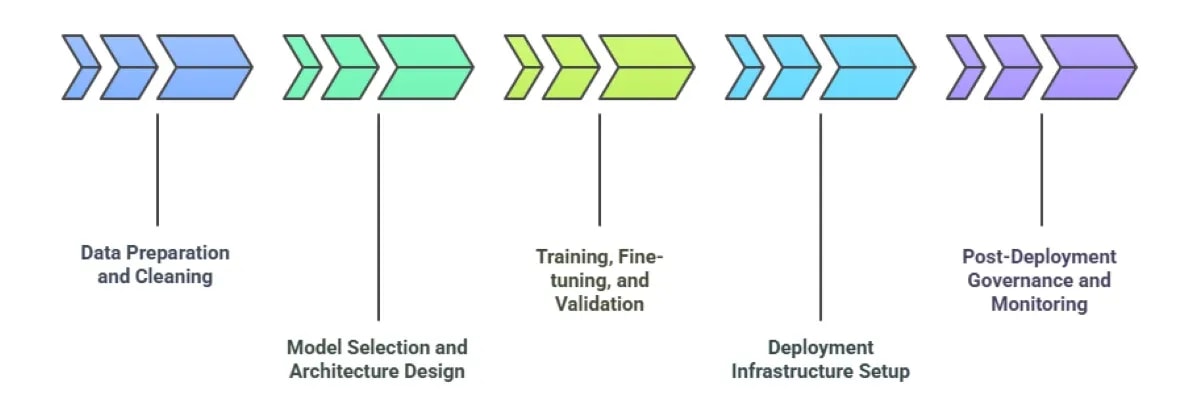
Custom LLM implementation follows five distinct phases: data preparation and cleaning, model selection and architecture design, training and fine-tuning, deployment infrastructure setup, and post-launch governance. Each phase has specific deliverables, timelines, technical decisions, and success criteria requiring careful consideration and planning.
Data ingestion and preprocessing
Extract data from databases, document management systems, CRMs, and APIs across your enterprise. Apply OCR technology to scanned images and PDFs, remove duplicate content, anonymize personally identifiable information, and chunk long documents into semantically meaningful segments optimized for model training. This critical phase typically consumes a substantial portion of the total project timeline.
Model selection: base model and architecture
Choose between fine-tuning foundation models (Llama 3, Mistral, GPT-4) or implementing the Retrieval-Augmented Generation architecture connecting LLMs to vector databases. Fine-tuning requires substantial labeled training examples; RAG works effectively with smaller datasets by retrieving relevant context from knowledge bases at query time, combining the strengths of both approaches.
Training, fine-tuning, and validation
Fine-tuning adapts pre-trained models to your specific domain using efficient techniques like LoRA or QLoRA for parameter optimization. Training typically requires several weeks on cloud GPU infrastructure at $10,000-$50,000 compute cost. Rigorous validation ensures accuracy targets, checks for bias across demographic groups, and tests comprehensive edge cases before deployment.
Deployment: cloud, on-premises, or hybrid
Deploy to AWS SageMaker, Azure ML, or Google Vertex AI for automatic scalability and managed infrastructure. Regulated industries often require on-premises deployment using Kubernetes and Docker containers, ensuring data sovereignty. Hybrid architectures process sensitive data on-premises while leveraging cloud computing for non-sensitive workloads, balancing security with flexibility.
Post-deployment governance and monitoring
Implement continuous monitoring, tracking accuracy drift, response latency, system throughput, and hallucination detection in real-time. Establish feedback loops where users flag incorrect responses for retraining. Schedule regular model updates incorporating new data and user corrections. Maintain comprehensive version control, ensuring rapid rollback capability when updates inadvertently degrade performance.
Use cases & real-world scenarios for large enterprises
Custom LLMs transform knowledge-intensive workflows across every industry vertical and business function. These proven real-world applications demonstrate measurable ROI through automation, improved decision quality, compliance risk reduction, enhanced customer experiences, and significant productivity gains achieved at enterprise scale.
Internal knowledge base and enterprise wiki assistant
Employees waste considerable time weekly searching for internal information scattered across SharePoint, Confluence, email, and department drives. Custom LLMs trained on your complete knowledge base provide instant, accurate answers with source citations, reducing search time substantially and dramatically improving onboarding efficiency for new hires.
Customer support automation and virtual assistants
Leading enterprises deploy virtual assistants successfully, handling the majority of customer queries autonomously without human intervention. Custom LLMs understand your specific products, policies, pricing structures, and customer history. They resolve routine issues instantly while intelligently escalating complex cases to human agents, reducing annual support costs substantially.
Document summarization and compliance review
Legal teams spend extensive hours reviewing standard contracts for regulatory compliance, non-standard clauses, and potential risks. Custom LLMs trained on legal terminology and your contract standards identify problematic clauses, flag unusual terms requiring attention, and summarize lengthy agreements into concise executive briefs, accelerating review cycles substantially.
Automated report generation and data analysis
Finance teams manually compile monthly reports, gathering data from multiple systems, analyzing trends, and formatting presentations. Custom LLMs query databases directly, perform statistical analysis, and generate natural language summaries with relevant charts and tables automatically. Tasks requiring days now complete in minutes with greater accuracy and consistency.
Content generation with brand voice consistency
Marketing teams need content at scale while maintaining strict brand guidelines, tone requirements, and compliance rules. Custom LLMs trained on approved materials generate product descriptions, email campaigns, social media posts, and blog content matching your specific voice, terminology standards, and regulatory requirements without extensive manual editing.
Risks, challenges & how to mitigate them
Enterprise LLM projects face predictable challenges, including data quality issues, model hallucinations, budget overruns, user adoption resistance, and compliance violations. Understanding these risks upfront with proactive mitigation strategies increases success probability substantially, saving millions in failed project costs.
Data privacy, compliance, and governance risks
Implement encryption at rest (AES-256) and in transit (TLS 1.3), role-based access controls limiting query permissions, comprehensive audit logs tracking every interaction, and regular third-party security audits. Engage legal and compliance teams from project inception, not as an afterthought before launch, ensuring requirements shape architecture decisions rather than constraining completed systems.
Model drift and hallucination management
Deploy confidence scoring thresholds that trigger mandatory human review for uncertain responses. Require citation of specific source documents for all factual claims. Implement automated monitoring, alerting technical teams when accuracy drops below an acceptable baseline. Schedule regular retraining cycles incorporating new data, corrected responses, and updated business processes.
Cost overruns and infrastructure expenses
Start with a limited proof of concept on restricted data and a small user group before committing the full budget. Use cloud spot instances, reducing compute costs substantially compared to on-demand pricing. Implement model quantization and intelligent caching strategies, reducing inference costs. Define strict success criteria before expanding project scope or requesting additional budget.
User adoption and change management resistance
Frame LLM as an assistant augmenting humans rather than a threatening replacement of jobs. Pilot with enthusiastic early adopters who become internal champions promoting benefits. Show concrete time savings with specific examples relevant to each user group. Provide comprehensive training, easily accessible support channels, and continuous communication during rollout, addressing concerns promptly.
Regulatory compliance and audit requirements
Document all training data sources, model decision logic, and system interactions comprehensively. Implement explainable AI features showing reasoning behind recommendations and decisions. Maintain strict version control for models, training data, and system configurations. Conduct compliance reviews before each major release, not after deployment, catching issues early when fixes cost less.
Vendor evaluation checklist
Selecting the right development partner fundamentally determines project success or failure. Evaluate vendors objectively across technical capabilities, industry expertise, security certifications, post-deployment support quality, and cultural fit. This structured framework ensures comprehensive comparison, reducing selection risk and preventing costly mistakes.
Technical expertise and proven track record
Assess vendor portfolio depth: Do they have multiple completed similar projects in your specific industry with documented results? Request detailed case studies with concrete ROI metrics, implementation timelines, and customer references. Verify deep expertise in fine-tuning, RAG architectures, multi-modal AI, and MLOps. Request technical architecture reviews demonstrating understanding.
Data security and compliance certifications
Verify SOC 2 Type II, ISO 27001, and industry-specific certifications (HIPAA for healthcare, PCI-DSS for payments, FedRAMP for government). Confirm they support flexible deployment options: on-premises, private cloud, hybrid architectures. Validate they understand data residency requirements and can support air-gapped environments if your security policies demand complete network isolation.
Transparent development process and communication
Request detailed project plans with clear milestone deliverables, acceptance criteria, and realistic timelines. Evaluate communication frequency and clarity during the sales process. This accurately predicts project collaboration quality. Ensure they provide regular progress updates, comprehensive documentation, and proactive knowledge transfer, preparing your team for ongoing operations post-deployment.
Post-deployment support and maintenance services
Define explicit service level agreements for response time, bug fixes, performance optimization, and retraining schedules. Clarify ongoing costs: Is monitoring included? What about model updates and infrastructure scaling? How do they handle version upgrades, security patches, and evolving compliance requirements? Get written commitments before signing contracts.
Clear ROI-focused deliverables and success metrics
Strong vendors define success metrics upfront during scoping: accuracy thresholds, latency requirements, adoption targets, and quantified cost savings projections. They propose comprehensive measurement frameworks tracking business impact, not just technical metrics. They commit contractually to optimization based on real-world performance data post-launch, aligning their success with yours.
How to roll out custom LLM at your company — step-by-step action plan
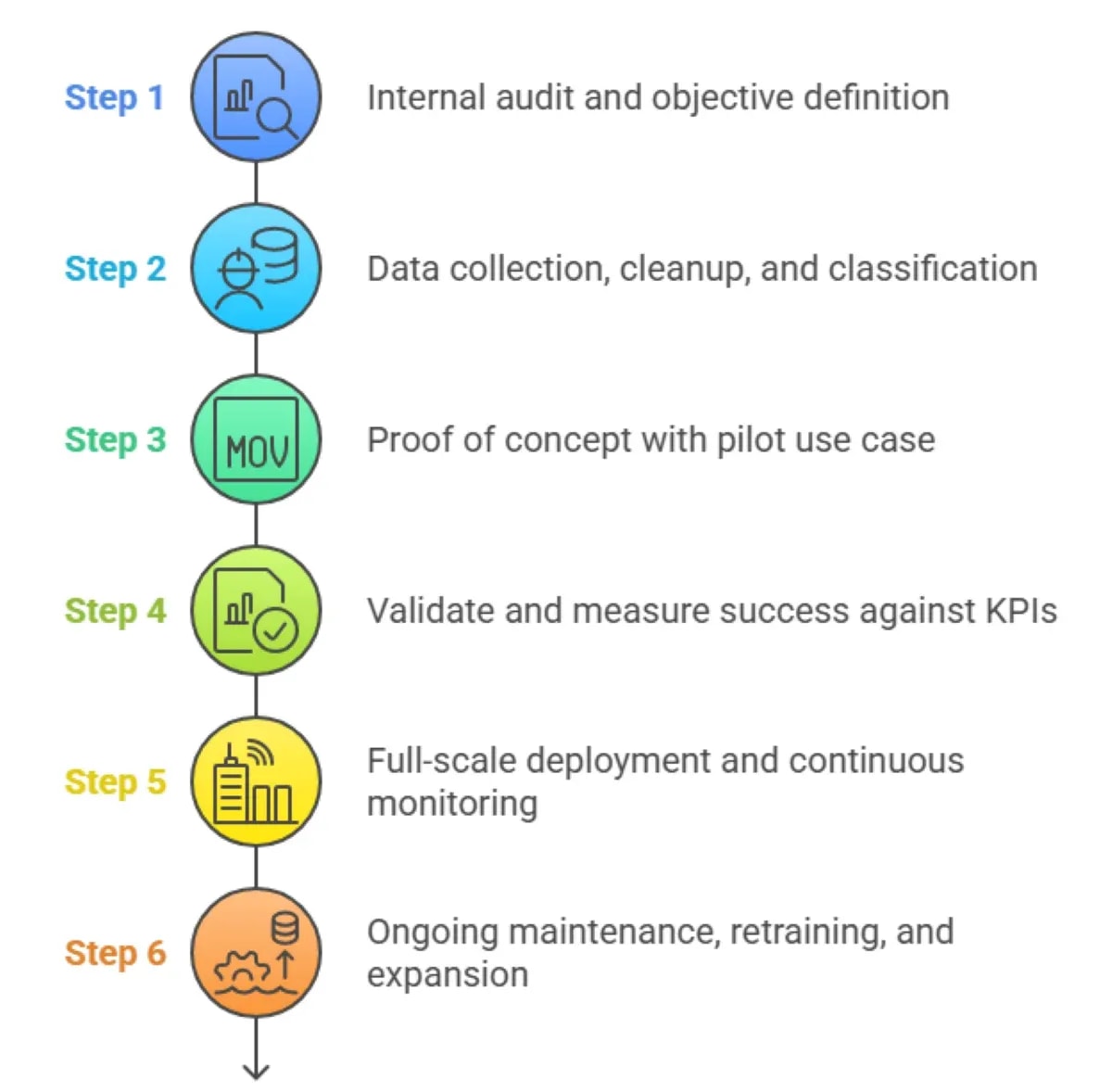
Successful enterprise LLM deployment follows a phased approach: start narrow, proving value quickly, expand gradually, building organizational confidence, and scale systematically. This step-by-step framework minimizes risk while building technical capability and organizational readiness for enterprise-wide scaling across multiple departments.
Step 1: Internal audit and objective definition
Conduct a comprehensive assessment: inventory all data sources, interview stakeholders across departments about pain points, map current workflows and bottlenecks, and identify quick-win use cases. Define measurable success criteria (e.g., reduce processing time substantially, achieve high accuracy, save high costs annually, improve user satisfaction considerably).
Step 2: Data collection, cleanup, and classification
Allocate sufficient time for intensive data engineering work. Extract documents from disparate systems, apply OCR to images and PDFs, remove duplicates and corrupted files, anonymize sensitive information, and label training examples. Classify data by sensitivity level (public, internal, confidential, restricted) and applicable regulatory requirements (GDPR, HIPAA, PCI).
Step 3: Proof of concept with pilot use case
Select a narrow, well-defined use case (e.g., HR policy assistant for limited users in a single department). Develop a minimal viable model testing core functionality. Test with friendly, patient users who provide detailed qualitative feedback and quantitative usage data. Measure baseline performance: accuracy, latency, user satisfaction, and time savings per interaction.
Step 4: Validate and measure success against KPIs
Run pilot collecting comprehensive metrics: query volume, response accuracy, user ratings, time saved per interaction, error rates, and qualitative feedback. Conduct structured user interviews, identifying specific friction points, desired improvements, and expansion opportunities. Compare actual results against the success criteria defined in Step 1, adjusting plans based on findings.
Step 5: Full-scale deployment and continuous monitoring
Expand to the full user base using a phased rollout, minimizing risk. Implement comprehensive monitoring: real-time dashboards tracking latency, throughput, errors, user satisfaction, and adoption rates. Deploy feedback mechanisms allowing users to flag incorrect responses, suggest improvements, and report issues. Establish dedicated support channels providing rapid assistance.
Step 6: Ongoing maintenance, retraining, and expansion
Schedule regular model updates incorporating new data, user feedback, and business process changes. Regular reviews analyze performance trends, identify improvement opportunities, and prioritize enhancements. After a stable operations period, evaluate additional use cases applying lessons learned for faster subsequent deployments. Budget 15-20% of development costs annually for maintenance.
Measuring success & ROI metrics for enterprises
Custom LLM value manifests across quantitative cost savings and qualitative productivity improvements. Establish comprehensive baseline metrics before deployment, track continuously during rollout, calculate ROI using both direct savings and productivity gains, and assess strategic benefits like risk reduction and competitive advantage.
Cost savings through automation
Calculate employee hours saved multiplied by loaded hourly rates, including salary, benefits, and overhead. Example: A Substantial number of employees save hours weekly searching for information. At typical loaded cost rates, this generates millions in annual savings versus $400K Year 1 development and infrastructure costs, delivering substantial ROI.
Time reduction for key tasks and workflows
Measure median time for document review, support ticket resolution, report generation, or contract analysis before and after LLM deployment. Target substantial time reduction for routine, repetitive tasks. Track throughput increases: contracts processed daily, reports generated weekly, support queries resolved hourly. Quantify efficiency gains translating to capacity for strategic work.
Reduction in support tickets and manual processes
Monitor support ticket volume deflection rates after deploying customer-facing LLM assistants. Best-in-class implementations achieve significant deflection for routine inquiries without sacrificing quality. Calculate direct savings: tickets deflected × cost per ticket (typically $15-35 including agent time, systems costs, overhead, management). Reinvest savings in handling complex issues.
User satisfaction and adoption rate metrics
Track daily and weekly active users as a percentage of the eligible population (target: high adoption within months of launch). Measure Net Promoter Score through regular surveys (target: strong positive scores indicating satisfaction). Monitor query volume growth over time, indicating increasing user trust, perceived value, and integration into daily workflows.
Compliance and risk reduction benefits
Quantify regulatory violations avoided, audit findings reduced, and faster compliance reporting cycles. While harder to measure than direct savings, risk reduction delivers substantial value: a single GDPR violation averages a €4.5 million penalty, HIPAA breaches cost $1.5-7 million, and securities violations can exceed $50 million, including reputational damage.
How Folio3 AI can help with custom LLM development
Folio3 AI delivers comprehensive custom LLM development services designed specifically for enterprise needs. From initial strategy consultation through deployment and ongoing optimization, we provide full-spectrum support, ensuring your AI investment delivers measurable business value.
LLM consulting & strategy development
Our LLM development journey begins with understanding your business needs, industry dynamics, and specific use cases. Leveraging deep expertise in NLP and ML, we collaborate to create custom strategies aligning with organizational goals and competitive requirements.
End-to-end LLM development
We craft Large Language Models from scratch, providing competitive advantages. Our process includes detailed consultation, meticulous data preparation, and model training using your proprietary data, ensuring models align perfectly with business requirements and performance expectations.
LLM fine-tuning for business optimization
We fine-tune pre-trained models like GPT, Llama, and PaLM to meet specific industry needs across finance, legal, healthcare, and other sectors. Our fine-tuned LLMs deliver contextually accurate, relevant results, enhancing decision-making processes throughout organizations.
LLM-powered AI solutions
Harness LLM power with robust AI solutions. From chatbots and virtual assistants to sentiment analysis and speech recognition systems, we build custom solutions transforming how your business operates, communicates, and innovates across departments.
Seamless LLM integration
Our developers ensure smooth integration of LLMs into existing enterprise systems, including CRM, ERP, and content management platforms. We prioritize minimizing downtime during integration, ensuring operations continue without disruption while maintaining data integrity.
Ongoing support & maintenance
We provide comprehensive support, keeping LLMs and LLM-based solutions running seamlessly. Services include continuous monitoring, adapting to evolving data, implementing necessary updates, and ensuring optimal performance of AI systems as requirements change over time.
Frequently asked questions
{ "@context": "https://schema.org", "@type": "FAQPage", "mainEntity": [ { "@type": "Question", "name": "What is a custom LLM and how does it differ from out-of-the-box models?", "acceptedAnswer": { "@type": "Answer", "text": "A custom LLM is trained on your proprietary data to understand company-specific terminology, comply with regulations, and integrate with internal systems. It keeps data private, understands domain jargon, and connects directly to your databases without exposing information externally." } }, { "@type": "Question", "name": "Why should a large company invest in a custom LLM rather than using a generic public model?", "acceptedAnswer": { "@type": "Answer", "text": "Generic models expose IP to third parties, cannot understand industry-specific terminology, and often cost around $200,000 annually at scale. Custom LLMs provide automation for support tickets, accelerate contract review, increase efficiency, and offer significant long-term ROI." } }, { "@type": "Question", "name": "How do we ensure data security, compliance, and privacy when building a custom LLM?", "acceptedAnswer": { "@type": "Answer", "text": "Deploy the model on-premises or in a private cloud with AES-256 encryption, role-based access controls, full audit logs, anonymized training data, and security audits validating SOC 2, ISO 27001, HIPAA, or PCI-DSS compliance depending on industry needs." } }, { "@type": "Question", "name": "What is the typical process and timeline for developing and deploying a custom LLM in a large enterprise?", "acceptedAnswer": { "@type": "Answer", "text": "Custom LLM development follows five phases: Discovery, POC, Production, Optimization, and Expansion. Costs range from $40,000-$400,000 for fine-tuning or $250,000-$1 million for full custom builds. Initial value appears quickly, with full ROI typically realized months after launch." } }, { "@type": "Question", "name": "How do we measure ROI from a custom LLM?", "acceptedAnswer": { "@type": "Answer", "text": "ROI is measured by tracking hours saved multiplied by hourly rate, support tickets deflected multiplied by cost per ticket, throughput increases, error rate reductions, user satisfaction, and adoption rates compared against initial and ongoing costs." } }, { "@type": "Question", "name": "Should we build the LLM in-house or hire a vendor? What should we consider when selecting a vendor?", "acceptedAnswer": { "@type": "Answer", "text": "Build in-house if you have experienced ML engineers and extended timelines. Work with vendors—usually costing $75,000-$400,000—if you need faster deployment, lack expertise, or require compliance frameworks. Evaluate vendors by their track record and security certifications." } }, { "@type": "Question", "name": "What are the common challenges and risks when implementing custom LLMs, and how can they be mitigated?", "acceptedAnswer": { "@type": "Answer", "text": "Mitigate data quality issues by dedicating time to cleaning, reduce hallucinations through confidence thresholds and citations, prevent cost overruns with narrower POCs, improve adoption with pilot programs, and avoid compliance issues by involving legal teams early." } }, { "@type": "Question", "name": "Can a custom LLM scale across multiple departments or use cases in the company?", "acceptedAnswer": { "@type": "Answer", "text": "Yes. Using a modular architecture with shared infrastructure such as vector databases and monitoring systems, enterprises can scale a custom LLM across departments with additional fine-tuning for each specific use case." } }, { "@type": "Question", "name": "How is maintenance, governance, and model drift handled post-deployment?", "acceptedAnswer": { "@type": "Answer", "text": "Maintenance includes continuous monitoring with drift alerts, scheduled retraining using updated data, version control for quick rollbacks, and annual budgeting of 15–20% of development costs for ongoing governance and operational support." } } ]
}
What is a "custom LLM" and how does it differ from out-of-the-box models?
A custom LLM is trained on your proprietary data to understand company-specific terminology, comply with regulations, and integrate with internal systems, keeping your data private, understanding domain jargon, and connecting directly to your databases without exposing information externally.
Why should a large company invest in a custom LLM rather than using a generic public model?
Generic models expose IP to third parties, can't understand industry terminology, cost approximately $200,000 annually at scale, and violate compliance requirements. Custom LLMs automate significant portions of support tickets, accelerate contract review substantially, and deliver strong ROI over several years.
How do we ensure data security, compliance, and privacy when building a custom LLM?
Deploy on-premises or in private cloud with AES-256 encryption, role-based access controls, comprehensive audit logs, anonymized training data, and third-party security audits validating SOC 2, ISO 27001, HIPAA, or PCI-DSS certifications as required.
What is the typical process and timeline for developing and deploying a custom LLM in a large enterprise?
Development follows five phases (Discovery, POC, Production, Optimization, Expansion) with total costs ranging $40,000-$400,000 for fine-tuning or $250,000-$1 million for custom builds, with initial value realized quickly and full ROI realization following several months post-launch.
How do we measure ROI from a custom LLM?
Track hours saved × hourly rate, support tickets deflected × cost per ticket ($15-35), throughput increases, error rate reductions, user satisfaction scores, and adoption rates to calculate ROI against initial investment and ongoing costs.
Should we build the LLM in-house or hire a vendor? What should we consider when selecting a vendor?
Build in-house if you have sufficient ML engineers and extended timeline tolerance; partner with vendors (typical costs $75,000-$400,000) for faster production systems when lacking expertise or needing compliance frameworks, evaluating proven track records and security certifications.
What are the common challenges and risks when implementing custom LLMs, and how can they be mitigated?
Mitigate data quality issues (dedicate substantial budget to cleaning), hallucinations (confidence thresholds, citations, feedback loops), cost overruns (narrow POC first), low adoption (pilot with champions), and compliance violations (engage legal early).
Can a custom LLM scale across multiple departments or use cases in the company?
Yes, using modular architecture with shared infrastructure (vector databases, monitoring) and department-specific fine-tuning—organizations typically deploy multiple use cases over time, sharing substantial portions of underlying systems while customizing for specific needs.
How is maintenance, governance, and model drift handled post-deployment?
Implement continuous monitoring with automated alerts for accuracy degradation, schedule regular retraining with new data, maintain version control for rapid rollback, and budget 15-20% of development costs annually for ongoing maintenance and optimization.