Why do so many AI projects succeed in the lab but fail across the business? Because enterprise AI adoption challenges are rarely about the technology itself. They are about everything around it: the data, the people, the infrastructure, and the organizational readiness to absorb change.
Companies across every industry are pouring money into artificial intelligence. Generative AI has moved from a buzzword to a boardroom priority. Pilot projects are everywhere. But the gap between running a successful AI experiment and deploying AI at production scale is where most enterprises get stuck, and where competitive advantage is won or lost.
The root cause is almost never the model or the platform. AI success depends more on organizational readiness than on the sophistication of the technology you deploy. Data readiness, governance, talent, culture, and infrastructure all play roles that are at least as important as choosing the right algorithm.
This post breaks down the seven most critical barriers to AI adoption and provides practical strategies for overcoming each one. Whether you are a CTO evaluating your AI infrastructure or a business leader building a case for AI investment, this guide is built to help you move from pilot to production with confidence.
Enterprise AI adoption: Key Statistics from Industry Research
The 7 Key Challenges in Enterprise AI Adoption
Enterprise AI adoption promises major value, but scaling beyond pilots remains difficult. Organizations often face challenges with data, talent, governance, infrastructure, ROI, culture, and production readiness before AI can deliver impact. Overcoming these barriers is essential for successful artificial intelligence enablement at the enterprise level.
Challenge 1: Poor data quality and data silos
Data is the fuel that powers every AI system. When that fuel is fragmented, inconsistent, or locked away in departmental silos, the results are predictable: unreliable outputs, failed models, and teams that lose trust in AI before it has a chance to prove its value.
Many enterprises struggle with data that is spread across teams, tools, and systems. Sales, operations, and customer service often work from separate sources of truth, using different formats, labels, and update cycles. When AI models rely on that kind of disconnected data, they produce inconsistent insights and miss important context. Outdated records, incomplete fields, and manual data entry errors only make the problem worse.
This is exactly the type of issue identified in a practical AI readiness checklist used by enterprises to evaluate data maturity before scaling AI initiatives.
How to overcome poor data quality
Build a unified data architecture. Break down departmental data silos by connecting systems through a centralized data platform or data lake. This does not mean replacing every existing tool. It means creating a layer that allows AI systems to access clean, consistent data across the organization.
Implement data governance frameworks. Define clear ownership for every dataset. Establish standards for data entry, validation, and maintenance. Without governance, even the best data architecture will degrade over time.
Standardize data and invest in metadata management. Consistent field names, formats, and labeling conventions across departments reduce friction during AI model training and improve the reliability of outputs.
Challenge 2: Lack of AI skills and the Talent Gap
One of the biggest barriers to enterprise AI adoption is the gap between ambition and internal capability. Many organizations want to move quickly with AI, but they do not yet have the right mix of technical expertise, business understanding, and operational readiness to make that happen. This is often identified early through ai readiness assessment services that evaluate organizational skill maturity.
The challenge is not limited to hiring data scientists or machine learning engineers. Enterprises also need AI-literate business analysts, product managers who can translate business problems into AI use cases, and leaders who understand how AI fits into everyday workflows. When technical teams and business teams are not aligned, projects slow down, expectations become unclear, and investment loses momentum.
How to overcome the AI talent gap
Launch upskilling and reskilling programs. Not every AI initiative requires deep technical specialization. AI workforce development starts with investing in AI literacy training across the organization, from executives shaping strategy to managers and teams working with AI-powered tools.
Build cross-functional AI teams. Pair data scientists with business domain experts. The best AI outcomes happen when technical capability meets deep understanding of the business problem. Create structures where these teams work together from the start, not just at handoff.
Partner with AI specialists. Not every company needs to build an internal AI center of excellence from scratch. Working with experienced AI enablement partners can accelerate deployment timelines, reduce risk, and transfer knowledge to your internal teams over time.
Challenge 3: Weak AI governance, Risk, and Compliance
As AI moves from experimentation to production, governance becomes the difference between scaling successfully and stalling out. Without clear guardrails, even promising AI initiatives can create risk faster than they create value.
Many organizations still lack policies for responsible AI use. That opens the door to biased outputs, inaccurate responses, data exposure, compliance issues, and loss of customer trust. It also creates uncertainty inside the business, where teams may hesitate to adopt AI because expectations, ownership, and accountability are not clearly defined.
How to overcome governance challenges
Establish an AI governance framework. This should include policies for data usage, model selection, output validation, and escalation paths when AI-generated content or decisions need human review. Make governance a leadership responsibility, not just an IT checkbox.
Develop ethical AI policies. Address bias testing, transparency requirements, and accountability structures. Define who is responsible when an AI system produces a harmful or inaccurate output.
Implement model monitoring, auditability, and compliance systems. Track model performance in production. Log decisions for audit trails. Align AI usage with data privacy requirements and industry regulations before issues arise, not after.
For organizations that lack the internal resources to build these systems from scratch, AI governance as a service offers a practical alternative. External partners can provide ready-made governance frameworks, ongoing compliance monitoring, and audit support, allowing enterprises to move faster without compromising on oversight or accountability.
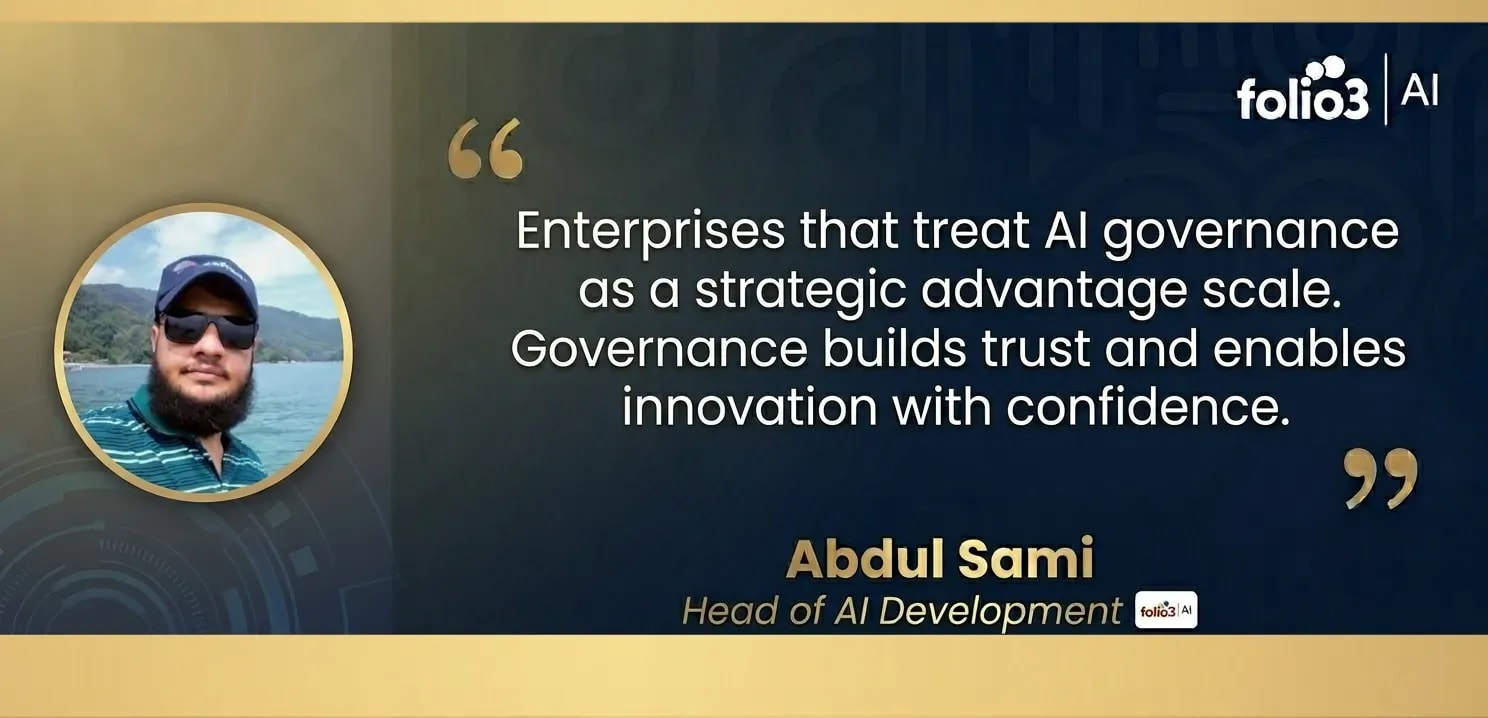
“The enterprises that treat AI governance as a strategic advantage rather than a compliance burden are the ones scaling fastest. Governance is not about slowing innovation down. It is about building the trust infrastructure that lets you move faster with confidence.” — Abdul Sami, Head of AI Development
Challenge 4: Legacy Infrastructure and System Integration Issues
You cannot run modern AI workloads on outdated infrastructure. Yet many enterprises are trying to do exactly that. Legacy ERP systems, on-premise databases, and rigid IT architectures were not designed for the real-time data processing, API-driven integrations, and scalable compute that AI requires.
In many organizations, the bigger issue is not just old infrastructure, but disconnected infrastructure. When core systems cannot share data easily, AI models are forced to work with incomplete information. That leads to weaker predictions, slower insights, and unnecessary friction during deployment.
How to overcome infrastructure barriers
Prioritize cloud modernization. Cloud-native infrastructure provides the elasticity, scalability, and computing power that AI workloads demand. This does not require a full rip-and-replace. Start with the systems that most directly support your AI use cases.
Adopt an API-first architecture. APIs allow legacy systems to communicate with modern AI platforms without requiring complete system overhauls. Build integration layers that let data flow between old and new systems.
Take an incremental integration approach. Replace systems gradually rather than attempting a full infrastructure transformation at once. Focus on modernizing the components that create the highest friction for AI deployment first.
Get a Clear Score Across Every AI Readiness Pillar
Measure your enterprise readiness across data maturity, governance, operational capability, and scaling potential.
Check AI Readiness
Challenge 5: Unclear ROI and weak business case for AI
Many AI initiatives lose momentum because the value case is not clear enough from the beginning. Teams may be excited about the technology, but leadership still needs to understand what business problem it solves and how success will be measured.
This often happens when AI projects are framed around experimentation rather than outcomes. Instead of focusing on revenue growth, cost reduction, efficiency, or customer experience, organizations focus on the tool itself. Without clear KPIs tied to real business goals, AI can start to look like a promising idea without a compelling business case.
How to overcome ROI uncertainty
Adopt a use-case-driven AI strategy. Do not start with the technology and look for problems it can solve. Start with high-value business problems, such as reducing customer churn, accelerating invoice processing, or improving demand forecasting, and then identify how AI can address them.
Define measurable KPIs from day one. For every AI initiative, establish metrics tied to efficiency, revenue, cost reduction, or customer satisfaction. Track these throughout the project lifecycle, not just at launch.
Start with high-impact pilot projects. Pick use cases where the potential ROI is clear and measurable. Success in focused pilots builds internal support, generates proof points for leadership, and creates momentum for broader adoption.
Challenge 6: Organizational resistance and change management
Technology is only half the equation. Even the best AI tools will struggle to gain traction if the people expected to use them do not trust them, understand them, or see their value.
Resistance often comes from fear of automation, unclear communication from leadership, and uncertainty about how AI will affect day-to-day roles. When employees see AI as a threat rather than a support system, adoption slows down, no matter how strong the technology may be.
How to overcome organizational resistance
Implement a structured change management strategy. AI adoption is an organizational transformation, not just a technology deployment. Treat it with the same rigor you would apply to any major business change: communication plans, stakeholder engagement, and phased rollouts led by a dedicated AI enablement team to ensure alignment across departments.
Launch AI awareness programs. Help employees understand what AI can and cannot do. Show them how AI augments their work rather than replacing it. Highlight internal success stories where AI has made teams more effective.
Design human-in-the-loop workflows. Build AI systems where humans review, validate, and refine AI outputs. This builds trust, improves accuracy, and gives employees a sense of ownership over the AI tools they use.
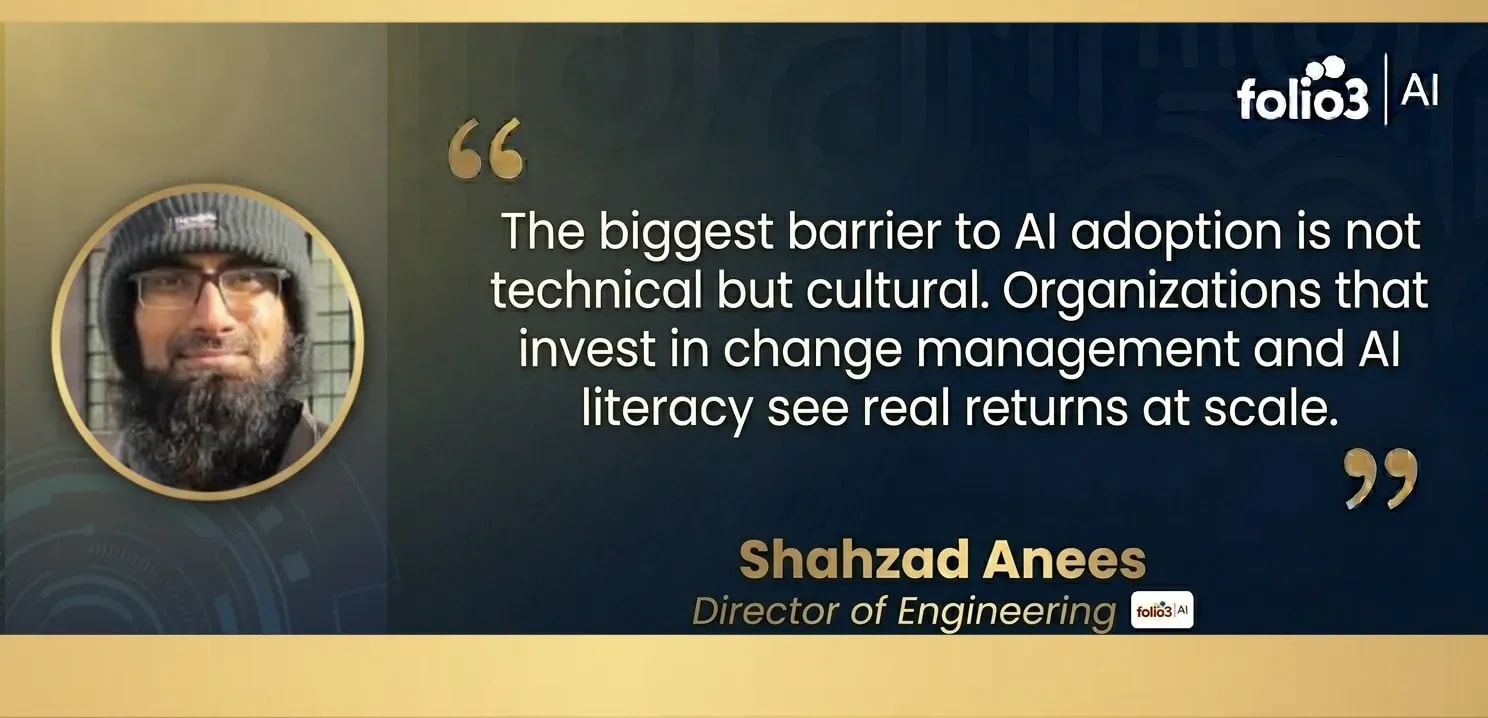
“The biggest barrier to AI adoption is rarely technical. It is cultural. Organizations that invest as much in change management and AI literacy as they do in model development are the ones that actually see returns at scale.” — Shahzad Anees, Folio3 Director of Engineering
Challenge 7: Scaling AI from pilot to production
The pilot-to-production gap is where many enterprise AI initiatives lose momentum. It is one thing to prove that an AI solution works in a controlled environment. It is another to deploy it consistently across teams, systems, and business processes.
The biggest obstacles are usually operational. Teams may build a successful pilot, but lack the processes, ownership, monitoring, and infrastructure required to support it in production. Without a clear operational strategy, early wins remain isolated and never turn into organization-wide value.
How to overcome scaling challenges
Invest in MLOps and AI lifecycle management. MLOps (Machine Learning Operations) creates the infrastructure for deploying, monitoring, and updating AI models in production. It is the equivalent of DevOps for AI, and it is essential for scaling.
Build standardized deployment pipelines. Create repeatable processes for moving AI models from development to production. This includes testing protocols, approval workflows, and integration standards that reduce friction with every new deployment.
Establish continuous model monitoring and optimization. AI models degrade over time as data patterns shift. Build monitoring systems that track model accuracy, detect drift, and trigger retraining before performance drops affect business outcomes.
Find Out What’s Slowing Down Your AI Adoption
Assess gaps in data quality, governance, talent, and infrastructure before they stall your AI initiatives.
Take the AI Readiness Assessment
Why Enterprise AI Adoption Fails: Key Root Causes?
Individual challenges do not exist in isolation. When you examine why enterprise AI adoption fails at scale, five interconnected root causes consistently surface across industries and company sizes. Addressing these challenges requires a well-defined AI enablement framework that aligns data, governance, and operations across the organization.
1. Fragmented data ecosystems
When data lives in disconnected systems with inconsistent formats and no shared governance, AI models cannot access the complete picture they need. Fragmentation forces teams to spend more time cleaning and reconciling data than actually building AI solutions.
2. Lack of governance and trust
Without clear policies for responsible AI use, organizations default to caution. Leadership hesitates to expand beyond controlled pilots, employees distrust AI outputs, and ungoverned shadow AI tools introduce security and compliance risks.
3. Skills shortages in AI/ML and the business alignment gap
The talent shortage spans both sides: not enough technical AI specialists to build, and not enough AI-literate business leaders to direct. This misalignment between builders and decision-makers causes AI projects to solve the wrong problems or stall at deployment.
4. Infrastructure limitations from legacy systems
Outdated ERP, CRM, and data storage systems were not designed for AI workloads. They lack the real-time processing, API connectivity, and scalable compute that production AI demands, turning every integration into an engineering project.
5. Poor ROI visibility and unclear business cases
When AI projects cannot demonstrate measurable business value, continued investment becomes difficult to justify. Vague success criteria, cost-focused framing, and disconnected KPIs make AI look like an expense rather than a growth driver.
Best Practices for Successful Enterprise AI Adoption
The enterprises succeeding with AI share a set of common practices. These are not theoretical frameworks. They are patterns validated by organizations that have moved from pilots to production-scale deployment.
1. Start with high-value, low-risk use cases
Pick projects where data is available, business impact is measurable, and failure is survivable. Early wins build internal credibility, create champions across departments, and generate the proof points leadership needs to fund broader AI adoption.
2. Align AI strategy with business outcomes
Every AI initiative should connect directly to a business goal: revenue growth, cost reduction, operational efficiency, or customer experience improvement. If you cannot articulate how an AI project moves a business metric, it is not ready for investment.
AI adoption that lives only in IT or innovation labs rarely scales. Executive sponsorship ensures AI gets the cross-functional access, budget allocation, and organizational authority it needs to move from department-level experiments to company-wide capability.
4. Establish AI governance early
Do not wait for your first AI incident to create governance policies. Build responsible AI practices, including bias testing, compliance protocols, and accountability structures, into your adoption strategy from day one, before scaling amplifies risks.
The companies seeing the highest returns are those redesigning workflows, retraining teams, and restructuring decision-making around AI capabilities. Bolting AI onto existing operations delivers incremental gains. Transforming operations around AI delivers a competitive advantage.
Talk to Folio3 about your AI adoption strategy →
Conclusion
Enterprise AI adoption is not failing because the technology is not ready. It is failing because organizations are not ready. The seven challenges covered in this post, data quality, talent gaps, governance, infrastructure, ROI clarity, change management, and scaling, are all solvable. But they require deliberate, strategic effort that goes far beyond purchasing an AI platform.
The enterprises that succeed with AI treat adoption as a business transformation. They invest in data foundations, build cross-functional teams, establish governance early, and measure success against business outcomes rather than technical milestones.
The gap between AI experimentation and enterprise-wide deployment is not closing on its own. But with the right strategy, the right frameworks, and the right partner, it is absolutely closable. Folio3 AI helps enterprises navigate every stage of this journey, from readiness assessment and AI enablement strategy to custom AI development, MLOps, and production-scale deployment. Whether you are trying to fix your data foundations, upskill your teams, or scale your first successful pilot across the business, Folio3’s AI specialists work alongside your teams to turn AI ambition into measurable business results.
Move From AI Pilots to Enterprise-Scale Execution
Build the strategy, governance, and enablement framework needed to turn promising AI experiments into measurable business outcomes.
Explore AI Enablement Services Frequently Asked Questions
What are the biggest challenges in enterprise AI adoption?
The biggest enterprise AI adoption challenges include poor data quality and data silos, a shortage of AI skills and talent, weak AI governance and compliance frameworks, legacy infrastructure that is not AI-ready, unclear ROI, organizational resistance to change, and difficulty scaling AI from pilot to production.
Why do many enterprise AI projects fail?
Most enterprise AI projects fail due to fragmented data ecosystems, a lack of governance and organizational trust, misalignment between technical and business teams, infrastructure limitations from legacy systems, and an inability to demonstrate measurable business value. These root causes are interconnected and reinforce each other.
How can enterprises overcome AI adoption challenges?
Enterprises can overcome AI adoption barriers by building unified data architectures, investing in AI skills training, establishing governance frameworks early, modernizing infrastructure incrementally, defining measurable KPIs for every AI project, and partnering with experienced AI enablement specialists to accelerate deployment.
What role does data play in successful AI adoption?
Data is the foundation of every AI system. Only 7% of enterprises consider their data fully AI-ready. Successful AI adoption requires clean, standardized, and accessible data supported by strong governance policies and integrated data platforms that eliminate silos.
How do you measure ROI in enterprise AI initiatives?
AI ROI should be measured against predefined KPIs tied to business outcomes: cost reduction, revenue growth, efficiency improvements, and customer satisfaction gains. Start by defining metrics before deployment, track them throughout the project lifecycle, and compare results against baseline performance.
What is the difference between AI pilots and full-scale AI adoption?
AI pilots test a concept in a controlled environment with a limited scope. Full-scale AI adoption means deploying AI solutions across business functions with standardized processes, monitoring systems, governance structures, and organizational buy-in. The pilot-to-production gap is where most enterprise AI initiatives stall.
Why is scaling AI difficult for enterprises?
Scaling AI is difficult because it requires operational infrastructure that most pilot projects lack: deployment pipelines, model monitoring, retraining workflows, and clear ownership of AI systems in production. Without MLOps and standardized deployment processes, pilot success does not translate into enterprise-wide impact.
What are the best practices for successful enterprise AI adoption?
Best practices include starting with high-value, low-risk use cases, aligning AI with business strategy, securing executive sponsorship, establishing governance early, investing in cross-functional AI teams, and treating AI adoption as a business transformation rather than a technology project.


-fba59e49-f902-4c9e-b43a-b6baa75ef444.webp&w=1920&q=90)