

Artificial Intelligence

In the age of digital transformation, images are ubiquitous. However, efficiently organizing, retrieving, and processing vast amounts of visual data poses significant challenges. Image retrieval systems, which aim to find relevant images from large databases based on a query image or keyword, play a pivotal role in addressing these challenges.
At the heart of these systems lies feature extraction and feature matching, two foundational techniques that determine their performance and accuracy.
This blog delves into the intricacies of feature extraction and matching, their key techniques, and how they contribute to modern image retrieval systems.

In image processing, features are distinct attributes or patterns within an image that are used to describe and distinguish it from other images. Features could range from simple characteristics, such as edges and corners, to complex patterns like textures and shapes. Features are broadly categorized into two types:
Low-Level Features: Basic characteristics like color, texture, and shape.
High-Level Features: Semantic attributes such as objects or concepts within an image.
In image retrieval, the ability to represent an image using its key features allows for:
Efficient Comparison: By representing images as feature vectors, databases can compare images faster than using raw pixel data.
Robustness: Well-chosen features make the system resilient to variations in scale, orientation, and illumination.
Feature extraction is the process of identifying and describing the relevant features of an image. The goal is to reduce the dimensionality of the data while preserving its important characteristics.
Global Features: These describe the image as a whole. Examples include color histograms and shape descriptors.
Local Features: These focus on specific regions or keypoints in the image. Examples include corners, edges, or blobs.
Color is a fundamental visual cue, and several techniques have been developed to leverage it:
Color Histograms: Represent the distribution of colors in an image. While simple, they are sensitive to lighting changes.
Color Moments: Summarize the statistical distribution of colors, offering a compact representation.
Color Correlograms: Capture the spatial correlation of colors, making them more robust to spatial transformations.
Texture describes patterns or repetitions in pixel intensities, often representing surface properties. Popular texture extraction methods include:
Gray Level Co-occurrence Matrix (GLCM): Captures the spatial relationship between pixel intensities.
Local Binary Patterns (LBP): Encodes local texture patterns into binary descriptors.
Gabor Filters: Analyze texture by decomposing the image into different frequency and orientation components.
Shape descriptors are crucial when identifying objects or contours in an image. Techniques include:
Contour-Based Descriptors: Such as Fourier descriptors, which represent shapes using boundary information.
Region-Based Descriptors: Like Zernike moments, which capture the global shape characteristics.
Keypoints are distinctive points in an image that remain stable under transformations. Popular keypoint detection techniques include:
Harris Corner Detector: Identifies corners in an image.
Difference of Gaussian (DoG): Used in scale-invariant feature transform (SIFT) to detect stable keypoints at multiple scales.
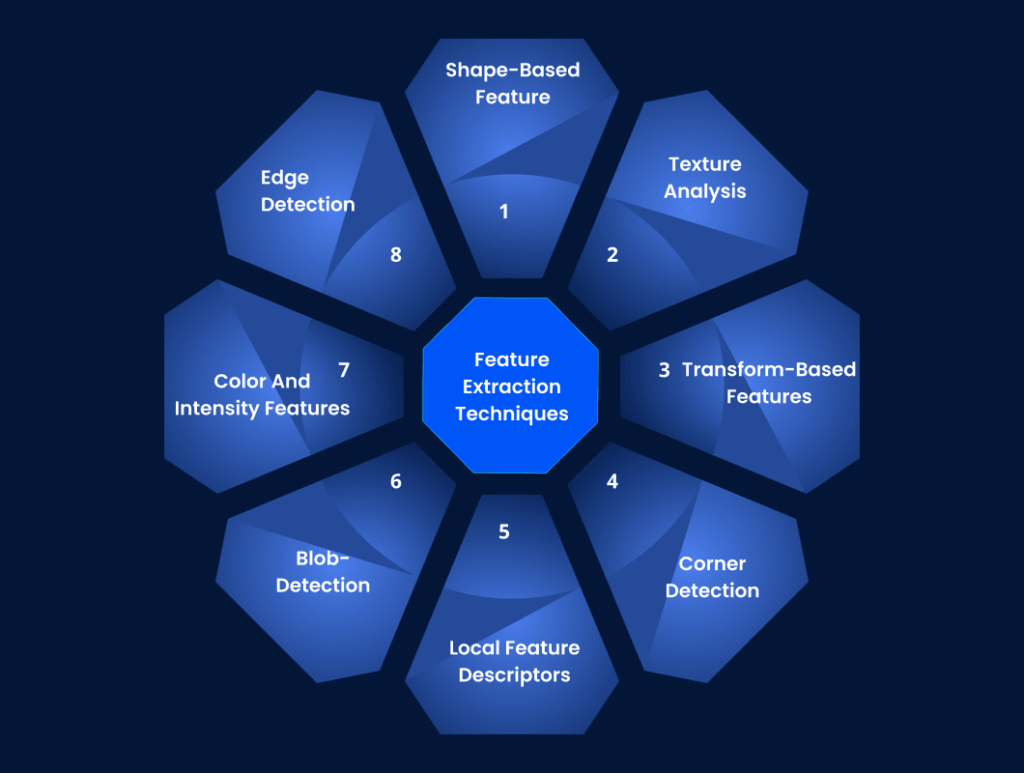
Once features are extracted, the next step is to match them between images. Feature matching involves finding correspondences between the feature sets of two images to determine similarity.
Feature matching can be broadly categorized into:
Exact Matching: Suitable for discrete features like binary descriptors.
Approximate Matching: Used for continuous feature representations like SIFT or HOG descriptors.
Feature matching relies on calculating a similarity score between feature vectors. Common distance metrics include:
Euclidean Distance: Measures the straight-line distance between two vectors.
Cosine Similarity: Measures the angle between two vectors, focusing on their direction rather than magnitude.
Hamming Distance: Used for binary feature vectors like ORB descriptors.
This straightforward method compares every feature in one image with every feature in another image. While accurate, it is computationally expensive for large datasets.
This method finds the k closest features for each feature in the query image. It is often paired with ratio tests to eliminate ambiguous matches.
FLANN accelerates the matching process by approximating nearest neighbors. It is particularly useful for large-scale image datasets.
RANSAC refines feature matches by estimating the geometric transformation between images. It helps reject outliers and improves robustness.
With the rise of deep learning, handcrafted features have given way to features learned directly from data.
CNNs have revolutionized feature extraction by automatically learning hierarchical features from raw images. Key layers include:
Convolutional Layers: Extract spatial features like edges or textures.
Pooling Layers: Downsample features for computational efficiency.
Fully Connected Layers: Aggregate extracted features into a compact representation.
Deep learning-based feature matching leverages architectures like Siamese networks and Triplet networks to learn feature embeddings optimized for similarity comparison.
Pre-trained models like VGG, ResNet, and EfficientNet are often used as feature extractors in image retrieval tasks. These models are fine-tuned on specific datasets to extract domain-relevant features.
CBIR systems rely heavily on feature extraction and matching to find visually similar images. Applications include:
Medical imaging for diagnosing diseases.
E-commerce platforms for finding visually similar products.
Facial recognition systems use deep features for robust face matching, even under challenging conditions like varying lighting or occlusions.
Applications like autonomous vehicles and surveillance systems use feature matching to recognize and track objects in dynamic environments.
AR systems use feature matching to align virtual objects with real-world scenes accurately.
Despite their utility, feature extraction and matching face several challenges:
Scale and Orientation Variations: Ensuring features remain invariant under transformations.
Illumination Changes: Robustness to lighting variations is critical.
Large-Scale Datasets: Scaling feature matching for databases containing millions of images.
Real-Time Processing: Balancing accuracy with computational efficiency for real-time applications.
The field of image retrieval is evolving rapidly. Some emerging trends include:
Self-Supervised Learning: Techniques that learn features without labeled data are gaining traction.
Transformers for Vision: Vision transformers (ViTs) are being explored for feature extraction.
Cross-Modal Retrieval: Systems that bridge the gap between images and text for more flexible search capabilities.
Feature extraction and matching are the cornerstones of image retrieval systems, enabling efficient and accurate retrieval of visual data. From traditional handcrafted features to modern deep learning-based methods, these techniques have come a long way in addressing the challenges of large-scale visual search.
As technology continues to advance, we can expect even more robust and intelligent systems capable of handling complex real-world scenarios.
Feature extraction is the process of identifying and representing key visual attributes (like color, texture, or shape) that help computers recognize and classify images efficiently.
Feature matching links similar key points between two or more images to identify correspondences, crucial for tasks like object detection, tracking, and image stitching.
AI, especially deep learning, automates feature extraction by using convolutional neural networks (CNNs) to detect patterns and representations without manual intervention.
Popular methods include SIFT (Scale-Invariant Feature Transform), SURF, ORB, HOG (Histogram of Oriented Gradients), and CNN-based deep feature extraction.
Feature extraction identifies unique features in an image, while feature matching compares those features between different images to find similarities or differences.
It allows image databases to store compact, meaningful representations of images, making search, comparison, and retrieval faster and more accurate.
Yes. AI models can perform color feature extraction by analyzing hue, saturation, and brightness components to identify patterns and classify visual data effectively.
Applications include facial recognition, medical imaging, autonomous vehicles, visual search engines, and industrial defect detection.
Deep learning models learn hierarchical feature representations that make image matching more robust to lighting, orientation, and scale variations.
Computer Vision, a subdomain of AI, focuses on enabling machines to interpret and understand visual information, using feature extraction and matching as core techniques.