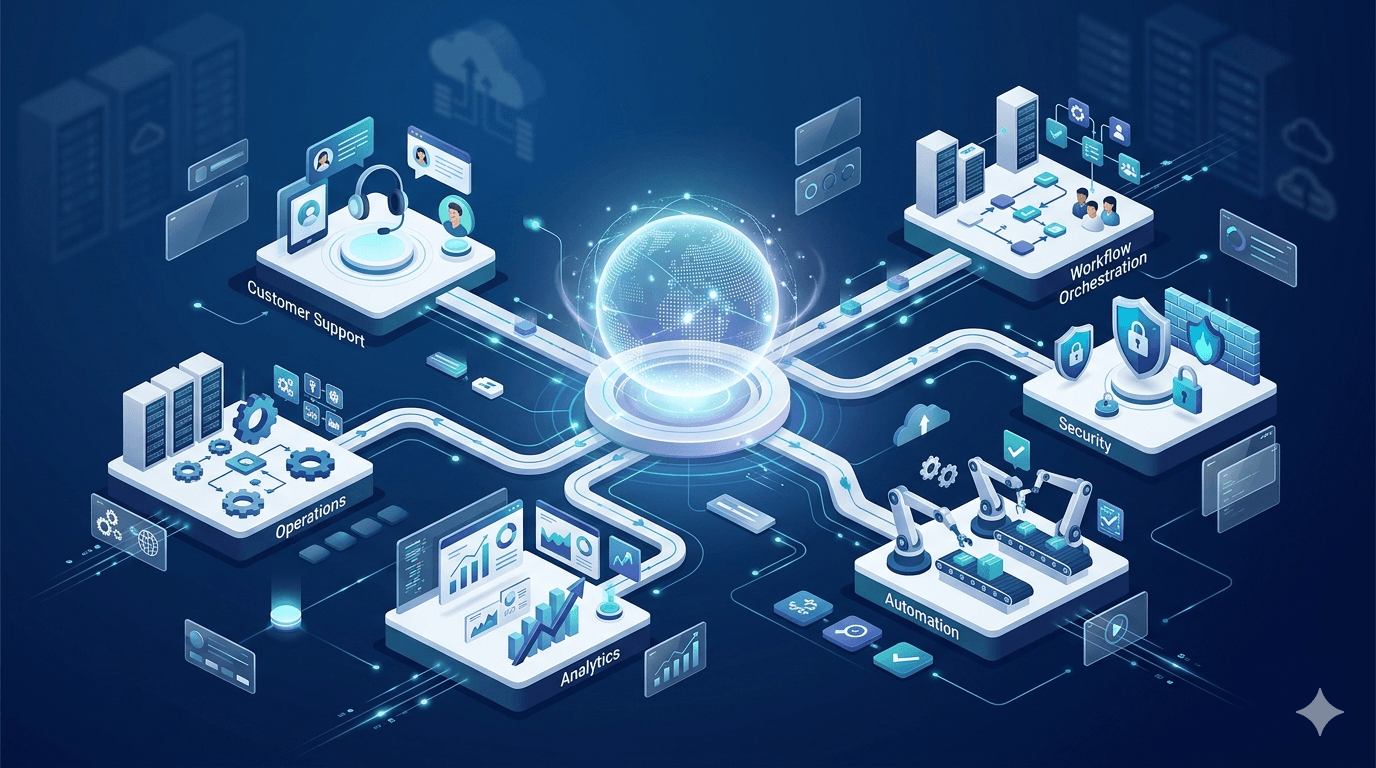
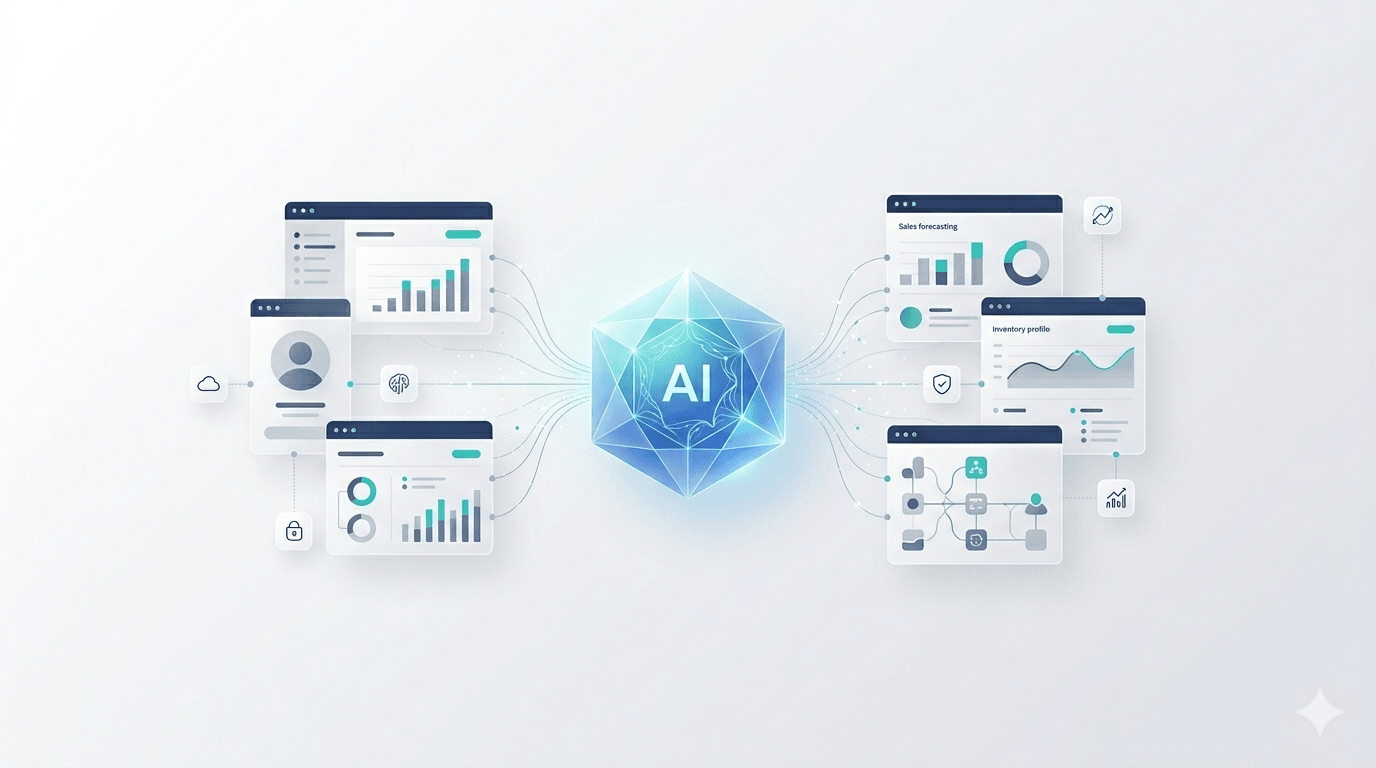
Enterprises don’t need flashy demos; they need dependable AI agents that plug into real systems, drive measurable outcomes, and scale securely. This guide distills how CTOs and technical leaders can design, deploy, and govern custom AI agent solutions that automate work across complex, multi-system workflows. We focus on agentic AI; systems that perceive, decide, and act, rather than one-off content generation.
From orchestration frameworks and memory strategy to HITL controls, governance, and ROI tracking, you’ll find pragmatic steps to go from pilot to production with confidence. At Folio3, we build outcome-first, enterprise-grade agents that integrate with your stack, emphasize security and transparent pricing, and leverage our deep expertise in computer vision for real-world document and vision-heavy workflows.
Understanding Custom AI Agents for Enterprises
A custom AI agent for enterprises is a software system that autonomously perceives, decides, and acts within business workflows, integrating deeply with company infrastructure and tailored to unique enterprise needs.
Unlike generative AI that focuses on producing content, agentic AI is designed to take actions, orchestrate tools, call APIs, and maintain long-lived context across tasks and sessions. Agentic frameworks such as LangChain (with LangGraph), CrewAI, and LlamaIndex provide standardized building blocks for stateful planning, tool use, retrieval, and memory, critical for scalability, reliability, and domain-specific customization.
Folio3 approaches enterprise AI agent development with a problem-first lens: we design custom AI solutions that fit your infrastructure, ensure robust integrations, and deliver measurable impact.
Ready to move from AI experimentation to enterprise-scale execution?
Learn how to build custom AI agents that are secure, scalable, and aligned with real business goals.
Book a Consultation
Defining Measurable Use Cases and Success Metrics
Start with business pain points where automation can show tangible value without risking core operations. Well-scoped pilots should target a single workflow, have clear success criteria, and surface integration constraints early. Industry guidance recommends beginning in one domain with measurable goals to build momentum and reduce risk, with typical pilots running 2–3 months to assess technical fit and business impact.
Common metrics include ticket deflection, average handle time (AHT), cycle time reduction, SLA adherence, first-contact resolution, and hours of manual work saved.
Use case | Primary metric(s) | Example target for pilots |
IT/service desk triage | Ticket deflection, AHT, FCR | 25–40% deflection |
Invoice processing | Cycle time, straight-through processing (STP) | 25–40% faster cycle time |
Order-to-cash exceptions | Backlog reduction, days sales outstanding | 10–20% backlog cut |
HR onboarding | Task completion time, HR ticket volume | 20–30% faster completion |
Knowledge ops/document QA | Time-to-answer, accuracy-at-top-k | 30–50% faster responses |
Define ROI with a simple framing: (labor hours saved + revenue impact + SLA penalties avoided − compute + licensing + support) over the pilot window.
Selecting the Right Agent Frameworks and Architectures
For multi-step, stateful workflows, orchestration-first architectures shine. Combinations like LangChain + LangGraph or CrewAI coordinate planning, tool calls, memory, and error handling across tasks and agents.
Representative options, each with distinct strengths:
- Rasa: fine-grained custom business logic and NLU control
- Botpress: visual flow building for complex dialog graphs
- Dify: low-code agent building and prompt ops
- n8n: workflow automation that pairs well with agent actions
Core components to plan up front:
Component | What it does | Enterprise concerns |
Orchestrator | Plans steps, routes tasks, and manages multi-agent workflows | Determinism, retries, and auditability |
Memory | Stores short- and long-term context and domain knowledge | Retention policy, privacy, vector quality |
Execution engine | Executes tools/API calls, handles errors/timeouts | Idempotency, rate limits, observability |
Retrieval | Fetches relevant knowledge over docs, data, and logs | Freshness, grounding, citation integrity |
Policy layer | Enforces guardrails, approvals, and data access controls | Governance, RBAC, compliance |
Create Smarter, Scalable AI Agents for Your Organization
From architecture to governance, learn how to build custom AI agents that are reliable, efficient, and enterprise-ready.
Book a Consultation
Stateful memory turns demos into dependable operators. Short-term memory options like Zep or MemGPT manage conversational and task context; long-term memory relies on vector stores such as Pinecone and Weaviate, plus knowledge graphs to model entities and relationships for higher-fidelity retrieval.
Plan connectivity and scalability together. Standardize tool connectors, implement API gateways, and deploy on Kubernetes for elasticity and resilience.
Layer | Purpose | Typical tech choices |
Memory | Short- and long-term context | Zep, MemGPT; Pinecone, Weaviate; knowledge graphs |
Integration | Secure data/system access | API gateways, OAuth/SAML, message buses, CDC pipelines |
Tool connectivity | Actuation via services and SaaS | REST/GraphQL, gRPC, SDKs, RPA bridges |
Execution plane | Scalable runtime and scheduling | Kubernetes, Docker, event queues, serverless functions |
This is where enterprise AI integration, vector stores, and tool connectivity decisions determine long-term maintainability.
Implementing Reasoning Patterns and Human-in-the-Loop Controls
Embed human-in-the-loop (HITL) controls to keep automation safe:
- Trigger HITL when actions affect money movement, access rights, PII, or external communications.
- Require policy review for bulk updates, irreversible changes, or low-confidence model outputs.
- Provide override paths in production, with time-bounded approvals and full audit logs.
HITL checklist:
- Define confidence and risk thresholds
- Route high-risk actions to approvers
- Log evidence and rationale
- Capture reviewer feedback to fine-tune policies.
Testing, Compliance, and Validating Business Impact
Before scaling, validate reliability under load and across edge cases. Test for latency spikes, API rate limits, tool failures, and degraded upstream systems; verify audit trails, governance hooks, and legal/compliance adherence are intact.
Benchmark ROI against compute and licensing during pilots. Track tokens, tool calls, and user actions with platforms like Langfuse and Helicone to surface drift and cost anomalies over time.
Operational loop: Test → Audit → Measure → Iterate. Ship small, verify against metrics, and harden guardrails before expanding scope.
Deploying, Monitoring, and Scaling AI Agents in Production
Scale with discipline:
- Roll out incrementally, one domain or cohort at a time, and expand after meeting targets.
- Use Docker/Kubernetes for resilience, auto-scaling, and multi-cluster/region redundancy.
- Instrument both system health (latency, error budgets) and business KPIs (deflection, STP). Tools like Langfuse and Helicone support real-time observability of prompts, tokens, and user journeys.
Deployment pipeline:
- Provision infrastructure and secrets
- Register tools/data sources
- Configure policies/HITL
- Canary release with SLOs
- Observe and tune
- Gradually widen traffic.
Ensuring Governance, Security, and Ethical Compliance
AI governance is a set of controls, audits, and policies embedded in the agent lifecycle to guarantee security, traceability, and responsible decision-making.
Put safeguards in the path of execution: immutable audit trails, approval workflows, PII redaction, and content safety filters (e.g., Azure AI Content Safety) for outbound messages. Moveworks outlines how enterprise-grade AI hinges on strong safeguards, access control, and explainability.
Compliance essentials:
- Secure PII and sensitive data with field-level encryption and role-based access.
- Align with internal policies and regulations (e.g., GDPR, HIPAA, SOC).
- Maintain transparent records of prompts, tool calls, outputs, and human approvals.
Common pitfalls include weak auditability and permissive policies; issues that compromise trust and stall adoption.
Common Enterprise Use Cases and Industry Applications
Enterprises realize value when agents automate routine work, surface knowledge, and execute actions across systems. Appian reports notable efficiency gains, like a 36% reduction in invoice processing time with intelligent document processing, when agents orchestrate people, data, and systems. Looking ahead, Gartner research summarized by Wizr suggests agentic AI could resolve up to 80% of support issues by 2029.
Use case | What the agent does | Measurable impact |
Customer service triage | Classifies, routes, and resolves Tier-0/Tier-1 tickets | 25–40% deflection; faster first response |
Invoice processing and AP automation | Extracts, validates, posts, and escalates exceptions | 25–40% cycle-time reduction |
Fraud monitoring | Correlates signals, flags anomalies, triggers reviews | Lower false positives; faster resolution |
HR onboarding | Orchestrates tasks across HRIS, IT, and facilities | 20–30% faster time-to-productivity |
Document management and QA | Retrieves, summarizes, and validates policy/document answers | 30–50% faster answers; higher accuracy |
Overcoming Challenges in Enterprise AI Agent Development
Challenge | Why it happens | What to do about it |
Over-automation of high-risk steps | Missing policies and confidence thresholds | Add HITL gates, approval workflows, and risk-based routing |
Poorly scaling frameworks | Ad-hoc orchestration, no state model | Adopt agentic frameworks with explicit state and retries |
Skipping monitoring/governance | Pilot shortcuts become production liabilities | Instrument observability, audit trails, and policy-as-code early |
Legacy integration complexity | Fragmented APIs, brittle RPA, data silos | Use API gateways, event-driven patterns, and phased connector build |
Knowledge drift and stale retrieval | Static docs and weak update pipelines | Implement CI for knowledge, recency scoring, and freshness SLAs |
Uncontrolled costs | Prompt bloat, needless tool calls | Token budgets, caching, and ROI-vs-compute dashboards |
Comprehensive AI Agent Development Services
We build intelligent, autonomous AI agents using AutoGen, LangChain, and CrewAI powered by GPT-4, Claude, and leading LLMs. Our agents automate complex workflows, make real-time decisions, and scale with your business.
AI Agent Strategy & Roadmapping
We analyze your operations to identify high-impact automation opportunities, recommend suitable agent architectures, and create implementation roadmaps that align with your business objectives while ensuring measurable ROI and scalable deployment.
Custom AI Agent Development
Our development team builds adaptive agents tailored to your specific workflows using advanced frameworks. We prioritize flexibility, performance optimization, and autonomous decision-making capabilities that evolve with your operational requirements.
AI Agent Integration
We connect AI agents seamlessly into your existing infrastructure, ensuring secure data exchange, API compatibility, and minimal disruption. Our integration approach maintains system reliability while enabling agents to access necessary resources.
Maintenance & Optimization
We provide ongoing monitoring, performance tuning, and updates to keep your agents operating at peak efficiency. Our maintenance services include version upgrades, bug fixes, and optimization based on usage patterns.
Human-AI Experience Design
We design intuitive interfaces that facilitate natural human-agent collaboration. Our approach focuses on multimodal interactions, transparent decision-making, and user experiences that build confidence and encourage adoption across teams.
Agent Training & Continuous Learning
We implement feedback loops that enable agents to learn from performance data and user interactions. Through continuous fine-tuning and model updates, your agents become more accurate, efficient, and aligned with evolving needs.
Turn Enterprise AI Into Measurable Business Impact
Build AI agents that do more than automate tasks. Create intelligent systems that improve operations, support decision-making, and scale with your business.
Book a Consultation
Frequently Asked Questions
What are the core components of scalable custom AI agents?
Scalable custom AI agents combine orchestrators, memory systems, execution engines, tool integrations, and monitoring to ensure robust, stateful, and reliable performance at an enterprise level.
How can enterprises ensure AI agents integrate with legacy systems?
Enterprises achieve integration by using custom connectors, APIs, and middleware that bridge AI agents with existing databases and workflows, ensuring smooth data flow and minimal disruption.
What are the best practices for monitoring and maintaining AI agents?
Implement token and activity tracking tools, real-time observability dashboards, and scheduled reviews to align system health with business goals and catch drift early.
How do you balance automation with human oversight in AI agents?
Design structured approval steps for high-stakes actions while automating routine, low-risk tasks, and adjusting thresholds as confidence improves.
What initial budget and timeline should enterprises expect for AI agent projects?
Expect $50K–$1M for initial efforts and a 2–3 month pilot window, varying by scope, data readiness, and integration complexity.