
AI Enablement
100 AI Job Replacement Statistics You Should Know in 2026
Explore 100 AI job replacement statistics for 2026, including layoffs, automation risks, exposed roles, and main workforce trends.
Understand precision and recall in machine learning with real examples, formulas, and practical use cases.
Imagine you're training a spam filter to identify unwanted emails in your inbox. Let's see how precision and recall help evaluate its performance:
Example: Your filter identifies 30 emails as spam. Upon checking, 25 are true spam (TP), while 5 are important emails flagged incorrectly (FP).
From model evaluation to deployment, our AI experts help you create high-performing machine learning systems.
Explore Free Consultation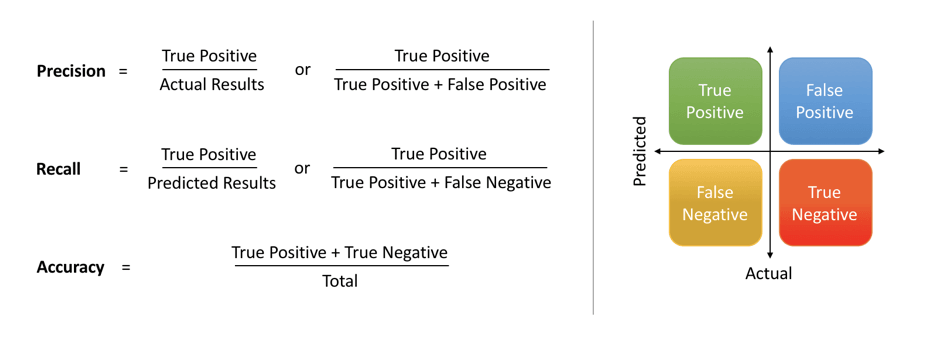
This example highlights the potential trade-off between precision and recall. A higher precision (filter avoids flagging important emails) might come at the cost of lower recall (missing some spam emails). You'll need to decide which metric is more important for your needs. For instance, if missing important emails is a bigger concern, you might adjust the filter to prioritize higher recall, even if it means catching some non-spam emails in the process.
Precision and recall are paramount in machine learning tasks, especially classification, because accuracy can mislead you. They're important for the following reasons.
The importance of precision versus recall depends on the specific problem you're tackling. Here are some scenarios where each metric takes center stage.
Precision and recall often have a trade-off. Focusing on maximizing one might negatively impact the other. Understanding both metrics allows you to find a balance that best suits your requirements. For instance, you might prioritize high precision for a medical diagnosis system while aiming for a good balance between precision and recall for a spam filter.
Precision and recall are the building blocks for other valuable metrics like F1 score and ROC-AUC curve. These metrics provide even deeper insights into model performance, considering factors like class imbalance and exploring the trade-off between precision and recall across different thresholds. Precision and recall empower you to go beyond a surface-level understanding of accuracy and make informed decisions about your machine-learning models for various classification tasks. They provide the tools to assess how well your model avoids mistakes, captures all relevant cases, and ultimately achieves the desired outcome for your specific application.
In addition to precision and recall, other metrics are commonly used to evaluate a machine-learning model's performance. These include.
As mentioned earlier, precision and recall are often inversely related. This means that improving one metric may result in a decrease in the other. Therefore, machine learning practitioners must find a balance between these metrics depending on their specific task or application. For example, in a medical diagnosis setting, it may be more important to have high recall (to ensure that all positive cases are correctly identified), even if it means sacrificing some precision. On the other hand, in a spam email detection task, precision may be more important to avoid mistakenly labeling legitimate emails as spam.
Ultimately, the choice of which metric to focus on (precision or recall) depends on the specific task and its requirements. Machine learning practitioners should carefully consider the trade-offs between these metrics and choose the one that aligns with their goals.
Our AI specialists can help you fine-tune machine learning models for better precision, recall, and ROI.
Explore Free Consultation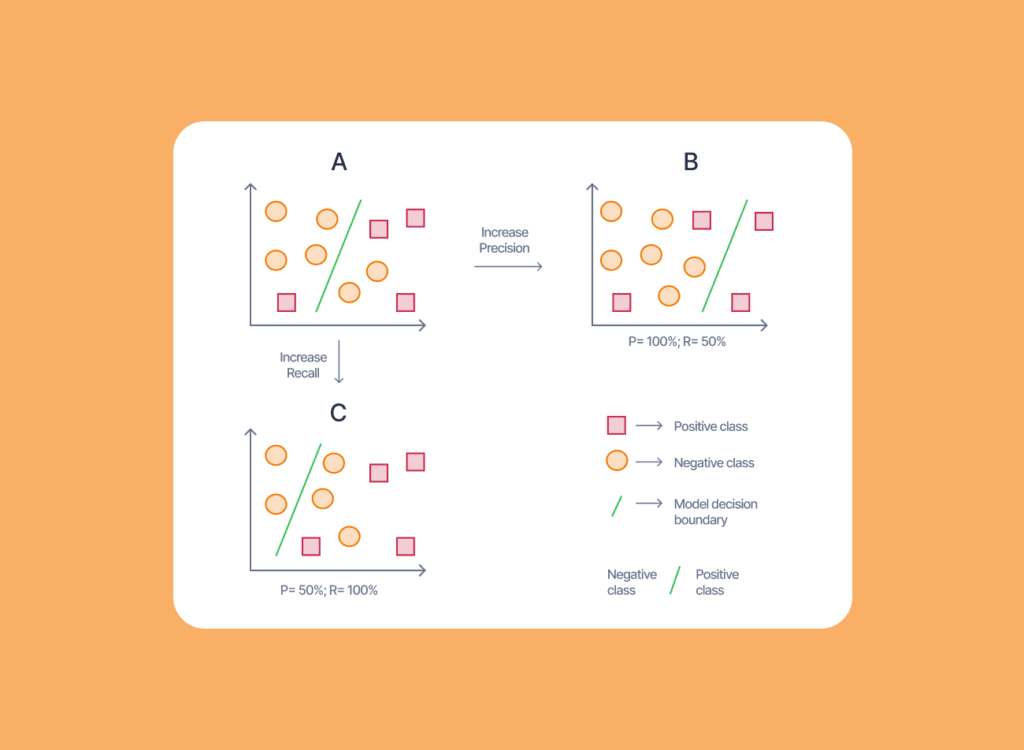
In addition to understanding and balancing precision and recall, there are also various techniques that can be used to improve these metrics in machine learning models. Some of these techniques include:
By implementing these techniques, machine learning practitioners can work towards improving both precision and recall in their models
Explore 100 AI job replacement statistics for 2026, including layoffs, automation risks, exposed roles, and main workforce trends.

Today, large language models can access internal documents, customer records, generate code, call APIs, and perform tasks through autonomous AI agents. Retrieval-augmented generation (RAG) lets organizations connect AI systems to private data for more relevant outputs.
Most enterprises get this decision wrong by comparing year-one costs. This guide breaks down the AI build vs buy decision across TCO, data control, talent gaps, and compliance, so you can choose with confidence.