

Generative AI
 AI & DataAgentic AI, computer vision, generative AI
 App DevelopmentWeb, mobile, and custom software
 SecurityEngineering, warehousing, analytics
 AgtechFarm, livestock, and crop software
 FoodtechTraceability and food supply chain
 Digital HealthEHR, telehealth, and interoperability
 NetSuiteERP implementation and support
 Microsoft DynamicsDynamics 365 and Business Central
 SalesforceCRM consulting and integration
 EcommerceB2B ecommerce, ERP integrations and migrationsAI & DataAgentic AI, computer vision, generative AIApp DevelopmentWeb, mobile, and custom softwareSecurityEngineering, warehousing, analyticsAgtechFarm, livestock, and crop softwareFoodtechTraceability and food supply chainDigital HealthEHR, telehealth, and interoperabilityNetSuiteERP implementation and supportMicrosoft DynamicsDynamics 365 and Business CentralSalesforceCRM consulting and integrationEcommerceB2B ecommerce, ERP integrations and migrations
Is your team spending hours on repetitive tasks that AI could handle in minutes? Are competitors launching products faster while your content creation bottlenecks slow you down? You're not alone. Businesses worldwide face a critical decision: embrace generative AI now or watch competitors pull ahead.
According to McKinsey research, generative AI could add between $2.6 trillion and $4.4 trillion annually to the global economy across various use cases. The question isn't whether generative AI will transform your industry; it's whether you'll lead that transformation or scramble to catch up. From Fortune 500 enterprises to growing mid-market companies, organizations implementing generative AI report dramatic improvements in efficiency, creativity, and customer engagement. What's holding your business back?
This comprehensive guide answers every question you have about generative AI implementation, from understanding core concepts to choosing the right development partner who can turn AI potential into measurable business results.
Generative AI refers to artificial intelligence systems that create new, original content based on patterns learned from existing data. Unlike traditional AI that analyzes or classifies information, generative AI produces text, images, code, audio, video, and other media types that closely resemble human-created work. These systems use deep learning models trained on massive datasets to understand contextual relationships and generate contextually relevant outputs.
The technology powers applications ranging from chatbots and content creation tools to drug discovery and software development assistants, enabling organizations to automate creative processes while maintaining quality and relevance across diverse business functions.

Generative AI operates through sophisticated neural network architectures that learn data patterns and generate new content based on those learned relationships. Understanding these core mechanisms helps organizations make informed decisions about implementation and application.
Transformer architectures revolutionized AI by processing entire sequences simultaneously rather than sequentially. These networks use self-attention mechanisms to identify relationships between data elements, enabling models to understand context and dependencies efficiently for superior output quality.
Large language models (LLMs) are trained on billions of text parameters, learning language structures, contextual meanings, and knowledge representations. Pre-training on diverse datasets followed by task-specific fine-tuning allows these models to generate coherent, contextually appropriate responses across applications.
Models undergo pre-training on massive unlabeled datasets to learn general patterns, then fine-tuning on domain-specific data to optimize performance for particular tasks. This two-phase approach balances broad capability with specialized accuracy for enterprise applications.
GANs employ two competing neural networks: a generator creating synthetic data and a discriminator evaluating authenticity. Through iterative competition, generators produce increasingly realistic outputs, making GANs particularly effective for image generation and data augmentation tasks.
Diffusion models generate content by gradually removing noise from random data through learned denoising steps. This approach produces high-quality images and videos with exceptional detail and control, becoming increasingly popular for creative and design applications.
Generative AI delivers transformative advantages that directly impact bottom-line results and competitive positioning. Organizations implementing these technologies experience measurable improvements across innovation speed, operational efficiency, and customer engagement.
Generative AI dramatically reduces time from concept to execution by automating ideation, prototyping, and content creation. Teams focus on strategic direction while AI handles repetitive creative tasks, enabling faster product launches and campaign deployments.
Automation of content production, customer support, and code generation significantly lowers operational expenses. Organizations report massive cost savings in content creation workflows while simultaneously increasing output volume and maintaining quality standards.
AI analyzes customer data to generate personalized recommendations, messaging, and experiences at scale. This hyper-personalization drives higher engagement rates, improved conversion metrics, and stronger customer loyalty across digital touchpoints.
Enterprises generate consistent, on-brand content across multiple channels, languages, and formats without proportional resource increases. This scalability supports global expansion and omnichannel strategies while maintaining brand voice and compliance.
Generative models simulate scenarios, predict outcomes, and generate insights from complex datasets. Decision-makers access data-driven recommendations and visualizations that improve strategic planning accuracy and reduce risk in critical business decisions.
Generative AI transforms operations across diverse sectors, each finding unique applications that address specific industry challenges. Real-world implementations demonstrate measurable returns and competitive advantages across verticals.
AI accelerates drug discovery by generating novel molecular structures and predicting compound interactions. Medical imaging enhancement, synthetic patient data for research, and personalized treatment planning improve outcomes while reducing development timelines from years to months.
Brands leverage AI for automated copywriting, social media content, personalized email campaigns, and creative asset generation. Marketing teams achieve 5x content output increases while maintaining brand consistency and optimizing messaging for audience segments.
AI coding assistants generate code snippets, debug applications, and automate testing workflows. Development cycles shorten by 40-50%, allowing engineering teams to focus on architecture and complex problem-solving rather than repetitive coding tasks.
Banks and fintech companies deploy AI for fraud detection, automated report generation, personalized financial advice, and risk assessment modeling. Real-time transaction monitoring and synthetic data generation improve security while maintaining regulatory compliance.
Generative design optimizes product structures for performance, material efficiency, and manufacturability. AI simulates countless design variations, generates 3D prototypes, and predicts manufacturing outcomes, reducing physical prototyping costs and accelerating time-to-market.
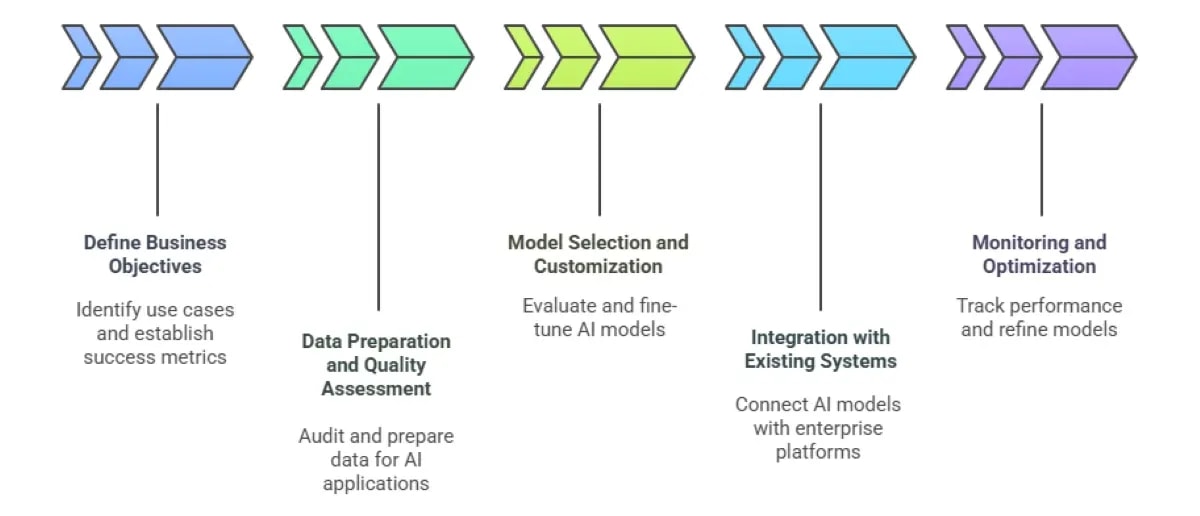
Successful generative AI deployment requires strategic planning, technical preparation, and organizational alignment. Following structured implementation approaches minimizes risks and maximizes return on investment for enterprise AI initiatives.
Identify specific use cases where generative AI delivers measurable value aligned with strategic priorities. Establish clear success metrics, expected outcomes, and stakeholder buy-in before technical implementation begins to ensure focused execution.
Audit existing data assets for quality, completeness, and relevance to intended AI applications. Clean, structure, and label datasets appropriately, addressing bias and ensuring compliance with privacy regulations before model training.
Evaluate pre-trained models versus custom development based on use case requirements, data availability, and performance needs. Fine-tune selected models on proprietary data to optimize accuracy and relevance for specific business contexts.
Plan seamless connections between AI models and enterprise platforms, including CRM, ERP, and proprietary applications. Develop APIs, establish data pipelines, and implement security protocols to ensure smooth workflows without disrupting operations.
Implement continuous performance tracking, output quality assessment, and model retraining schedules. Monitor for model drift, gather user feedback, and iterate on prompts and parameters to maintain accuracy and relevance over time.
Understanding the full cost structure enables accurate budgeting and realistic ROI projections. Generative AI investments span initial development through ongoing operational expenses across multiple cost categories.
Initial model development, whether custom-built or fine-tuned from existing architectures, requires data science expertise and computational resources. Depending on complexity, development costs range from $50,000 for basic implementations to several million for enterprise-scale solutions.
Training large models demands significant GPU/TPU compute power and cloud infrastructure. Organizations typically spend $10,000-$500,000 monthly on cloud computing, with costs varying based on model size, training frequency, and inference volumes.
Connecting AI systems to existing enterprise infrastructure requires API development, data pipeline creation, and security implementation. Integration projects typically cost $30,000-$300,000, depending on system complexity and customization requirements.
Models require regular retraining, monitoring, and optimization to maintain performance. Annual maintenance costs typically run 15-25% of initial development investment, covering infrastructure, monitoring tools, and performance optimization efforts.
Specialized roles, including ML engineers, data scientists, and AI architects, command premium salaries. Building internal teams costs $500,000-$2 million annually, while augmented teams or consulting partnerships offer flexible alternatives for organizations scaling capabilities.
The generative AI ecosystem offers diverse platforms, models, and frameworks suitable for different use cases and organizational needs. Selecting appropriate tools depends on technical requirements, budget constraints, and desired customization levels.
GPT-4 and GPT-4o provide industry-leading language generation capabilities via API access. These models excel at text generation, code assistance, and conversational AI applications, offering enterprise-grade reliability with straightforward integration for rapid deployment.
Google's Gemini models deliver multimodal capabilities, handling text, images, and code within unified architectures. Vertex AI provides a comprehensive MLOps infrastructure for training, deploying, and managing custom models at scale within the Google Cloud ecosystem.
Claude models offer strong reasoning capabilities with enhanced safety features and extended context windows. Particularly effective for complex analysis, document processing, and applications requiring a nuanced understanding with reduced hallucination risks.
LLaMA, Mistral, and Stable Diffusion provide customizable alternatives with full control over deployment and data privacy. Open-source options suit organizations requiring on-premises hosting or extensive model modifications for specialized applications.
Platforms like Kubernetes, MLflow, and Docker enable scalable model deployment, version control, and monitoring. These tools manage the complete ML lifecycle, ensuring production reliability, performance tracking, and seamless updates across distributed environments.
Generative AI continues evolving rapidly with emerging capabilities reshaping enterprise possibilities. Understanding current trends helps organizations anticipate opportunities and prepare for technology shifts.
Modern models seamlessly process and generate combinations of text, images, audio, and video within a single architecture. This convergence enables richer applications from interactive virtual assistants to comprehensive content creation suites handling multiple formats.
Beyond content generation, AI agents now execute complex multi-step tasks autonomously using tools, APIs, and external resources. These systems handle end-to-end workflows from research and analysis to execution, reducing human intervention requirements.
Advances in model compression and optimization produce smaller models matching larger predecessors' performance at a fraction of the computational cost. This democratization enables edge deployment and reduces operational expenses significantly.
Organizations prioritize transparency, fairness, and accountability frameworks for AI deployments. Enhanced model explainability, bias detection tools, and compliance monitoring address regulatory requirements and ethical concerns systematically.
Vertical-focused models trained on specialized datasets deliver superior performance for domain-specific applications. Healthcare, legal, financial, and manufacturing sectors benefit from purpose-built AI that understands industry terminology, regulations, and workflows.
As a trusted generative AI development partner, Folio3 AI delivers end-to-end solutions designed to help enterprises accelerate innovation, optimize operations, and achieve measurable business impact. From strategy to deployment, our scalable generative AI consulting and technology services enable organizations to unlock new levels of efficiency and growth.
We design and build custom generative AI models, fine-tuned to your data, industry, and use cases. Whether it's text, visuals, or complex datasets, our models deliver accuracy, scalability, and business-specific value.
We seamlessly embed generative AI solutions into your existing IT ecosystem. From CRM and ERP systems to proprietary platforms, we ensure smooth integration without disrupting workflows, maximizing operational efficiency.
Our experts craft optimized prompts tailored to your enterprise applications, ensuring consistent, relevant, and high-quality AI outputs. The result: better model performance and reliable results, every time.
Strengthen your internal teams with our seasoned MLOps specialists. We support your generative AI infrastructure services by managing model deployment, monitoring, scaling, and ongoing optimization, keeping your AI systems production-ready at all times.
We automate repetitive coding tasks using AI-driven tools, accelerating software development cycles, reducing manual effort, and ensuring higher code quality, all while freeing your teams to focus on high-value initiatives.

Traditional AI analyzes data and makes predictions or classifications based on patterns. Generative AI creates entirely new content, including text, images, code, and videos, by learning from existing data patterns and generating original outputs.
Healthcare, financial services, marketing, software development, and manufacturing see significant benefits. However, virtually every industry finds applications in content creation, customer service automation, data analysis, and operational efficiency improvements.
Basic implementations using pre-built APIs can launch within weeks. Custom model development and enterprise integration typically require 3-6 months, depending on complexity, data availability, and organizational readiness factors.
Key risks include generating inaccurate information (hallucinations), data privacy concerns, intellectual property questions, potential bias in outputs, and security vulnerabilities. Proper governance frameworks and monitoring mitigate these risks effectively.
Yes, cloud-based API services offer pay-as-you-go pricing starting under $100 monthly for basic usage. Open-source tools and pre-trained models provide accessible entry points without massive upfront infrastructure investments.
Accuracy varies by model, training data quality, and application. Modern LLMs achieve 85-95% accuracy for many tasks when properly fine-tuned. Critical applications require human oversight and validation processes.
Requirements depend on use cases. Pre-trained models need minimal data for fine-tuning (hundreds to thousands of examples). Custom models require larger datasets, typically tens of thousands to millions of examples, for optimal performance.
Track metrics including cost savings from automation, productivity improvements, revenue increases from personalization, time-to-market reductions, and customer satisfaction improvements. Most enterprises see positive ROI within 12-18 months.
With proper implementation, including data encryption, access controls, secure APIs, and compliance monitoring, generative AI meets enterprise security standards. Private deployments and on-premises options address stringent security requirements.
All are large language models with different strengths. GPT excels at general-purpose text generation, Claude offers enhanced reasoning and safety features, while Gemini provides strong multimodal capabilities across text, images, and code.